Itinéraire à imprimer
Peru and the Galapagos: Machu Picchu and Island Hopping by Land
16 jours · Lima à San Cristobal (flight to Quito or Guayaquil) · jusqu'à 12 voyageurs
Jour par jour
Itinéraire
- Lima1 nuit
- Cusco2 nuits
- Sacred Valley (Urubamba)2 nuits
- Aguas Calientes1 nuit
- Cusco1 nuit
- Quito1 nuit
- Puerto Ayora3 nuits
- Puerto Villamil2 nuits
- Puerto Baquerizo Moreno2 nuits
- San Cristobal (flight to Quito or Guayaquil)arrivée
- Étape avec nuitée
- Excursion d'une journée
- En bateau ou en train
Jour 1 : Arrive in Lima, the old centre
Jorge Chavez International Airport (LIM) to Miraflores, then the historic centre of Lima
- Environ 1.5 h de route
- Repas du soir
- Nuit : Lima
Détail du jour 1
Fly into Lima's Jorge Chavez International Airport (LIM), where a driver is proposed to meet you in arrivals for the drive to Miraflores, about 20 km and usually under an hour. We would stay in Miraflores, on the cliffs above the Pacific, a common base for visitors; your guide advises on evening walks and taxis. Plan to land by about 1 pm. Mid-afternoon your See Sight Tours guide would meet the group for a short briefing on the trip: the altitude, the train luggage limit and the Galapagos fees. Then we drive about 40 minutes into the historic centre, a UNESCO World Heritage Site. We walk the Plaza Mayor, past the Cathedral and the Government Palace, to the Basilica and Convent of San Francisco, with its cloisters, its old library and the catacombs beneath. We drive back to Miraflores as the light goes and go to a welcome dinner of Peruvian dishes, such as ceviche and lomo saltado. Lima is a single night, because the next flight is early.
Compris
- Proposed pick-up at Jorge Chavez International Airport (LIM)
- Welcome briefing with your guide
- The historic centre of Lima: the Plaza Mayor, the Cathedral and the Government Palace (outside)
- The Basilica and Convent of San Francisco and its catacombs
- Welcome dinner
Temps libre : Free until the afternoon briefing
Activité : If your flight lands after about 1 pm you would miss the centre walk; we can quote a night before the trip so you arrive rested.
Jour 2 : Fly to Cusco, an easy first day
Lima to Cusco by air, then a short walk to the Plaza de Armas
- Environ 1 h de route
- Petit-déjeuner
- Nuit : Cusco
Détail du jour 2
An early breakfast and the flight to Cusco, reported about 1.5 hours, with the Andes close below the wing on a clear morning. Cusco sits at a reported 3,400 metres or so, more than three kilometres above Lima, so today is built around doing very little. A driver would take you the short way into the historic centre and your room, where you can rest, drink water and try a cup of coca tea. Lunch is your choice; your guide suggests something light near the hotel. In the late afternoon, when most people feel steadier, we walk slowly down to the Plaza de Armas, framed by the Cathedral and the church of La Compania de Jesus, and through the arcades around it as the lights come on. Your guide explains how the Spanish city was laid over the Inca capital, much of it on Inca walls you can still see. The evening is free and short: eat early and sleep well.
Compris
- Transfer to Lima airport
- Flight from Lima to Cusco
- Evening walk around the Plaza de Armas with your guide
Option plus facile : Skip the evening walk and rest at the hotel; the Plaza is a few minutes' walk whenever you feel ready.
Temps libre : Middle of the day free to rest
Activité : Go slowly on stairs, drink plenty of water and avoid alcohol on the first night at altitude. Ask your doctor before you travel.
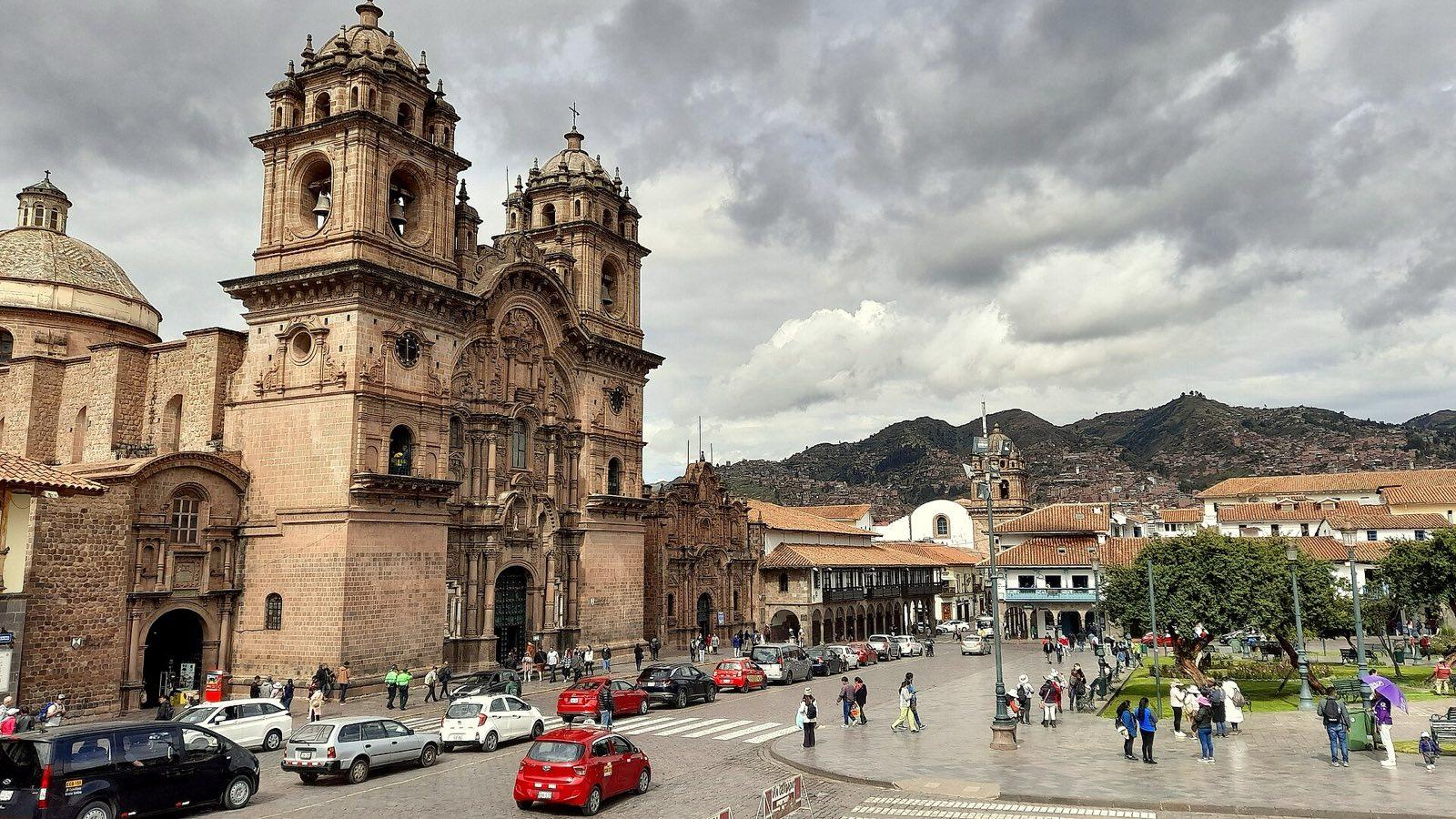
La Compania de Jesus on the Plaza de Armas, Cusco, photographed in May 2024 Photo: WIlde Vögel fliegen, Public domain, via Wikimedia Commons Jour 3 : Cusco: Sacsayhuaman, San Blas and Qorikancha
Sacsayhuaman, San Blas, the Cathedral and Qorikancha
- Environ 15 min de route
- Petit-déjeuner
- Nuit : Cusco
Détail du jour 3
A slow start, then at a time set in the quote, a short drive up to Sacsayhuaman, the Inca complex above the city, where zigzag walls of fitted stone face a wide grassy esplanade. Some of the blocks are estimated at more than 100 tonnes. From there we walk down steps and lanes into San Blas, the artisans' quarter, and past the twelve-angled stone on Hatun Rumiyoc street to the Plaza de Armas. Inside the Cathedral, built over an Inca palace, look for the colonial painting of the Last Supper with a roast guinea pig on the table. Lunch is your choice: your guide points out the counters of the San Pedro market or a quiet cafe. In the afternoon we visit Qorikancha, the Inca Temple of the Sun, where Dominican friars built their monastery on top of the curved Inca walls. Cusco's old centre is a UNESCO World Heritage Site. The rest of the day is free.
Compris
- Sacsayhuaman with your guide, entry proposed
- Walk through San Blas and past the twelve-angled stone
- Cusco Cathedral, entry proposed
- Qorikancha, the Temple of the Sun, entry proposed
Option plus facile : Ride back down from Sacsayhuaman in the vehicle instead of walking the steps into San Blas.
Temps libre : Late afternoon and evening free
Activité : About 3 hours on foot in all, mostly downhill on steps and cobbles.
Jour 4 : Pisac ruins, down into the Sacred Valley
Cusco to the Pisac ruins and market, then Urubamba
- Environ 2 h de route
- Petit-déjeuner et repas du midi
- Nuit : Sacred Valley (Urubamba)
Détail du jour 4
Your main bag stays at the Cusco hotel for the next three nights and you travel with a smaller bag. We leave early and drive about an hour over the hill to the Pisac archaeological site, aiming to arrive ahead of most day-tour buses. The ruins sit high above the town. Your guide walks you through the Intihuatana sector, where temples of fitted stone surround a carved ritual rock, with curved terraces dropping steeply to the river and old burial niches in the cliff across the gorge. Then we drive down to the town for a sit-down lunch and time in the market square, with market days set by the town. In the afternoon it is about 45 minutes down the valley to our hotel near Urubamba, lower than Cusco. The rest of the day is free: sit in the garden or walk by the river.
Compris
- Pisac archaeological site with your guide, entry proposed
- Sit-down lunch in Pisac and time at the market square
Option plus facile : Stay in the upper sector of the Pisac ruins, where the walking is gentle, and meet the group at the vehicle.
Temps libre : Late afternoon free in the Sacred Valley
Activité : The Pisac ruins are high in the valley, above 3,000 metres (confirm at quoting), with steep steps between sectors.
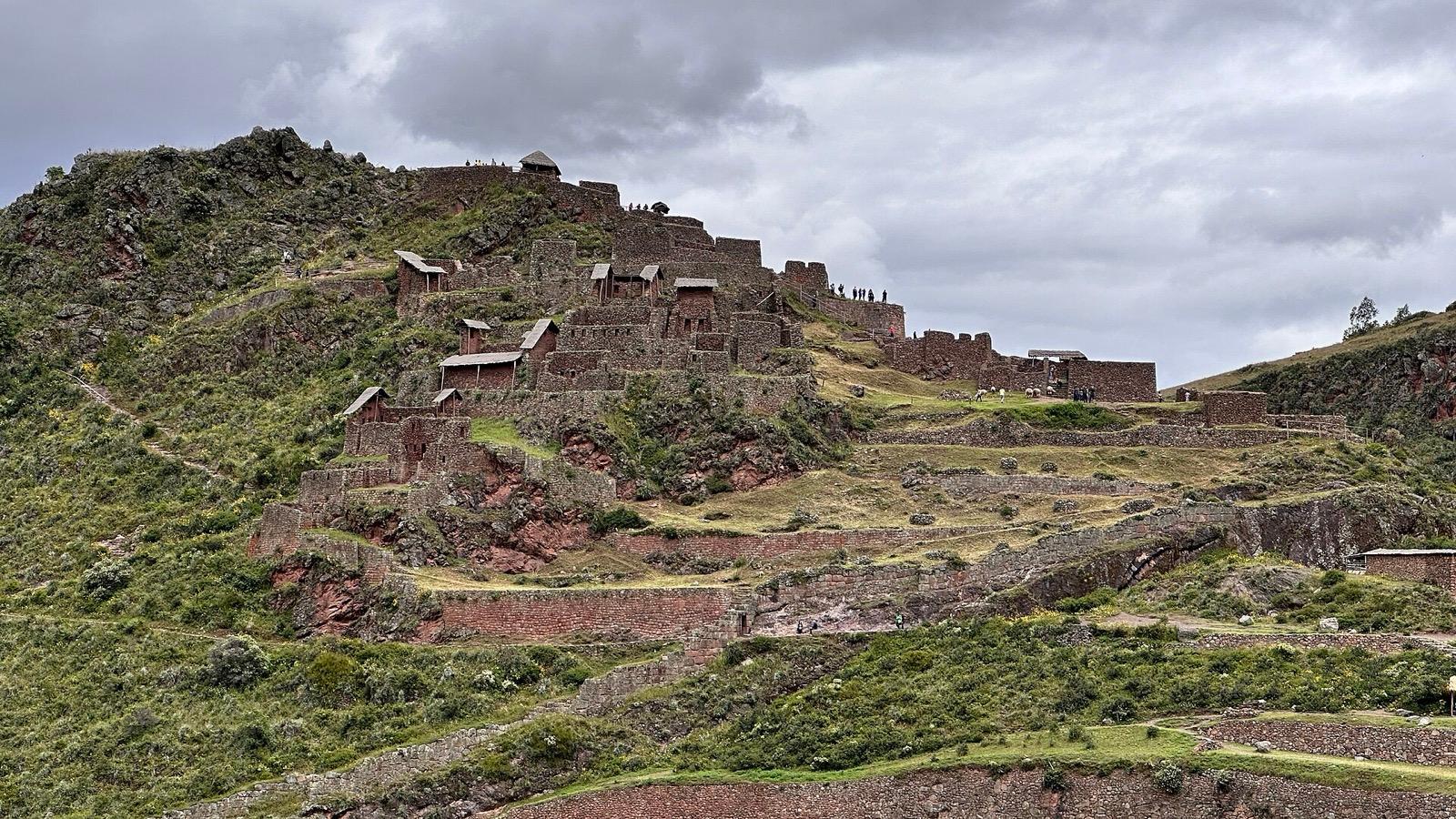
The Inca ruins above Pisac under cloud, photographed in March 2024 in the rainy season Photo: MorePix, CC0, via Wikimedia Commons Jour 5 : Moray and the Maras salt pans
Urubamba up to Moray, across to the Maras salt pans and back down to the valley
- Environ 2 h de route
- Petit-déjeuner et repas du midi
- Nuit : Sacred Valley (Urubamba)
Détail du jour 5
We leave mid-morning for the high plateau above the valley, a road of switchbacks up to a reported 3,500 metres or so. Moray is a set of circular Inca terraces set into natural hollows, some about 30 metres from rim to floor. The temperature changes from level to level, and many archaeologists believe the Incas used the terraces to test crops. From there a country road crosses farmland to the Maras salt pans: thousands of small pools stepped down a hillside, fed by a salty spring and worked by local families since before the Incas. We view the pools from the paths above, which is the best angle on the patchwork anyway. We come back down for a late sit-down lunch in Urubamba, and the afternoon is yours to rest before the Machu Picchu days.
Compris
- Moray terraces with your guide, entry proposed
- The Maras salt pans, entry proposed
- Sit-down lunch in Urubamba
Option plus facile : Watch Moray from the rim viewpoint instead of walking down into the terraces.
Temps libre : Afternoon free in the Sacred Valley
Activité : Moray is reported at about 3,500 metres; the path down into the terraces is steep coming back up.
Jour 6 : Ollantaytambo, then the train to Aguas Calientes
Urubamba to Ollantaytambo, then the train down the Urubamba gorge to Aguas Calientes
- Environ 30 min de route
- Petit-déjeuner, repas du midi et repas du soir
- Nuit : Aguas Calientes
Détail du jour 6
We drive about 30 minutes down the valley to Ollantaytambo and aim to reach the ruins early, ahead of most day tours from Cusco. Terraces climb steeply to the Temple Hill and its wall of six huge pink stone blocks, hauled from a quarry across the river. In 1537, by the usual account, Manco Inca held off a Spanish force here, one of the few times the Incas beat them in open battle. Below the ruins, families still live on the Inca street grid, with water channels running beside the lanes, and we walk it before lunch in town. In the early afternoon we board the train for reported about 1.5 to 2 hours down the Urubamba gorge, from dry hills into cloud forest, in a scenic-window carriage, subject to the operator's classes. Aguas Calientes is a small town wedged in the gorge below Machu Picchu. The late afternoon is free for the hot springs or a walk by the river, then we have dinner together in town.
Compris
- Ollantaytambo archaeological site with your guide, entry proposed
- Walk through Ollantaytambo's Inca town
- Lunch in Ollantaytambo
- Scenic-window train to Aguas Calientes, operator confirmed at quoting
- Dinner in Aguas Calientes
Option plus facile : Stay on the lower terraces at Ollantaytambo instead of climbing to the Temple Hill.
Temps libre : Late afternoon free in Aguas Calientes
Activité : Trains usually limit bag size and weight; pack a small overnight bag the night before. Limits are confirmed at quoting.
Jour 7 : Machu Picchu, back to Cusco
Aguas Calientes to Machu Picchu, then the train to Ollantaytambo and the road to Cusco
- Environ 2 h de route
- Petit-déjeuner et repas du midi
- Nuit : Cusco
Détail du jour 7
This is the day the trip is built around, and the reason we sleep in Aguas Calientes. We take a bus up the zigzag road. We would ask for the earliest entry the published slots allow, but the entry time is set by the ticket. Peru's Ministry of Culture sells timed tickets by circuit; its site lists three circuits grouping ten routes. Circuits, entry times, daily limits and guide rules are as published and are confirmed at quoting, so we do not promise a circuit, an hour or a view. Your guide plans the visit around the route the ticket allows. We ride down for lunch in Aguas Calientes, take an afternoon train back to Ollantaytambo and drive about an hour and three quarters over the Chinchero plateau to Cusco, where your main bag is waiting. The evening is free.
Compris
- Machu Picchu entry on the circuit and time set at quoting, with a guide
- Bus rides between Aguas Calientes and Machu Picchu
- Lunch in Aguas Calientes
- Scenic-window train to Ollantaytambo, then a vehicle to Cusco
Option plus facile : Ask us to choose a route with less climbing when the tickets are booked; the circuits differ.
Temps libre : Evening free in Cusco
Activité : About 4 hours on foot inside the site is typical, on uneven steps. Bring your passport. The site limits bag size, so carry a small day pack.
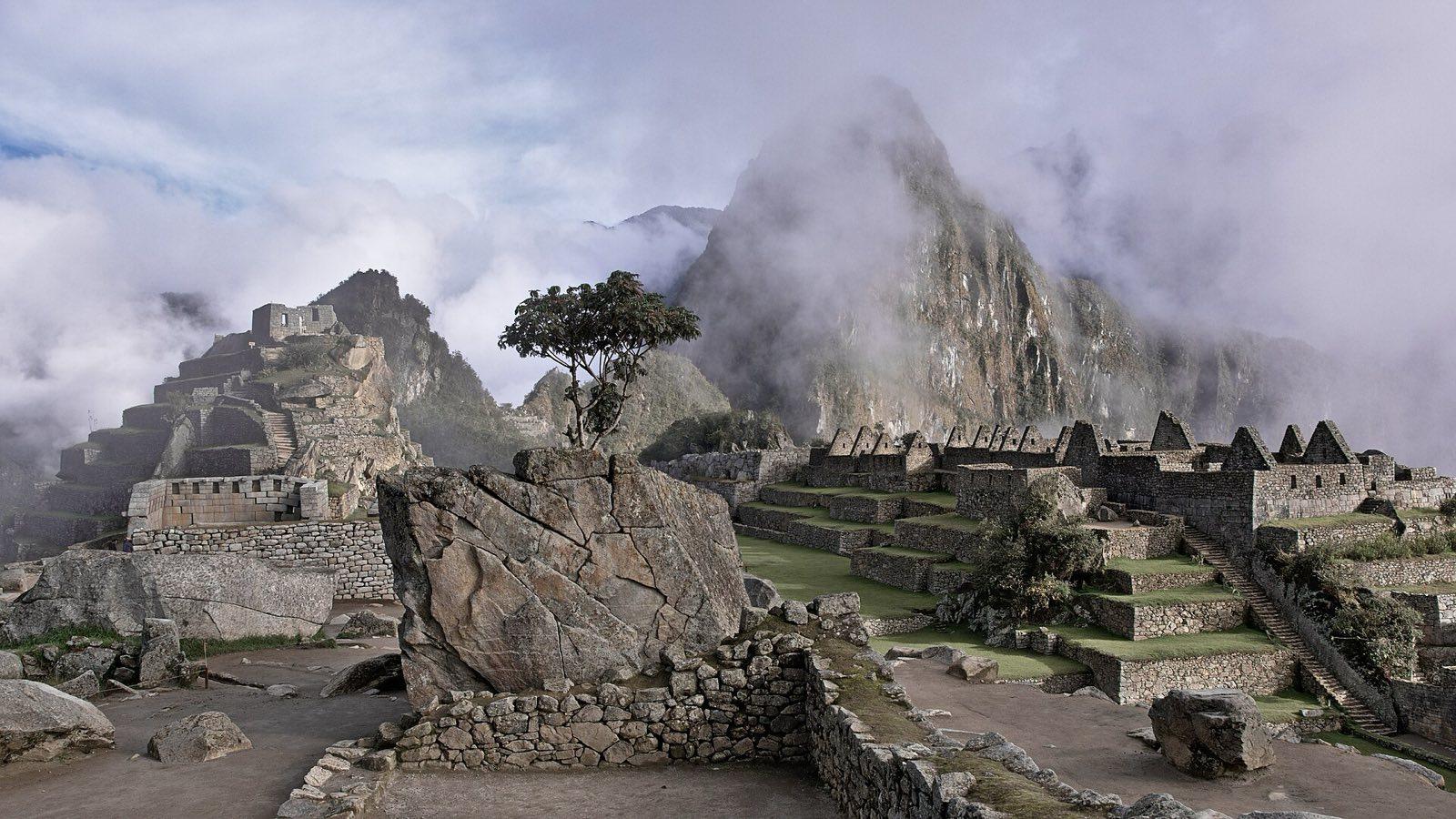
Inca houses and terraces at Machu Picchu in the morning mist, photographed in September 2016 Photo: Tomas Sobek, CC0, via Wikimedia Commons Jour 8 : From the Andes to Quito
Cusco to Lima by air, then Lima to Quito by air
- En avion
- Petit-déjeuner
- Nuit : Quito
Détail du jour 8
Today is a travel day, and we say so plainly: two flights, from Cusco to Lima, reported about 1.5 hours, and from Lima to Quito, reported about 2.5 hours, with a connection in Lima between them. We have not found a direct option to propose between Cusco and Quito, so the routing is by Lima; the quote sets the real schedule. Your guide travels with you, handles the check-ins and the connection, and checks bags are tagged through where the airline allows. Breakfast is at the hotel before the transfer; lunch is your choice at Lima airport. We land in Quito in the afternoon or early evening, depending on the flight schedule, and a driver would take us to the hotel. Quito sits at a reported 2,850 metres or so, which is still high, so the same care applies. The evening is free and short, because the Galapagos flight leaves early tomorrow. Flight times are set by the airlines and confirmed with your final itinerary.
Compris
- Flights from Cusco to Lima and Lima to Quito, with your guide
- Transfers to Cusco airport and from Quito airport to the hotel
Temps libre : Evening free in Quito
Activité : A long day in airports; keep a warm layer and snacks in your hand luggage.
Jour 9 : Fly to the Galapagos, tortoises in the highlands
Quito to Baltra by air, across the Itabaca Channel and through the Santa Cruz highlands to Puerto Ayora
- Environ 2 h de route
- Petit-déjeuner et repas du midi
- Nuit : Puerto Ayora
Détail du jour 9
An early transfer to the airport, where the Transit Control Card is issued and bags go through a biosecurity check, then the flight to Baltra, reported at about 2 to 2.5 hours, sometimes with a stop in Guayaquil. On landing the national park entrance fee is collected by park rangers, and a licensed naturalist guide is proposed for island visits, as park rules require. A short bus ride and a ferry across the Itabaca Channel bring us onto Santa Cruz. We break the drive south in the highlands, where giant tortoises can be seen roaming in the grassland and mud pools of a reserve, and you can walk through a lava tunnel; sightings are never guaranteed. Lunch is a sit-down meal in the highlands. We reach Puerto Ayora in the afternoon and check in for three nights. Before dinner, walk down to the fish market on the waterfront, where pelicans and sea lions are often seen beside the fishermen's tables.
Compris
- Flight from Quito to Baltra (GPS)
- Baltra bus and Itabaca Channel crossing
- Giant tortoises in the highlands, with a lava tunnel, sightings not guaranteed
- Sit-down lunch in the Santa Cruz highlands
Option plus facile : Skip the lava tunnel and watch the tortoises from the paths near the reserve entrance.
Temps libre : Evening free in Puerto Ayora
Activité : Cash is often needed in smaller island towns; we confirm what to carry at quoting.
Jour 10 : Tortuga Bay at opening
Puerto Ayora to Tortuga Bay on foot and back
- Petit-déjeuner
- Nuit : Puerto Ayora
Détail du jour 10
We are at the start of the Tortuga Bay trail when it opens (hours confirmed at quoting), and walk the stone path, reported at about 2.5 km, through a forest of giant prickly-pear cactus while it is still cool. The trail ends at Playa Brava, a long white beach where the surf is too strong to swim, but marine iguanas are often seen on the sand and leave tracks like tiny tyre marks. Walk to its far end and the calm lagoon of Playa Mansa opens up, sheltered by mangroves, where you can swim or snorkel; reef sharks, rays and turtles are sometimes seen. Breakfast is packed for the beach so we do not lose the quiet hours. We walk back before the midday sun, and the rest of the day is free: lunch in town, a rest, or a coffee on the waterfront watching the water taxis cross Academy Bay. Your guide is around for anyone who wants suggestions.
Compris
- Tortuga Bay walk at opening, with time to swim and snorkel at Playa Mansa
- Snorkel gear and a wetsuit proposed for the island days
Option plus facile : Take a water taxi back from Playa Mansa instead of walking, when it runs.
Temps libre : Afternoon and evening free; lunch and dinner are your choice in Puerto Ayora
Activité : About 5 km of walking in total, on a stone path and soft sand. Swim only at Playa Mansa; Playa Brava has strong currents.
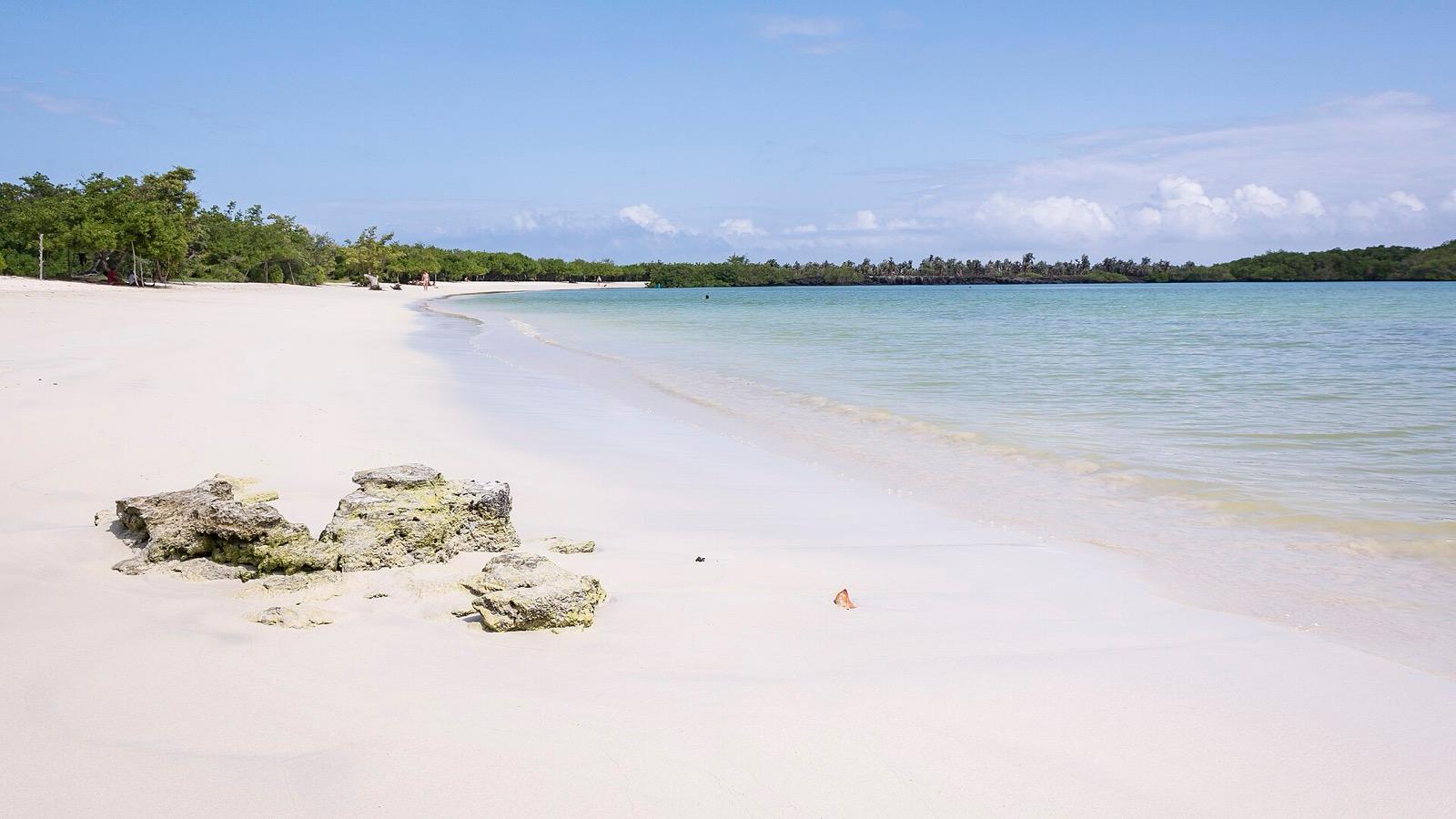
White sand and calm water at Tortuga Bay, Santa Cruz, photographed in April 2019 Photo: kuhnmi, CC BY 2.0 (https://creativecommons.org/licenses/by/2.0/), via Wikimedia Commons, resized Jour 11 : The Darwin Station and Las Grietas
Puerto Ayora to the Charles Darwin Research Station, then by water taxi to Las Grietas
- En bateau
- Petit-déjeuner
- Nuit : Puerto Ayora
Détail du jour 11
A slower day, in the middle of the trip on purpose. After breakfast we walk along the bay to the Charles Darwin Research Station and the Fausto Llerena tortoise centre, where young tortoises from different islands are reared for release, and where the story of Lonesome George, the last tortoise of his island, is told. Your naturalist explains how each island's tortoises evolved a different shell, the story that made the islands famous. Mid-morning we take the water taxi across Academy Bay and walk a short trail over lava and cactus to Las Grietas, a deep, narrow fissure of clear fresh and salt water between high rock walls, for a swim. We are back in town by lunchtime. The afternoon and evening are free: rest, snorkel from the beach at the Darwin Station, or browse the shops on Avenida Charles Darwin.
Compris
- Charles Darwin Research Station and the Fausto Llerena tortoise centre
- Las Grietas swim, with the water taxi across Academy Bay
Option plus facile : Skip Las Grietas and keep the late morning free in town.
Temps libre : Afternoon and evening free in Puerto Ayora
Activité : The Las Grietas trail is about 1 km each way over rough lava steps; wear shoes, not sandals.
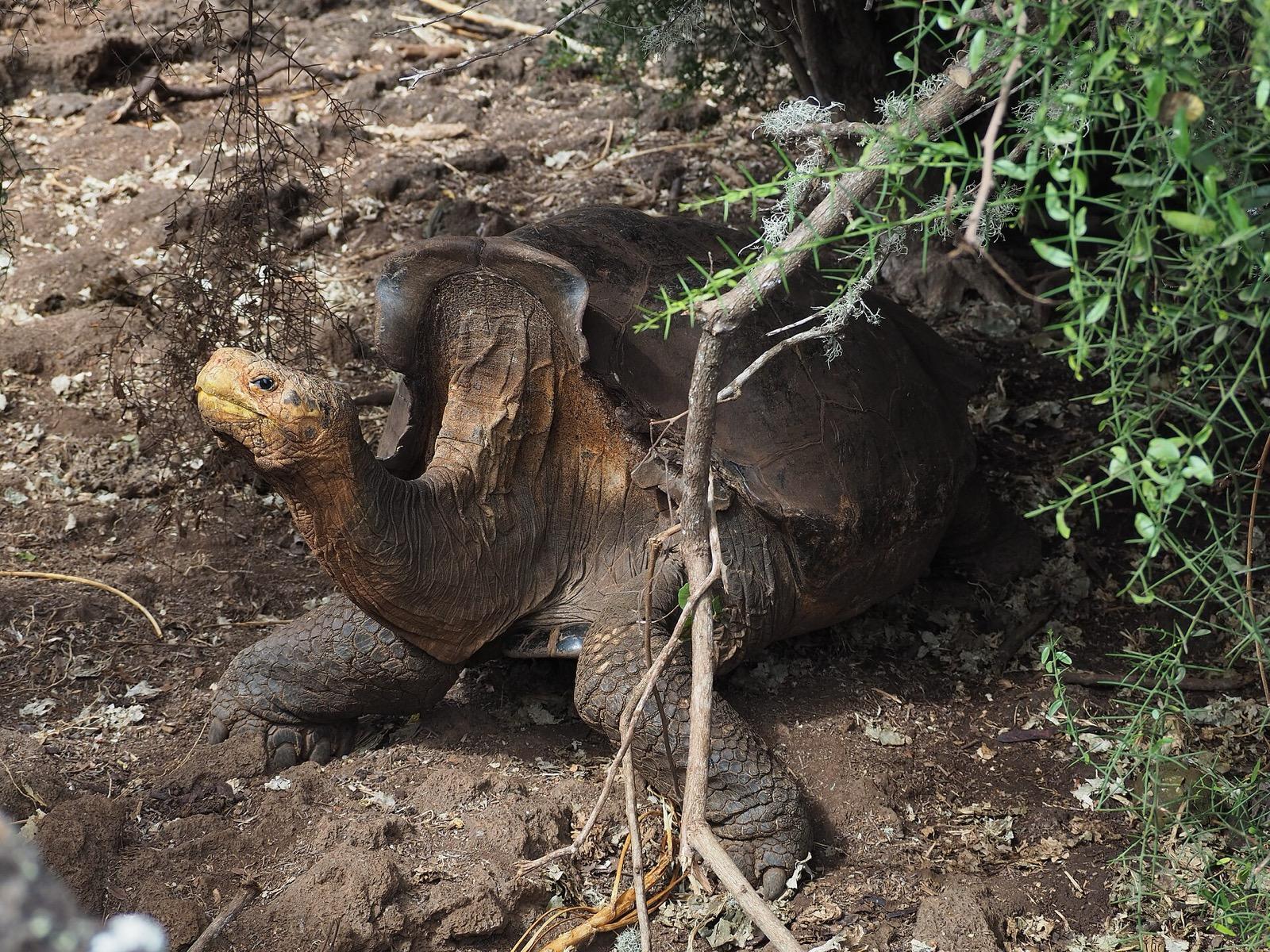
A giant tortoise at the Charles Darwin Research Station, photographed in December 2019 Photo: Kaldari, CC0, via Wikimedia Commons Jour 12 : Speedboat to Isabela, Los Tuneles
Puerto Ayora to Puerto Villamil by speedboat, then by boat to Los Tuneles
- En traversier
- Petit-déjeuner et repas du midi
- Nuit : Puerto Villamil
Détail du jour 12
The morning speedboat to Isabela takes about two to two and a half hours, past the southern coast of Santa Cruz and across open water to Puerto Villamil, a sand-street village behind a long beach. It is a shared public boat, and the crossing can be bumpy, so sit at the back and look at the horizon. The Isabela dock may charge a small municipal fee, which we would confirm at quoting; then we check in for two nights and have lunch. Then a licensed day-tour boat takes us west along the coast to Los Tuneles at Cabo Rosa, where old lava flows have collapsed into arches and tunnels over clear, shallow water. We walk on the lava between the channels, where blue-footed boobies are often seen nearby, then snorkel, where sea turtles, rays and seahorses can be seen and whitetip reef sharks sometimes rest in the caves; sightings are never guaranteed. We are back in the late afternoon, in time for sunset on the beach. Departure times depend on the sea and are set by the operators.
Compris
- Speedboat from Santa Cruz to Isabela
- Lunch in Puerto Villamil
- Los Tuneles boat trip with a naturalist guide, lava walk and snorkel, conditions permitting
Option plus facile : Stay on the boat during the snorkel and watch from the deck.
Temps libre : Evening free in Puerto Villamil
Activité : Two boat rides today. Sea state can cancel or change the Los Tuneles trip; the plan then switches to Las Tintoreras in Puerto Villamil's bay or free time.
Jour 13 : Sierra Negra and the flamingo lagoon
Puerto Villamil to the Sierra Negra trailhead and back, then the flamingo lagoon
- Environ 1.5 h de route
- Petit-déjeuner et repas du midi
- Nuit : Puerto Villamil
Détail du jour 13
We leave early for a drive of about 40 minutes up through farmland and misty highland forest to the Sierra Negra trailhead, so we walk before the midday heat. The trail climbs gently, often in cloud at first, to the rim of the caldera, one of the largest in the archipelago at a reported 10 km across, its floor black with lava from recent eruptions. From the rim the trail continues around the edge and down onto the lava fields of Volcan Chico, red and black cinder cones, spatter vents and lava spires, with views on a clear day across the other volcanoes of Isabela. Your naturalist guide explains how this young island is still building. We are back in the village for lunch in the early afternoon. Later, as it cools, we walk the boardwalk past the flamingo lagoon to the Arnaldo Tupiza tortoise breeding centre, then the evening is free.
Compris
- Sierra Negra caldera rim and the Volcan Chico lava fields with your guides
- Lunch in Puerto Villamil
- Flamingo lagoon and the Arnaldo Tupiza tortoise breeding centre
Option plus facile : Walk only to the caldera rim viewpoint and back, a much shorter walk, then return with the vehicle; or stay in the village and swim at Concha de Perla.
Option plus active : The full hike to Volcan Chico, about 16 km round trip on rocky volcanic ground, 5 to 6 hours.
Temps libre : Evening free in Puerto Villamil
Activité : Bring walking shoes, a hat, sunscreen and at least 2 litres of water; the trail is exposed once out of the cloud. The boardwalk is about 1.5 km each way on flat ground.
Jour 14 : Two boats to San Cristobal
Puerto Villamil to Puerto Ayora by speedboat, then on to Puerto Baquerizo Moreno
- En traversier
- Petit-déjeuner et repas du midi
- Nuit : Puerto Baquerizo Moreno
Détail du jour 14
The plan crosses from Isabela to San Cristobal by way of Santa Cruz, and it starts early. The first speedboat may leave around dawn, so breakfast is packed, and it reaches Puerto Ayora in about two hours. The middle of the day is free in Puerto Ayora: a coffee on the waterfront, the fish market or a last walk along Academy Bay, then a sit-down lunch together. An afternoon speedboat takes about two hours more to Puerto Baquerizo Moreno, the capital of the islands and the place Darwin is reported to have first landed in 1835. We arrive in time to walk the Malecon, where sea lions are often seen resting on the benches and the beach, and catch the last light from Playa Mann. The evening is free. Departure times are set by the boat operators and confirmed in the quote.
Compris
- Speedboats from Isabela to Santa Cruz and from Santa Cruz to San Cristobal
- Sit-down lunch in Puerto Ayora
- Sea lions on the Malecon and sunset at Playa Mann
Temps libre : Late morning free in Puerto Ayora between the two boats; evening free in San Cristobal
Activité : An early start and about four hours on boats in two crossings. Take seasickness tablets before boarding if you need them. Sightings are never guaranteed.
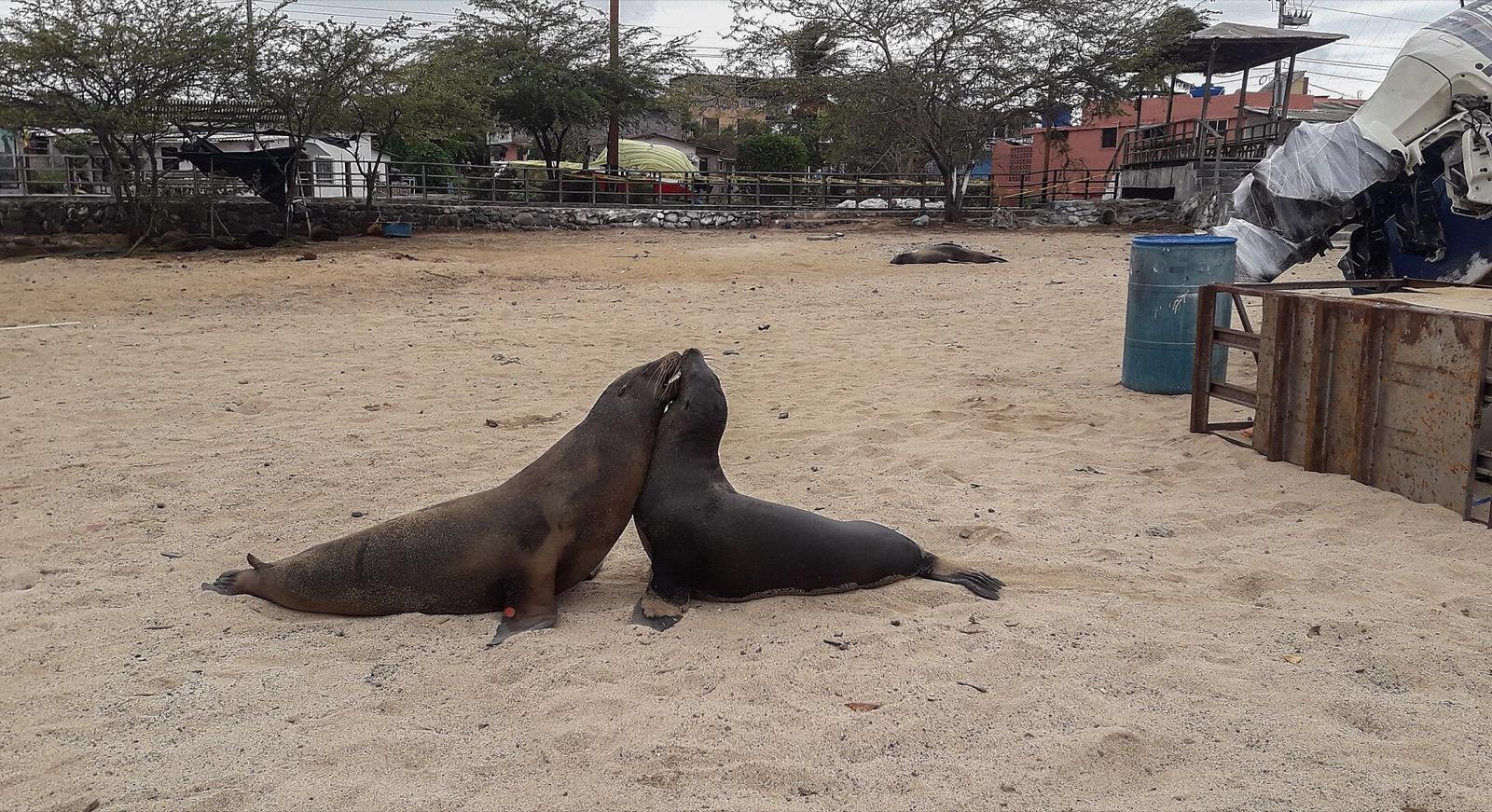
Sea lions on the fishermen's beach at Puerto Baquerizo Moreno, San Cristobal, photographed in December 2018 Photo: David Ceballos, CC BY 2.0 (https://creativecommons.org/licenses/by/2.0/), via Wikimedia Commons, resized Jour 15 : Kicker Rock by boat
Puerto Baquerizo Moreno to Kicker Rock (Leon Dormido) and a beach on San Cristobal's north coast, then back
- En bateau
- Petit-déjeuner, repas du midi et repas du soir
- Nuit : Puerto Baquerizo Moreno
Détail du jour 15
Today is a full day on a licensed day-tour boat with a park naturalist guide, out to Kicker Rock, the split volcanic tuff cone the islanders call Leon Dormido, the sleeping lion, rising a reported 150 metres or so straight out of the sea. The ride out is about an hour along the coast, often with frigatebirds and blue-footed boobies overhead. At the rock we snorkel the channel between the two halves, where turtles, rays, fish and sharks can be seen; the water is deep, and the naturalist and crew stay with the group. Lunch is served on board. On the way back the boat stops at a beach on the north coast, set by the park and the operator, for a walk and a swim; sea lions are often nearby, never guaranteed. We are back in town in the late afternoon. The last evening is planned as a farewell dinner with the group on the waterfront.
Compris
- Full-day boat to Kicker Rock (Leon Dormido) with a park naturalist guide
- Snorkel in the Kicker Rock channel, with a wetsuit, sea state permitting
- Beach stop on the north coast of San Cristobal
- Lunch on board
- Farewell dinner
Option plus facile : Stay on the boat at Kicker Rock and watch the seabirds from the deck; swim from the beach instead, where the water is shallow.
Activité : The snorkel at Kicker Rock is in deep, open water with a current; it suits confident swimmers, and life vests are on board. The day boat may carry other travellers as well as our group. Sightings are never guaranteed.
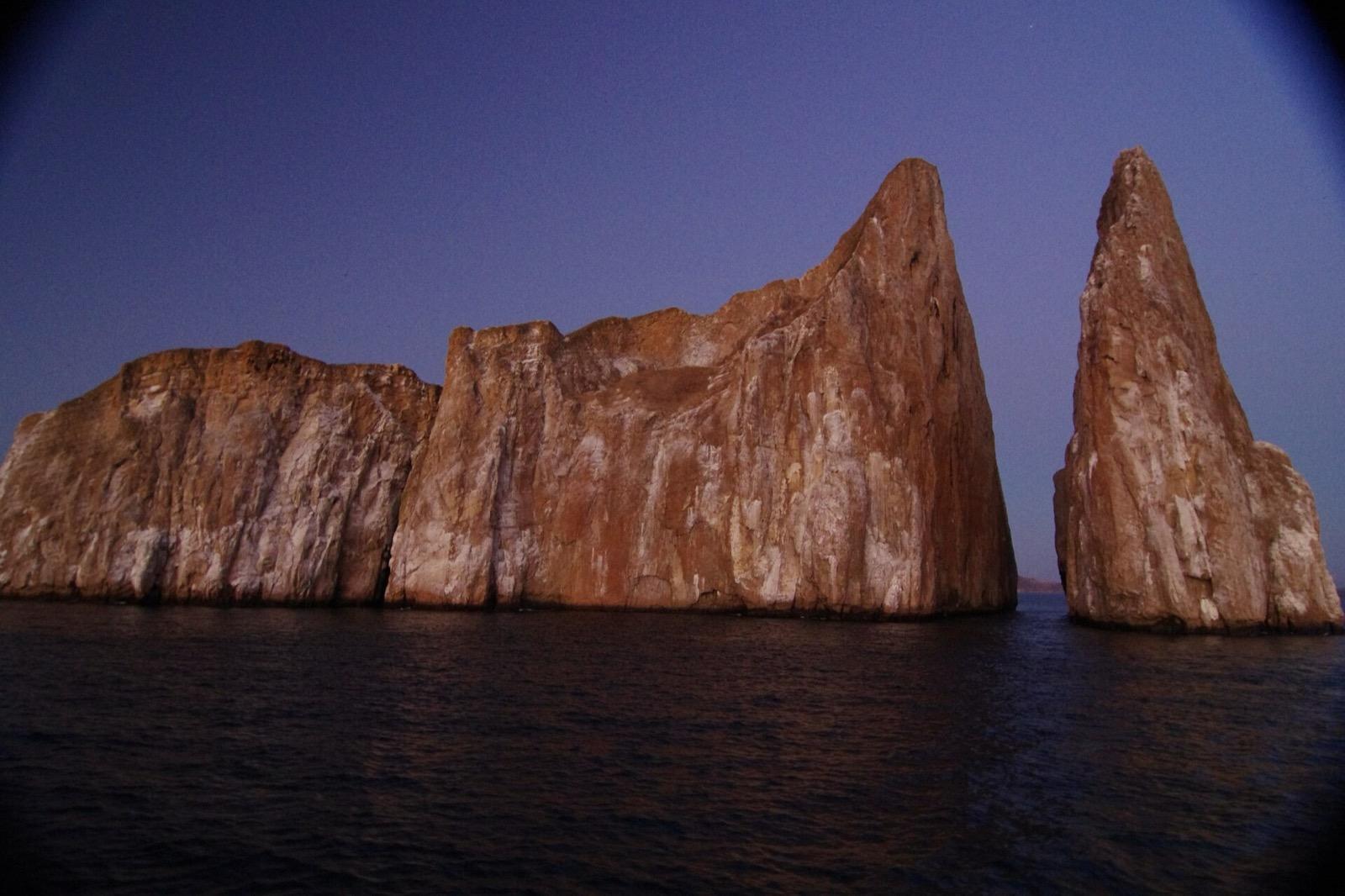
Kicker Rock (Leon Dormido) at dusk, seen from a boat, photographed in November 2011 Photo: Andrew Turner from Washington, DC, United States, CC BY 2.0 (https://creativecommons.org/licenses/by/2.0/), via Wikimedia Commons, resized Jour 16 : Frigatebird Hill and the flight home
Puerto Baquerizo Moreno to Cerro Tijeretas, then San Cristobal airport to Quito or Guayaquil
- En avion
- Petit-déjeuner
Détail du jour 16
A last early walk while the air is cool: along the bay to the San Cristobal Interpretation Center, which tells the story of the islands from volcanic birth to whalers, settlers and the conservation work of today, then up the trail to Cerro Tijeretas, Frigatebird Hill. From the lookout you see the bay where Darwin first came ashore, and frigatebirds hang in the wind overhead. Below the hill is a small cove where you can snorkel one more time, where sea lions and turtles are sometimes seen. We walk back to town for your bags; the airport is a few minutes' drive from the centre. The flight to Quito or Guayaquil proposed in the plan usually leaves around midday or early afternoon, and your guide sees you through check-in. Book your flight home from Quito or Guayaquil for the evening or the next day.
Compris
- San Cristobal Interpretation Center
- Cerro Tijeretas lookout and cove
- Flight from San Cristobal (SCY) to Quito (UIO) or Guayaquil (GYE)
Option plus facile : Skip the climb to the lookout and wait in the Interpretation Center garden.
Activité : Book a homeward flight from Quito or Guayaquil leaving after about 8 pm, or stay a night on the mainland.
Faune et météo : April to October is the usual planning window for the Andes; November falls in the rainy season the Government of Canada describes, with possible floods, landslides and rail or road closures. Read the page before you travel. The Peru page also lists wildfires from June to October, and both pages mention El Nino, as described there and not predicted by us. In the Galapagos, conditions shift from warmer, calmer water in the first months to cooler water, garua mist and choppier crossings from about June. Wildlife sightings are never guaranteed, and sea conditions can change plans.
15 nuits
Où vous logerez
Vos hôtels sont nommés dans la confirmation de votre voyage.
- Lima1 nuit
- Cusco2 nuits
- Sacred Valley (Urubamba)2 nuits
- Aguas Calientes1 nuit
- Cusco1 nuit
- Quito1 nuit
- Puerto Ayora3 nuits
- Puerto Villamil2 nuits
- Puerto Baquerizo Moreno2 nuits
Un seul prix
Ce que le prix comprend
Compris
Hébergement
- 15 nights proposed: 1 in Lima (Miraflores), 3 in central Cusco (2 at the start, 1 after Machu Picchu), 2 in the Sacred Valley near Urubamba, 1 in Aguas Calientes, 1 in Quito, 3 in Puerto Ayora on Santa Cruz, 2 in Puerto Villamil on Isabela and 2 in Puerto Baquerizo Moreno on San Cristobal
- Central hotels proposed at a 3-star-plus standard with private bathrooms; none is named or confirmed until the written quote
- Rooms shared, or your own for a supplement
Transport
- Airport pick-up in Lima on day 1, as proposed
- Vehicles and drivers in Lima, Cusco and the Sacred Valley, as proposed
- Flights proposed: Lima to Cusco, Cusco to Lima to Quito, Quito to Baltra, and San Cristobal to Quito or Guayaquil
- A scenic-window train from Ollantaytambo to Aguas Calientes and back, and the buses between Aguas Calientes and Machu Picchu, operator confirmed at quoting
- The Baltra bus, the Itabaca Channel crossing and transfers on the islands
- Shared public speedboats proposed from Santa Cruz to Isabela, Isabela to Santa Cruz and Santa Cruz to San Cristobal (about 2 hours each)
- Licensed day-tour boats to Los Tuneles and Kicker Rock, which may carry other travellers, and the Las Grietas water taxi
Votre guide
- A See Sight Tours guide planned from day 1 to day 16; no guide is named or confirmed
- A licensed site guide at Machu Picchu where the rules call for one
- Naturalist guides on island visits where park rules require them
Activités
- Lima: the historic centre and the Basilica and Convent of San Francisco with its catacombs
- Cusco: Sacsayhuaman, San Blas, the Cathedral and Qorikancha
- Sacred Valley: Pisac, Moray, the Maras salt pans and Ollantaytambo
- Machu Picchu: timed entry on the circuit set at quoting
- Santa Cruz: giant tortoises in the highlands, Tortuga Bay, the Charles Darwin Research Station and Las Grietas
- Isabela: Los Tuneles with snorkelling, the Sierra Negra walk, the flamingo lagoon and the tortoise breeding centre
- San Cristobal: Kicker Rock by boat with snorkelling, the Interpretation Center and Cerro Tijeretas
- Snorkel gear and a wetsuit for the island days
- Entry fees for the sites in the day plan, as set out in the quote
Repas
- 15 breakfasts
- 9 lunches: Pisac, Urubamba, Ollantaytambo, Aguas Calientes, the Santa Cruz highlands, Puerto Villamil (2), Puerto Ayora and on the Kicker Rock boat
- 3 dinners: welcome in Lima, Aguas Calientes and farewell in San Cristobal
Non compris
- International flights to Lima and home from Quito or Guayaquil
- The Galapagos Transit Control Card and national park entrance fee, as published and confirmed at quoting
- The Isabela municipal arrival fee, if charged
- Travel insurance, including medical and evacuation cover
- Meals not listed above
- Drinks
- Tips for guides, drivers and boat crews
- Activities you choose in your free time
- Personal expenses
Frais sur place
- Galapagos entry requirements as published, a Transit Control Card and a national park entrance fee, confirmed at quoting.
Suppléments
- Chambre individuelle
- Prix sur demande

See Sight Tours offre des services de voyage partout en Amérique du Nord depuis 2006. Présente dans 20 villes au Canada et aux États-Unis, l'entreprise se spécialise dans les tours en petit groupe qui offrent des expériences personnalisées et de grande qualité aux voyageurs.


Liens rapides
Réservez votre tour
Communiquez avec nous
- Sans frais1-888-961-6584
- Local1-289-271-9767
- Courrielinfo@seesight-tours.com


© 2026 See Sight Tours. Tous droits réservés.