Itinéraire à imprimer
Japan: the Nakasendo and the Kiso Valley
8 jours · Tokyo à Kanazawa · jusqu'à 12 voyageurs
À partir de CAD 6,155 par personne, en chambre partagée (prix estimé. Prix estimé. L'itinéraire, les hôtels et les disponibilités sont proposés sous réserve de confirmation. Votre devis précisera les conditions de réservation; l'envoi d'une demande ne confirme pas une réservation.)
Jour par jour
Itinéraire
- Tokyo1 nuit
- Matsumoto1 nuit
- Narai1 nuit
- Tsumago2 nuits
- Takayama2 nuits
- Kanazawaarrivée
- Étape avec nuitée
- Excursion d'une journée
- En bateau ou en train
Jour 1 : Arrive in Tokyo
Tokyo Haneda or Narita airport to your hotel near Shinjuku station
- Environ 1 h de route
- Welcome dinner
- Nuit : Tokyo
Détail du jour 1
Fly into Tokyo Haneda (HND) or Narita (NRT), where our driver meets you in arrivals for the drive to your hotel near Shinjuku station: about 45 minutes from Haneda, closer to 90 from Narita. We stay by Shinjuku because tomorrow's train to the mountains leaves from there, so the morning starts with a short walk rather than a cross-city transfer with suitcases. The afternoon is yours to rest or take a first look at the city: the free observation decks of the Tokyo Metropolitan Government Building are a few minutes' walk away, and the narrow lanes of Omoide Yokocho, beside the station, fill with grill smoke as the light goes. At 6 pm your See Sight Tours guide meets the group for a briefing on the week: how the walking days work, what goes in your daypack, how your suitcase travels ahead of you, and how to behave in a minshuku and its bath. Then we walk to a welcome dinner at an izakaya nearby.
Compris
- Pick-up at Tokyo Haneda (HND) or Narita (NRT) airport
- Welcome briefing with your guide
- Welcome dinner at an izakaya near Shinjuku
Temps libre : Free until the 6 pm briefing
Activité : Land by about 3 pm to make the briefing comfortably; the latest arrival time is confirmed with your final itinerary.
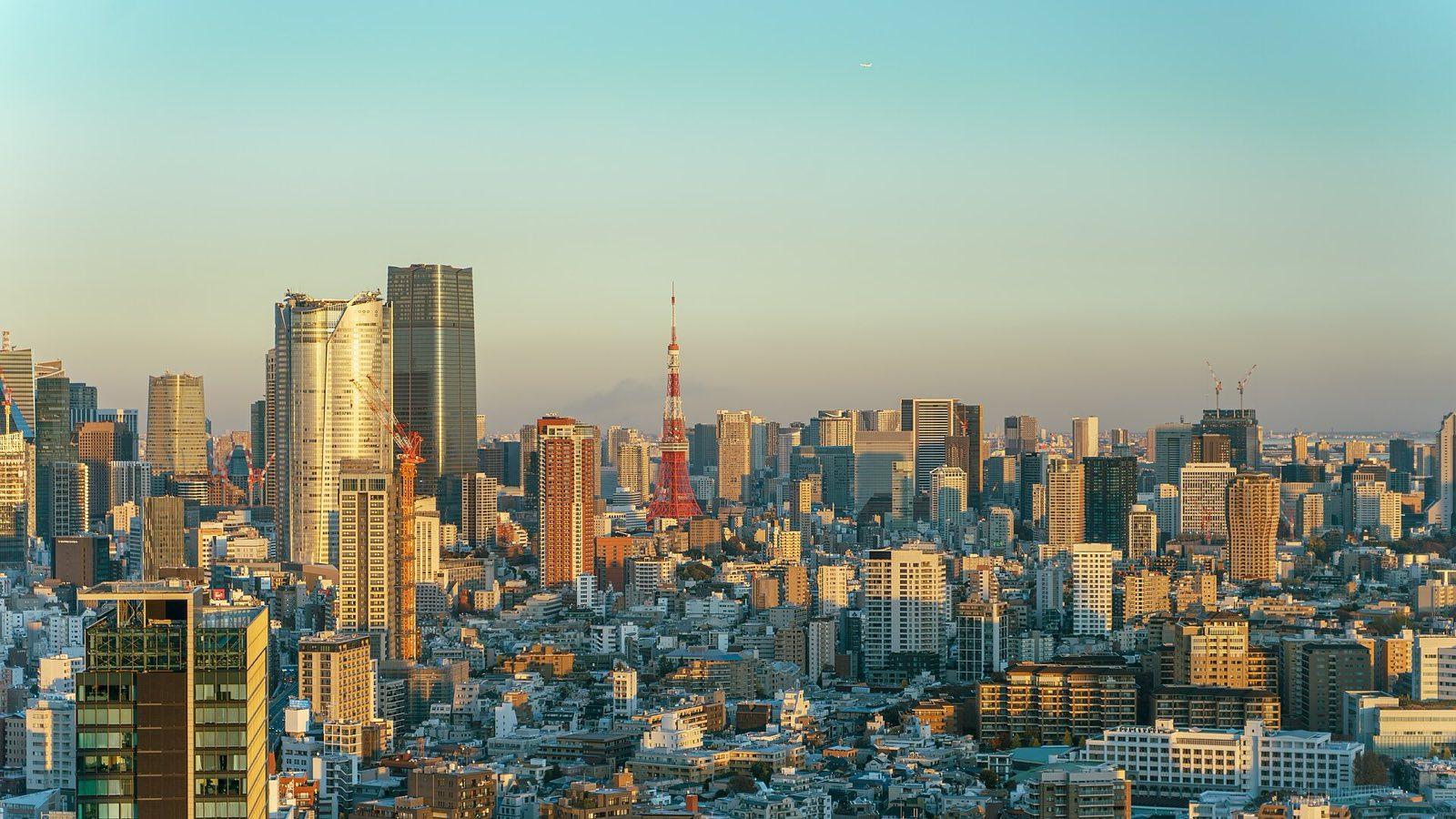
Tokyo from Minato at golden hour Photo: David Kernan, CC BY 4.0, via Wikimedia Commons (https://commons.wikimedia.org/wiki/File:Minato_City,_Tokyo,_Japan.jpg) Jour 2 : By train to Matsumoto
Tokyo (Shinjuku) by the Azusa limited express to Matsumoto
- En train
- Petit-déjeuner et repas du midi
- Nuit : Matsumoto
Détail du jour 2
After breakfast we walk to Shinjuku station for the Azusa limited express, about two hours and forty minutes to Matsumoto, with reserved seats. The line runs west past Hachioji, through the vineyards of the Kofu basin and up into Nagano, with the Southern Alps and the Yatsugatake peaks off to the side on a clear day. Our own vehicle and driver meet us at Matsumoto station and stay with the group to the end of the trip; from here your suitcase rides with them. Lunch is Shinshu soba, the buckwheat noodles this mountain prefecture is known for. In the afternoon your guide walks you through Nakamachi, a street of old storehouses with white plaster walls and black-and-white tiled lattice, and across the Metoba River to Nawate, a lane of small stalls by a shrine. The castle waits until tomorrow's opening, when it is quiet. The rest of the day is free: Matsumoto is the hometown of the artist Yayoi Kusama, and the city art museum holds a large collection of her work.
Compris
- Azusa limited express from Shinjuku to Matsumoto, reserved seats
- Soba lunch in Matsumoto
- Nakamachi and Nawate streets with your guide
Activités en option
- Matsumoto City Museum of Art
Temps libre : Late afternoon and evening free in Matsumoto
Activité : About 3 km on foot on flat town streets.
Jour 3 : Matsumoto Castle at opening, a night in Narai
Matsumoto Castle, then south to Kiso-Hirasawa and Narai-juku
- Environ 1.5 h de route
- Petit-déjeuner, repas du midi et repas du soir
- Nuit : Narai
Détail du jour 3
We are at Matsumoto Castle for the 8:30 opening, ahead of the tour groups. Its keep, completed in the 1590s and one of five castle keeps listed as National Treasures, is black-lacquered wood above a broad moat, and inside it is original: steep wooden stairs, gun ports, a hidden floor and, at the top, views across the city to the Northern Alps. Our vehicle then takes us about an hour south through Shiojiri to the head of the Kiso Valley and Narai-juku, the 34th of the 69 post towns on the Nakasendo, the inland road between Edo and Kyoto. Its single street of dark wooden inns and shops runs for about a kilometre, which earned it the name Narai of a thousand houses. After lunch in Narai we hop a few minutes to Kiso-Hirasawa, a town of lacquerware makers, to visit a workshop. Back in Narai, the day visitors leave by late afternoon, and your guide walks you down the empty street to the Kiso Ohashi, an arched bridge of local cypress. Dinner is at our inn.
Compris
- Matsumoto Castle at opening with your guide
- Drive to Narai-juku
- Lunch in Narai
- Lacquer workshop visit in Kiso-Hirasawa
- Late-afternoon walk along Narai's street to the Kiso Ohashi bridge
- Dinner at the inn in Narai
Temps libre : Free hour before dinner in Narai
Activité : The castle stairs are steep and narrow, almost ladders in places; you can stay on the lower floors.
Jour 4 : Over the Torii Pass to Yabuhara, on to Tsumago
Walk Narai to Yabuhara over the Torii Pass, then drive by Kiso-Fukushima to Tsumago
- Environ 1.5 h de route
- Petit-déjeuner, repas du midi et repas du soir
- Nuit : Tsumago
Détail du jour 4
The first walk. Your suitcase goes ahead in our vehicle, and we leave Narai at about 8:30 with a daypack, from the shrine at the south end of town onto the old road. The path climbs steadily through cedar and larch, partly on old stone paving, past stone markers and a spring to the Torii Pass at about 1,197 m, the highest point on the Kiso stretch of the Nakasendo. Its name comes from a torii gate set up here facing Mount Ontake, a sacred peak you can see across the valleys on a clear day. The descent to Yabuhara-juku, a post town known for combs carved from local wood, is gentler. It is about 6 km, two and a half to three hours with stops; ring the bells hung along the trail to warn bears you are coming. The vehicle meets us at Yabuhara for the half hour to Kiso-Fukushima, where we have lunch and visit the site of the Fukushima Sekisho, one of the main checkpoints on Edo-period roads. Then it is about an hour down the valley to Tsumago for two nights in a family-run minshuku, and a walk along the street after the coaches have gone.
Compris
- Walk the Nakasendo from Narai to Yabuhara over the Torii Pass with your guide (about 6 km)
- Sit-down lunch in Kiso-Fukushima
- Fukushima Sekisho checkpoint site
- Evening walk along Tsumago's street
- Minshuku dinner in Tsumago
Option plus facile : Skip the climb: explore Narai at your own pace in the morning and ride round through the Torii tunnel with the vehicle to meet the walkers at Yabuhara.
Temps libre : Evening free in Tsumago
Activité : About 6 km with about 260 m of steady climbing on stone paving and forest path, then a gentler descent.
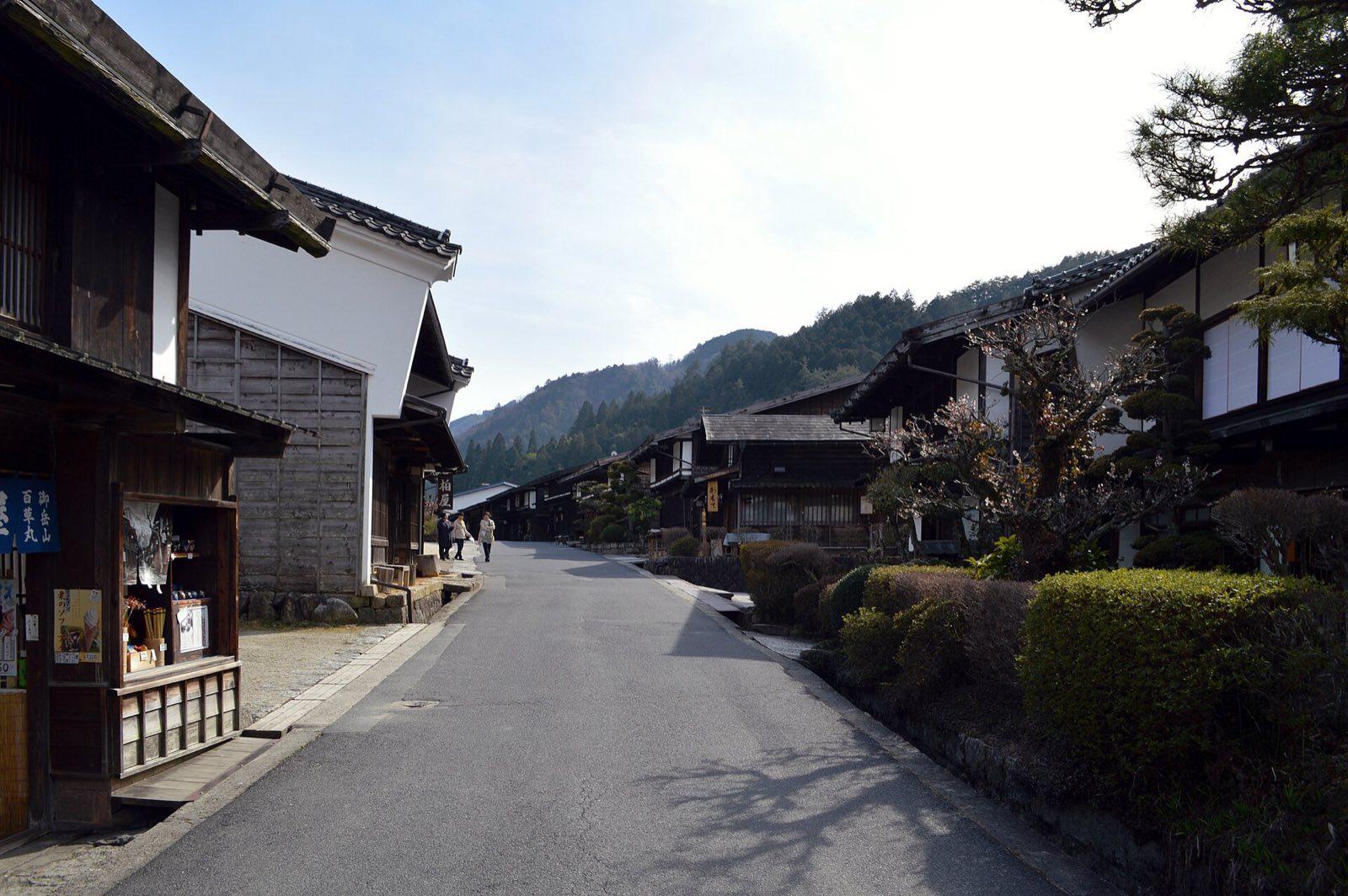
The Nakasendo through the middle of Tsumago-juku Photo: DimiTalen, CC0, via Wikimedia Commons (https://commons.wikimedia.org/wiki/File:Looking_up_the_Nakasend%C5%8D_in_the_central_part_of_the_village,_Tsumago-juku,_Nagiso,_2016.jpg) Jour 5 : Magome to Tsumago
Tsumago by road to Magome-juku, then walk the Nakasendo back to Tsumago
- Environ 30 min de route
- Petit-déjeuner, repas du midi et repas du soir
- Nuit : Tsumago
Détail du jour 5
Our vehicle takes us about 25 minutes over the hill to Magome-juku for a 9 am start, ahead of the day-trip coaches, on the best-known stretch of the Nakasendo. Magome sits on a ridge, and its stone-paved street climbs past water wheels, inns and shops; near the top a viewpoint looks out over the valley to Mount Ena. The novelist Shimazaki Toson, whose Before the Dawn is set here, was born in Magome, and the Toson Memorial Museum stands on the site of his family's inn. From the top of town the trail climbs gently to the Magome Pass at 801 m, then runs mostly downhill through forest and hamlets, past the Odaki and Medaki waterfalls and the old tateba teahouse at Ichikokutochi, where volunteers serve green tea when it is open. It is about 8 km, three to three and a half hours with stops. Lunch is in Tsumago, then your guide takes you round the Waki-honjin Okuya, an inn for travelling officials rebuilt in cypress in 1877. In 1971 Tsumago's residents agreed not to sell, rent or pull down their old houses, which is why the street still looks as it does. The afternoon and evening are free.
Compris
- Magome-juku and the Toson Memorial Museum
- Walk the Nakasendo from Magome to Tsumago over the Magome Pass with your guide (about 8 km)
- Sit-down lunch in Tsumago
- Waki-honjin Okuya with your guide
- Minshuku dinner in Tsumago
Option plus facile : Ride to the Magome Pass road and walk only the mostly downhill 5 km to Tsumago.
Option plus active : Start an hour earlier at Ochiai-juku and walk the old stone paving up to Magome first, about 4 km more.
Temps libre : Afternoon and evening free in Tsumago
Activité : About 8 km, about 200 m up to the pass and 380 m down, on stone paving, forest path and quiet lanes.
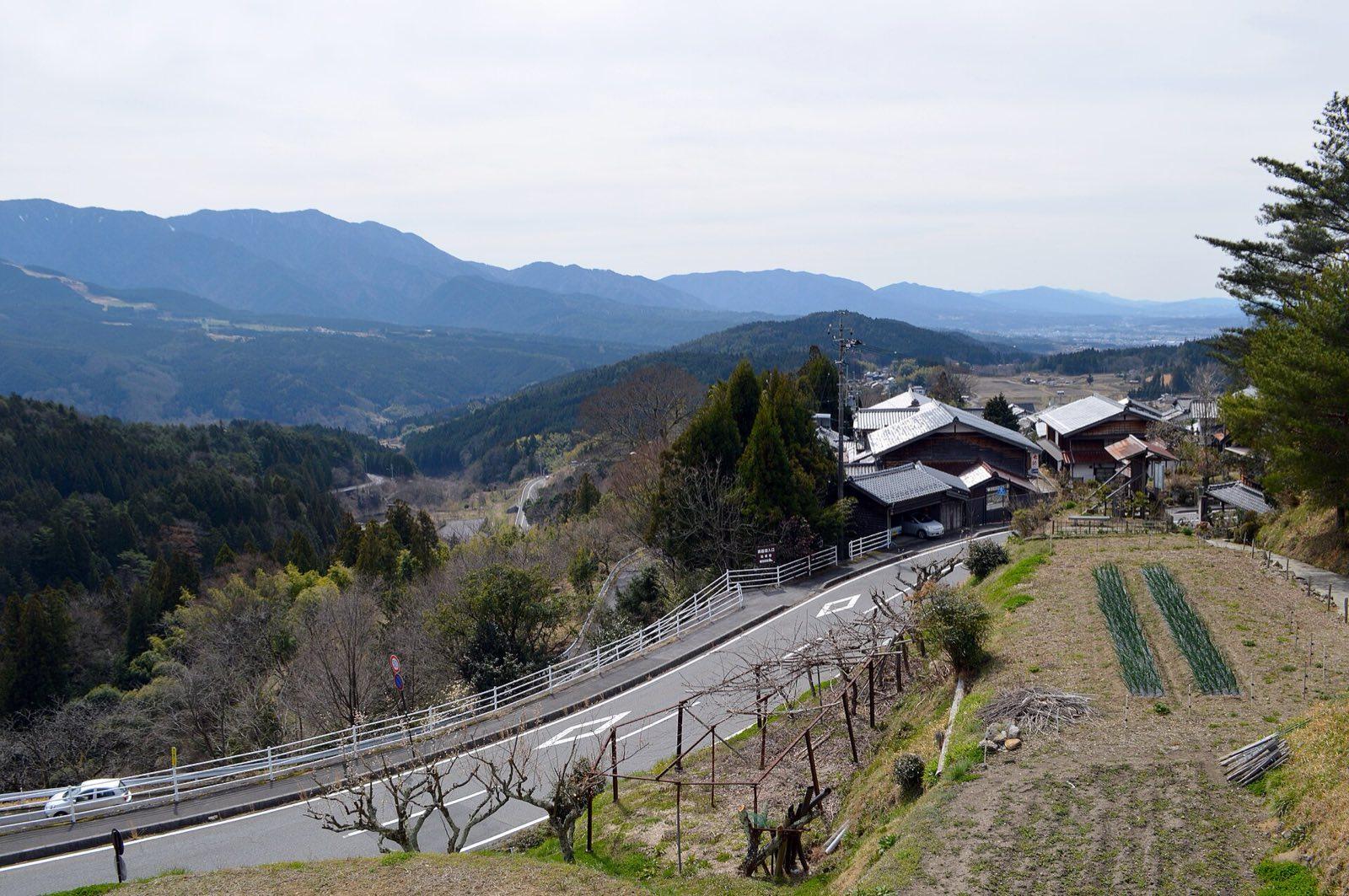
The view from the Magome-juku viewpoint Photo: DimiTalen, CC0, via Wikimedia Commons (https://commons.wikimedia.org/wiki/File:View_from_the_Magome-juku_viewpoint,_Nakatsugawa,_2016.jpg) Jour 6 : Down to Nagiso, over the hills to Takayama
Walk Tsumago to Nagiso, then drive by Route 256, Gero and Route 41 to Takayama
- Environ 2.5 h de route
- Petit-déjeuner et repas du midi
- Nuit : Takayama
Détail du jour 6
Early morning is the best time in Tsumago: the street is empty and the first light comes over the ridge onto the wooden fronts. After breakfast we walk the last stretch of the Nakasendo on this trip, about 3.5 km and an hour to an hour and a half, from Tsumago over a low rise and down through the houses of Nagiso to the Kiso River. Our vehicle meets us by the Momosuke Bridge, a long wooden suspension bridge from 1922 just north of Nagiso station. From Nagiso we drive west over the hills on Route 256 and north up the Hida River on Route 41 to Takayama, about 120 km and two and a half hours with a stop. Lunch is on the way in Gero, a hot spring town with free public foot baths. We reach Takayama mid-afternoon. Your guide walks you through Sanmachi Suji, three parallel lanes of dark-timbered merchant houses, to a sake brewery marked by a ball of cedar branches over the door, for a tasting. The evening is free in Takayama.
Compris
- Walk the Nakasendo from Tsumago to Nagiso with your guide (about 3.5 km)
- Momosuke Bridge in Nagiso
- Sit-down lunch in Gero
- Sanmachi Suji old town walk with your guide
- Sake tasting at a Takayama brewery
Option plus facile : Ride from Tsumago to Nagiso with the vehicle and the suitcases.
Temps libre : Evening free in Takayama
Activité : About 3.5 km on foot in the morning, mostly level then downhill on lanes and path.
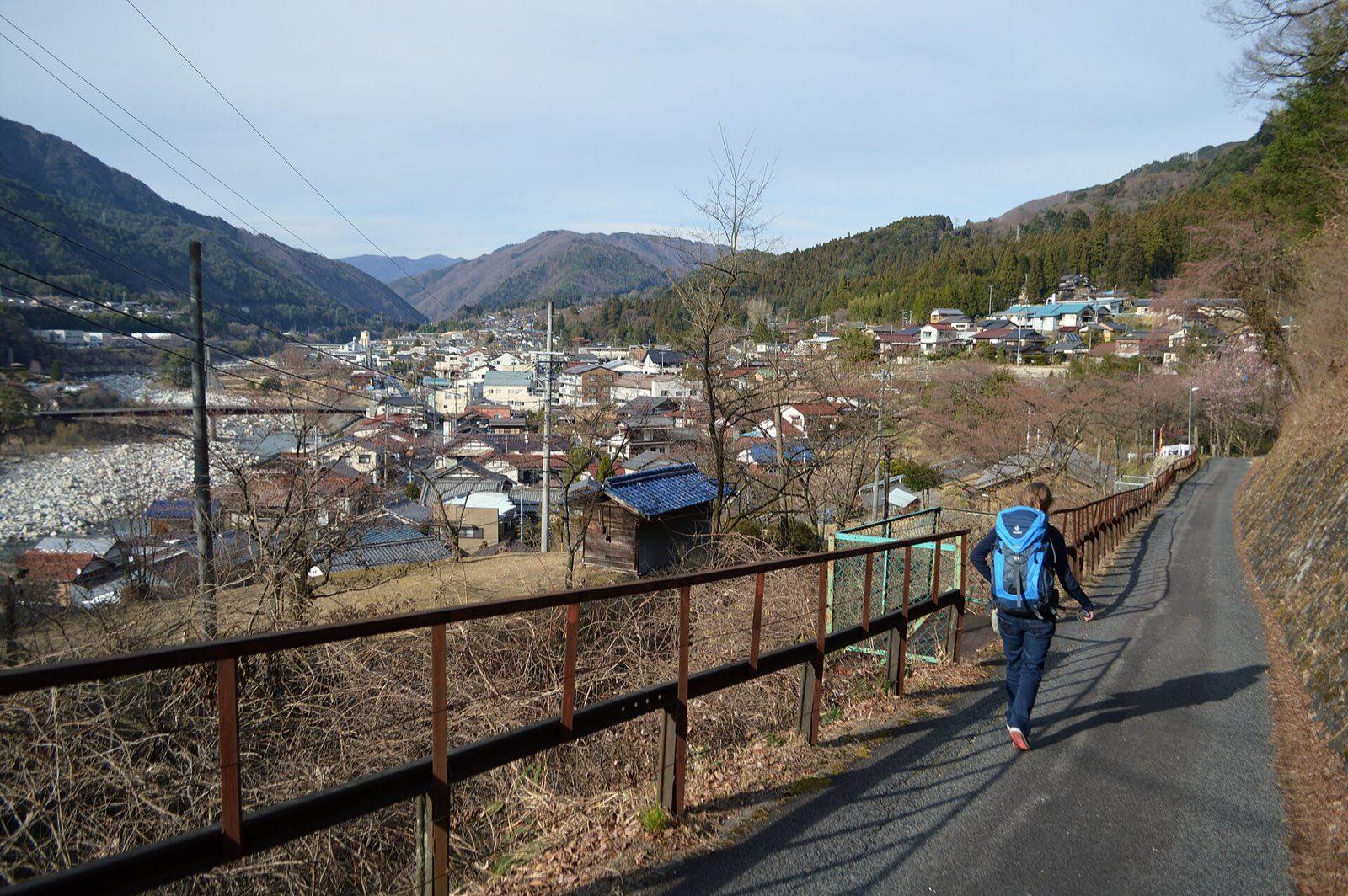
Descending the Nakasendo into Nagiso Photo: DimiTalen, CC0, via Wikimedia Commons (https://commons.wikimedia.org/wiki/File:Descending_the_Nakasend%C5%8D_to_Nagiso,_2016.jpg) Jour 7 : Takayama: the market, the Jinya and a free afternoon
A day on foot in Takayama
- Petit-déjeuner et repas du soir
- Nuit : Takayama
Détail du jour 7
A slow day in one place. Before breakfast, walk down to the Miyagawa morning market along the river, where farmers set out mountain vegetables, pickles, miso and sweets from about 7 am. At 8:45 we are at the door of Takayama Jinya when it opens: the government house from which officials of the shogun ran the Hida region after 1692, with its rice storehouse, tatami halls and courtyard garden. From there your guide takes you across the old town to Sakurayama Hachiman-gu and the Takayama Festival Floats Exhibition Hall, where some of the town's carved and lacquered festival floats, wheeled out each spring and autumn, are on show between festivals. Lunch is on your own: try Hida beef on a skewer from a street stall or a bowl of Takayama ramen. The afternoon is free. You might walk the Higashiyama course past temples on the wooded hillside east of town, or visit Hida no Sato, an open-air museum of farmhouses moved here from the mountains. In the evening we sit down together to a farewell dinner of Hida beef.
Compris
- Miyagawa morning market with your guide
- Takayama Jinya at opening
- Sakurayama Hachiman-gu and the Takayama Festival Floats Exhibition Hall
- Farewell Hida beef dinner
Activités en option
- Hida no Sato open-air museum
Option plus active : Walk the Higashiyama course, a loop of about 3.5 km past a dozen temples and shrines on the hillside, with your guide's map.
Temps libre : Afternoon free in Takayama
Activité : About 4 km on foot around town, on flat streets.
Jour 8 : Shirakawa-go and Kanazawa
Takayama to Shirakawa-go, then Kanazawa, ending at Kanazawa station
- Environ 2 h de route
- Petit-déjeuner et repas du midi
Détail du jour 8
We leave Takayama at 8 am and take the expressway west, about 50 minutes, to Shirakawa-go, so we arrive before most of the coaches. Ogimachi, the main village, is part of the Historic Villages of Shirakawa-go and Gokayama, listed by UNESCO in 1995 for their gassho-zukuri farmhouses: steep thatched roofs built to shed heavy snow, with attic floors once used to raise silkworms. We give it about two hours: the Shiroyama viewpoint above the village, a walk down among the houses and a visit inside the Wada House, one of the largest. It is then about an hour and a quarter to Kanazawa, where lunch is at Omicho Market, the city's food market since the Edo period, with seafood from the Sea of Japan. After an hour for lunch, your guide takes you through Kenroku-en for about an hour and a half: ponds, stone lanterns and old pines shaped by the Maeda lords, one of the three great gardens of Japan. The trip ends at Kanazawa station at about 4 pm. The Hokuriku Shinkansen reaches Tokyo in about two and a half to three hours, and Kyoto in a little over two hours with a change at Tsuruga.
Compris
- Shirakawa-go: the Shiroyama viewpoint, Ogimachi village and the Wada House
- Sit-down lunch at Omicho Market, Kanazawa
- Kenroku-en with your guide
- Drop-off at Kanazawa station
Activité : Do not book a flight home today. Plan an evening train to Tokyo or Kyoto and fly the next day, or stay on in Kanazawa.
Faune et météo : April and May bring fresh green and mild walking weather; from late October to mid-November the Kiso Valley maples turn. June to mid-July is the rainy season, and July and August are hot and humid, a little cooler in the valley. From December to March the Torii Pass can be under snow, so the trip runs from April to November.
7 nuits
Où vous logerez
Vos hôtels sont nommés dans la confirmation de votre voyage.
- Tokyo1 nuit
- Matsumoto1 nuit
- Narai1 nuit
- Tsumago2 nuits
- Takayama2 nuits
Un seul prix
Ce que le prix comprend
Compris
Hébergement
- 7 nights: 1 in Tokyo near Shinjuku station, 1 in Matsumoto, 1 at a traditional inn in Narai, 2 at a family-run minshuku in Tsumago, 2 in Takayama
- Tatami rooms with futons in Narai and Tsumago, with baths usually shared
- Rooms shared, or your own for a supplement
Transport
- Pick-up at Tokyo Haneda (HND) or Narita (NRT) airport
- Azusa limited express from Shinjuku to Matsumoto with reserved seats
- Our own vehicle and driver from Matsumoto station on day 2 to Kanazawa station on day 8, meeting the group at each trailhead and trail end
- Your suitcase carried ahead to each inn on walking days, so you walk with a daypack
- Drop-off at Kanazawa station
Votre guide
- A See Sight Tours guide for the whole trip, who walks every stage with the group
- The same driver from Matsumoto to Kanazawa
Activités
- Nakamachi and Nawate streets in Matsumoto
- Matsumoto Castle at opening
- Narai-juku and the Kiso Ohashi bridge
- Lacquer workshop visit in Kiso-Hirasawa
- Nakasendo walks: Narai to Yabuhara over the Torii Pass, Magome to Tsumago over the Magome Pass, Tsumago to Nagiso
- Fukushima Sekisho checkpoint site in Kiso-Fukushima
- Toson Memorial Museum in Magome
- Waki-honjin Okuya in Tsumago
- Momosuke Bridge in Nagiso
- Sanmachi Suji and a sake tasting in Takayama
- Miyagawa morning market, Takayama Jinya and the Festival Floats Exhibition Hall
- Shirakawa-go and the Wada House
- Omicho Market and Kenroku-en in Kanazawa
Repas
- Breakfast daily (7)
- 6 lunches, sit-down on every walking and travel day
- Welcome dinner in Tokyo
- Inn dinner in Narai
- 2 minshuku dinners in Tsumago
- Farewell Hida beef dinner in Takayama
Non compris
- International flights to Tokyo and home
- The onward train from Kanazawa
- A visa or travel authorisation, if your passport needs one
- Travel insurance, which must cover walking
- Dinners on days 2 and 6 and lunch on day 7
- Drinks, beyond the sake tasting
- Optional entries: Matsumoto City Museum of Art, Hida no Sato
- Tips (not expected in Japan)
- Laundry and personal expenses
Suppléments
- Chambre individuelle
- CAD 1,045 (prix estimé)

See Sight Tours offre des services de voyage partout en Amérique du Nord depuis 2006. Présente dans 20 villes au Canada et aux États-Unis, l'entreprise se spécialise dans les tours en petit groupe qui offrent des expériences personnalisées et de grande qualité aux voyageurs.


Liens rapides
Réservez votre tour
Communiquez avec nous
- Sans frais1-888-961-6584
- Local1-289-271-9767
- Courrielinfo@seesight-tours.com


© 2026 See Sight Tours. Tous droits réservés.