Itinéraire à imprimer
Japan: Kyushu and the Setouchi Art Islands
10 jours · Fukuoka à Osaka · jusqu'à 12 voyageurs
À partir de CAD 7,495 par personne, en chambre partagée (prix estimé. Prix estimé. L'itinéraire, les hôtels et les disponibilités sont proposés sous réserve de confirmation. Votre devis précisera les conditions de réservation; l'envoi d'une demande ne confirme pas une réservation.)
Jour par jour
Itinéraire
- Fukuoka2 nuits
- Nagasaki1 nuit
- Kurokawa Onsen1 nuit
- Beppu1 nuit
- Naoshima2 nuits
- Kurashiki1 nuit
- Osaka1 nuit
- Étape avec nuitée
- Excursion d'une journée
- En bateau ou en train
Jour 1 : Arrive in Fukuoka
Fukuoka Airport to your hotel near Hakata Station
- Environ 30 min de route
- Welcome dinner
- Nuit : Fukuoka
Détail du jour 1
Fly into Fukuoka Airport (FUK), about 5 km from the hotels around Hakata Station, where a driver meets you in arrivals for the short ride to the hotel. Plan to land by about 4 pm; the exact latest arrival is confirmed with your final itinerary, and if you are coming from Tokyo or Osaka instead, the shinkansen to Hakata works just as well. Fukuoka is Kyushu's largest city. Hakata, the old trading quarter by the river, still gives the main station its name, and the city is known across Japan for its food: tonkotsu ramen, mentaiko (spiced pollock roe) and the open-air yatai stalls by the river. In the early evening your See Sight Tours guide meets the group at the hotel for a short briefing: how the trains, ferries and our van fit together, when your suitcase is sent ahead, and what to pack in a small bag for the two island nights. Then we walk to a welcome dinner of Hakata mizutaki, chicken simmered at the table in a milky broth.
Compris
- Pick-up at Fukuoka Airport (FUK)
- Welcome briefing with your guide
- Welcome dinner of Hakata mizutaki
Temps libre : Free until the evening briefing
Jour 2 : Dazaifu, old Hakata and the yatai
Fukuoka to Dazaifu and back, then Hakata and Nakasu on foot
- En train
- Petit-déjeuner et repas du soir
- Nuit : Fukuoka
Détail du jour 2
We take the Nishitetsu train to Dazaifu, about 40 minutes, and arrive soon after the gates open, ahead of the school groups. Dazaifu Tenmangu is built over the grave of Sugawara no Michizane, a 9th-century scholar and poet now honoured as the patron of learning, and about 6,000 plum trees fill the grounds, flowering in February and early March. Walk the approach street and try umegae mochi, a grilled rice cake filled with sweet bean paste, then cross the arched bridges over the shrine pond. If you want more history, the Kyushu National Museum sits just behind the shrine (it closes on Mondays). We are back in the city by early afternoon, and the rest of the afternoon is free: Ohori Park, the ruins of Fukuoka Castle, or a bowl of ramen. At dusk your guide leads a walk through Kushida Shrine and the old Hakata lanes to the yatai stalls on the Nakasu riverbank, where we split into small groups across a few stalls for dinner.
Compris
- Dazaifu Tenmangu with your guide, and umegae mochi on the approach street
- Evening walk through Kushida Shrine and old Hakata
- Yatai dinner on the Nakasu riverbank
Activités en option
- Kyushu National Museum in Dazaifu (closed Mondays)
Temps libre : Lunch on your own; afternoon free in Fukuoka
Activité : Yatai stalls close in heavy rain or storms; if they do, dinner moves to a restaurant in Nakasu.
Jour 3 : Nagasaki: the Peace Park and Dejima
Fukuoka to Nagasaki by van
- Environ 2 h de route
- Petit-déjeuner et repas du midi
- Nuit : Nagasaki
Détail du jour 3
Our own van and driver join us this morning and stay with the group for four days across Kyushu, carrying the suitcases so you are not lifting them on and off trains. The drive to Nagasaki is about two hours on the expressway. We go first to the Atomic Bomb Museum and the Peace Park, which tell the story of 9 August 1945, when the bomb exploded above the Urakami district at 11:02 am. Allow about two hours here with a local peace guide; a talk by a hibakusha, a survivor of the bombing, is arranged when one is available. Lunch is champon, Nagasaki's noodle soup piled with seafood and vegetables, in Shinchi Chinatown. In the afternoon we walk Dejima, the fan-shaped artificial island where Dutch traders were confined during Japan's two centuries of isolation, now rebuilt warehouse by warehouse. The late afternoon and evening are free. Your guide can point you to the ropeway up Mount Inasa for the night view over the harbour.
Compris
- Nagasaki Atomic Bomb Museum, the hypocentre and the Peace Park with a local peace guide
- Champon lunch in Shinchi Chinatown
- Dejima with your guide
Activités en option
- Mount Inasa ropeway for the night view (paid locally)
Temps libre : Late afternoon and evening free
Activité : The museum's exhibits on the bombing and its victims are hard to look at; you can leave the exhibition at any point and wait in the Peace Park.
Jour 4 : Glover Garden, Kumamoto Castle and a ryokan night
Nagasaki to Kumamoto, then up to Kurokawa Onsen
- Environ 4 h de route
- Petit-déjeuner, repas du midi et repas du soir
- Nuit : Kurokawa Onsen
Détail du jour 4
Glover Garden opens at 8 am, and we are at the gate early to have the hillside to ourselves. The Former Glover House, built in 1863 for the Scottish merchant Thomas Glover, is the oldest surviving Western-style wooden building in Japan and part of the UNESCO-listed Sites of Japan's Meiji Industrial Revolution; Oura Church next door, completed in 1865, belongs to the separate UNESCO listing of Hidden Christian sites in the Nagasaki region. By about 9:30 we are on the road: a little over two hours on the expressway to Kumamoto, with lunch near the castle. Kumamoto Castle was badly damaged in the 2016 earthquakes; its main keep reopened in 2021, and from the raised walkway you look down on stone walls still being rebuilt, work the city expects to run into the 2050s. In the afternoon the road climbs onto the grasslands around Aso to Kurokawa, a village of wooden inns along a narrow river, about an hour and a half away. Tonight is a ryokan night: a yukata, a kaiseki dinner and a soak before bed.
Compris
- Glover Garden at opening, with the Former Glover House
- Oura Church
- Lunch in Kumamoto
- Kumamoto Castle with your guide
- Kaiseki dinner and the baths at the ryokan
Option plus facile : Skip the castle's upper walkway and wait in the Sakuranobaba Josaien food and craft street below the walls.
Temps libre : Evening free at the ryokan
Activité : About four hours of driving today, the most on the trip, split into a morning and an afternoon leg by the castle and lunch.
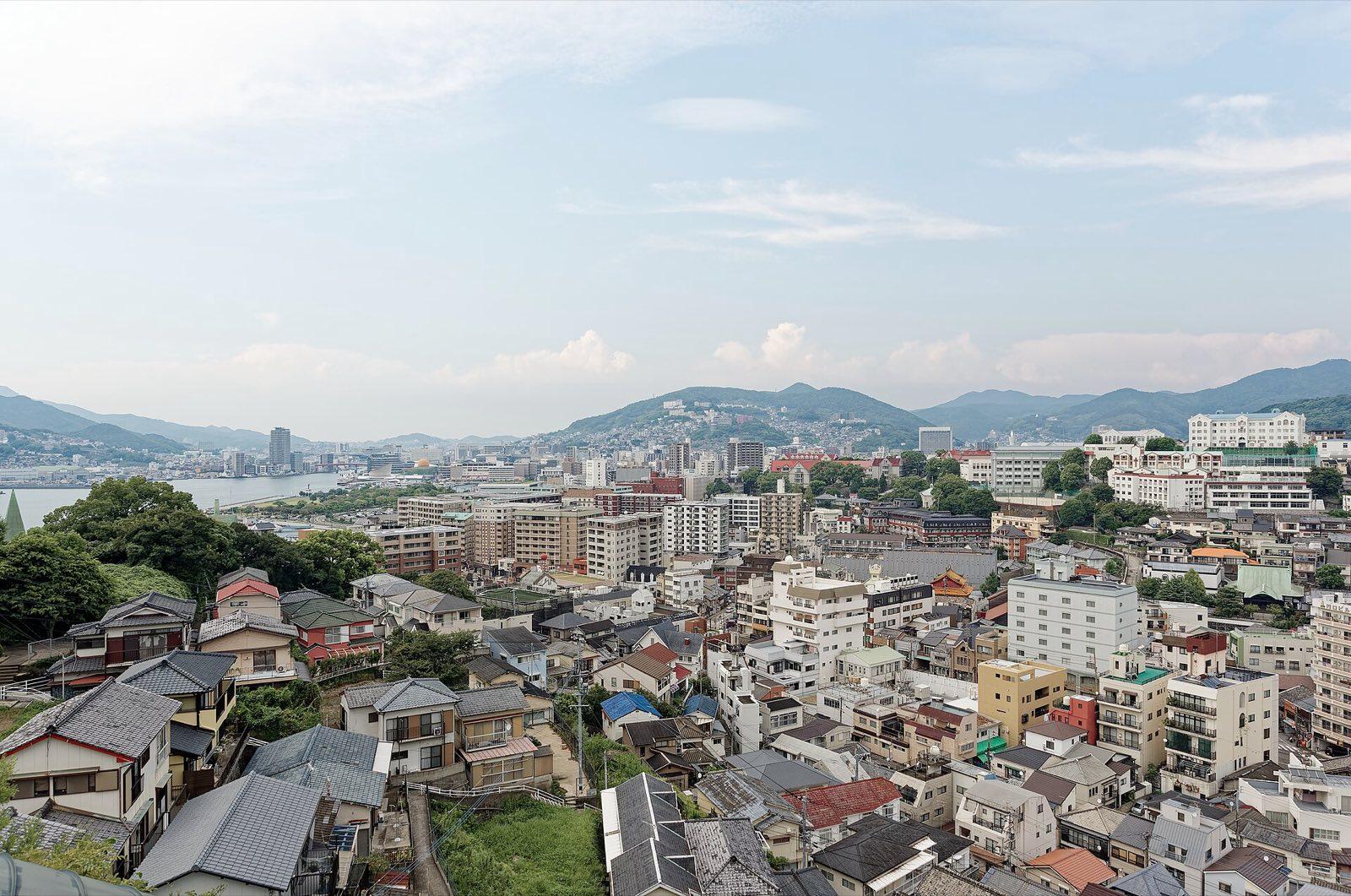
Nagasaki harbour from the Glover Sky Road, beside Glover Garden Photo: Jakub Hałun, CC BY 4.0, via Wikimedia Commons (https://commons.wikimedia.org/wiki/File:View_of_Nagasaki_from_the_Glover_Sky_Road,_20240814_1623_3497.jpg) Jour 5 : The Aso caldera, Yufuin and Beppu
Kurokawa Onsen to Daikanbo and Kusasenri, then the Yamanami Highway to Yufuin and Beppu
- Environ 4 h de route
- Petit-déjeuner et repas du midi
- Nuit : Beppu
Détail du jour 5
Before breakfast, walk the river path through Kurokawa while steam rises off the baths. Each guest has a nyuto tegata, the wooden pass that opens three of the village's open-air baths: use it this morning or keep it as a souvenir. Then we drive about 40 minutes to Daikanbo on the northern rim of the Aso caldera, one of the largest calderas on earth, where the five central peaks are said to look like a reclining Buddha. We cross the caldera floor to Kusasenri, a grass meadow with a pond below the cone of Eboshi-dake. If the volcano alert level and gas readings allow, we go up to the rim of Nakadake's crater; when it is closed, as it often is, we walk the meadow instead. Lunch is Aso akaushi beef, from the brown cattle raised on these grasslands. The afternoon drive follows the Yamanami Highway over the Kuju highlands to Yufuin, where you have an hour for Lake Kinrin and the lanes below Mount Yufu, then it is a short run down to Beppu by about 5 pm. The evening is free for the town's public baths.
Compris
- Nyuto tegata bath pass in Kurokawa
- Daikanbo viewpoint on the Aso caldera rim
- Kusasenri meadow, and the Nakadake crater rim when it is open
- Lunch of Aso akaushi beef
- Yufuin and Lake Kinrin
Option plus facile : Stay at the Kusasenri viewpoint and the Aso Volcano Museum instead of walking the meadow.
Option plus active : Climb Kishima-dake from Kusasenri, about an hour up and down, for a view into the active crater area.
Temps libre : Evening free in Beppu
Activité : Kusasenri sits at about 1,100 m and is often windy and cool; bring a warm layer.
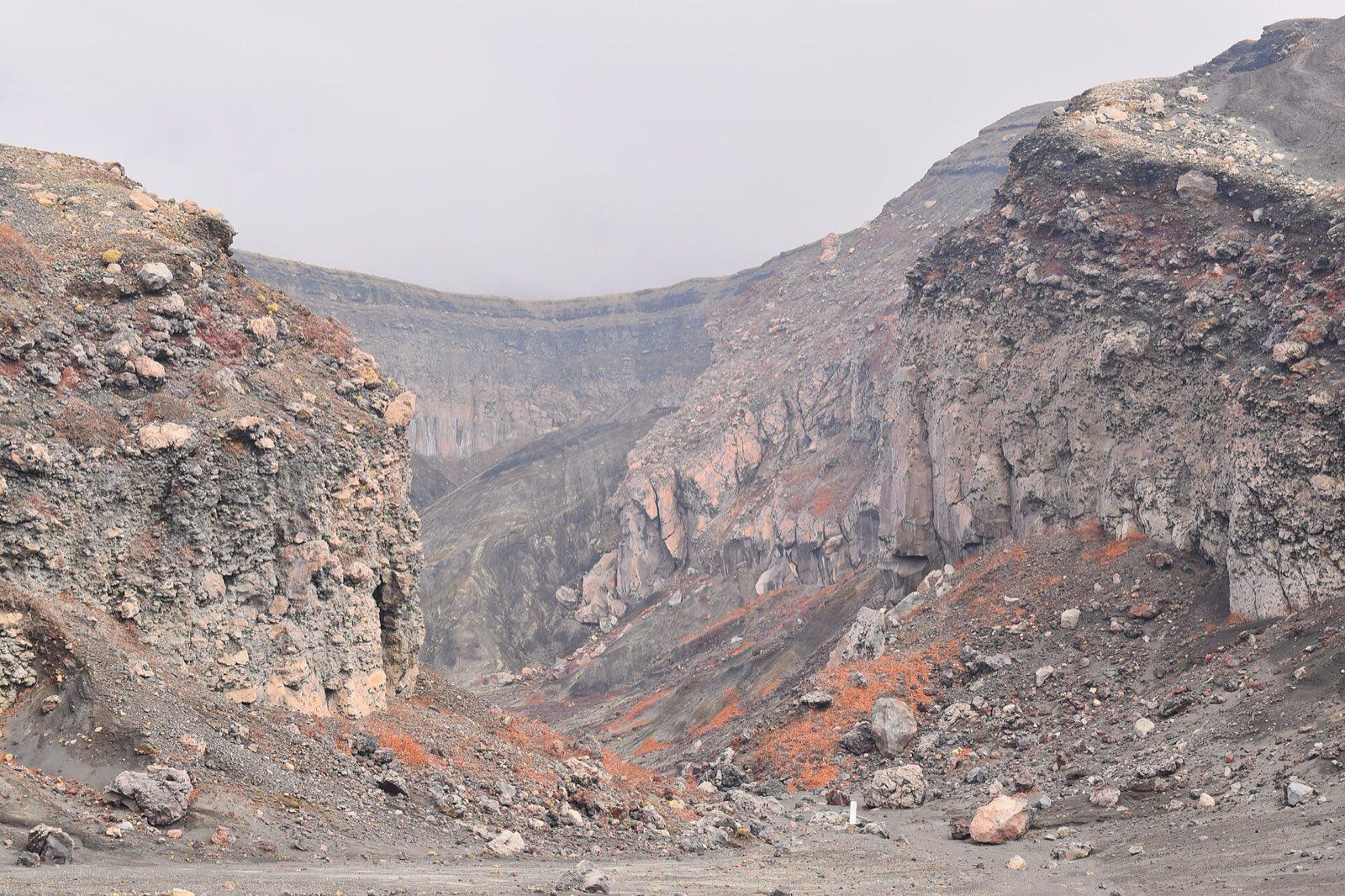
Volcanic rock on Mount Aso Photo: Raita Futo from Tokyo, Japan, CC BY 2.0, via Wikimedia Commons (https://commons.wikimedia.org/wiki/File:Mount_Aso_(49647955511).jpg) Jour 6 : Beppu's hells, then by train to Naoshima
Beppu by van, then train to Kokura, Okayama and Uno, and the ferry to Naoshima
- Environ 30 min de route
- Petit-déjeuner, repas du midi et repas du soir
- Nuit : Naoshima
Détail du jour 6
Beppu has more hot-spring sources than any other city in Japan, and in the Kannawa district steam drifts from drains, rooftops and garden walls. We are at the hells (jigoku) when they open at 8 am: Umi Jigoku, a cobalt-blue pond that is close to boiling, the bubbling grey mud of Oniishibozu Jigoku, and the red water of Chinoike Jigoku a short drive away. Then comes a jigoku-mushi lunch: we choose vegetables, seafood and eggs and cook them in baskets over the spring steam. Your suitcase leaves this morning by courier for the Kurashiki hotel; you carry a small bag for the islands. After lunch we take the train: the Sonic limited express up the coast to Kokura, about 1 hour 20 minutes, the Sanyo Shinkansen to Okayama, about 1 hour 40 minutes, and a local train to Uno port, with reserved seats on the long legs. This is the trip's one long travel day, about five hours door to door, because no road gets to the islands faster. A 20-minute ferry lands us on Naoshima in the evening, usually around 7 pm depending on the ferry timetable, and dinner together on the island is included.
Compris
- The Beppu hells at opening: Umi Jigoku, Oniishibozu Jigoku and Chinoike Jigoku
- Jigoku-mushi steam-cooked lunch in Kannawa
- Suitcase forwarding to Kurashiki
- Trains from Beppu to Uno, and the ferry to Naoshima
- Dinner on Naoshima
Activité : A long sitting day: about four hours on trains with two changes, which your guide manages. Snacks and drinks are easy to buy at the stations.
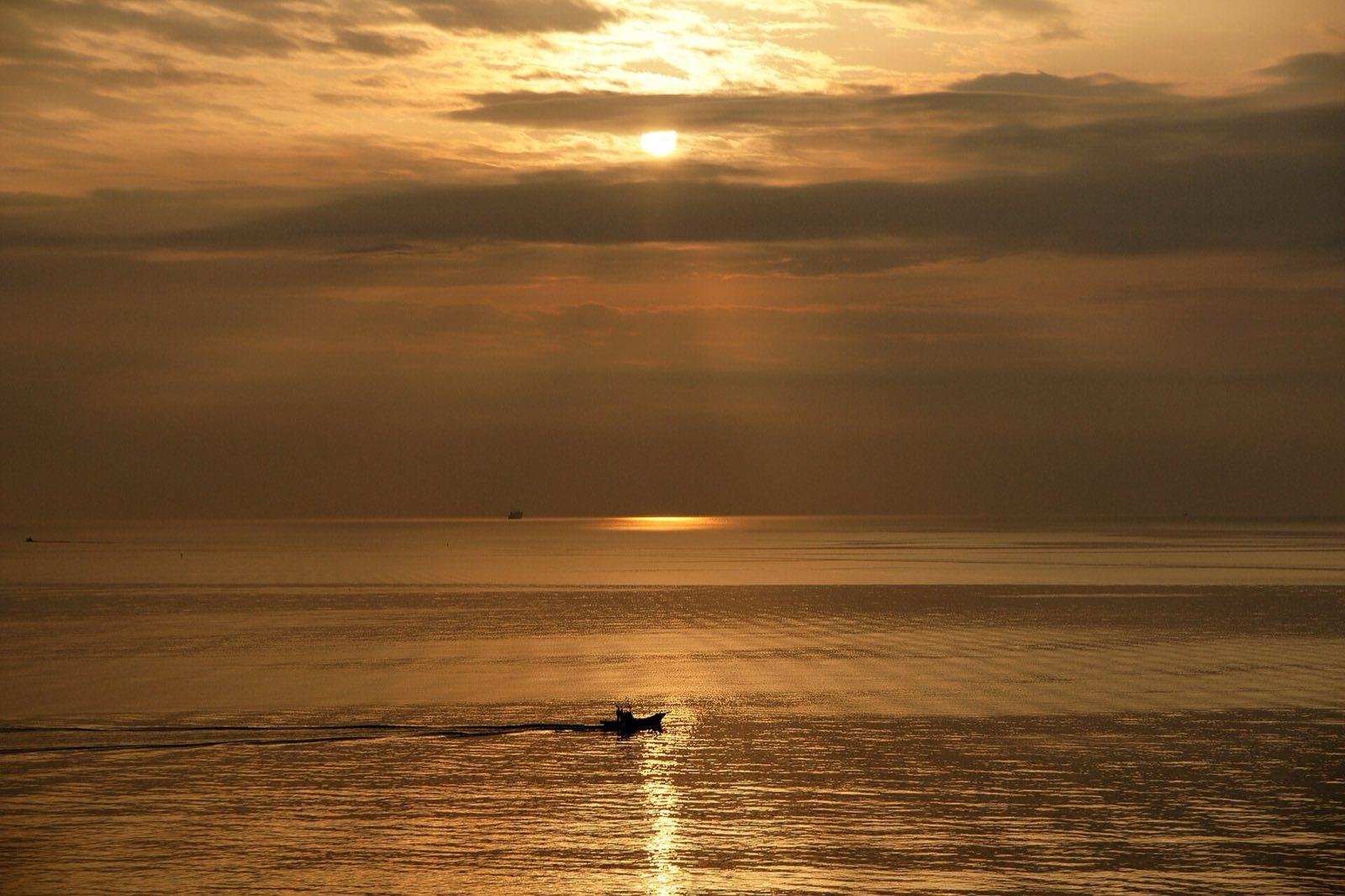
Morning sun over Beppu Bay Photo: 663highland, CC BY 2.5, via Wikimedia Commons (https://commons.wikimedia.org/wiki/File:Beppu_Bay02n4272.jpg) Jour 7 : A full day among Naoshima's museums
Around Naoshima: Chichu, the Benesse area and Honmura
- Petit-déjeuner et repas du soir
- Nuit : Naoshima
Détail du jour 7
Naoshima was an island of fishing and copper refining until the Benesse foundation began building art sites here in the late 1980s, many with the architect Tadao Ando. We start at the Chichu Art Museum, set into the hillside so most of it is underground, in our timed entry slot: Claude Monet's Water Lilies lit only by daylight, and rooms by James Turrell and Walter De Maria. Next is the Lee Ufan Museum, then Benesse House Museum on the bluff above the sea, and Yayoi Kusama's yellow Pumpkin on its pier, reinstalled in 2022 after a typhoon swept the first one away. Lunch is your choice at a cafe in Honmura. In the afternoon we walk Honmura, the old village around the town hall and the scalloped-roof post office, and its Art House Project, old houses and a shrine turned into installations, including Minamidera, a building by Ando for a work by Turrell that you enter in darkness. The late afternoon is free: rent a bike, sit on the beach, or soak in I Love Yu, the bathhouse by Shinro Ohtake by the port. Dinner together on the island.
Compris
- Chichu Art Museum, timed entry
- Lee Ufan Museum
- Benesse House Museum and the outdoor works along the shore, including Kusama's Pumpkin
- The Art House Project in Honmura, including Minamidera
- Island bus and shuttle fares
- Dinner on Naoshima
Activités en option
- I Love Yu bathhouse (paid locally)
- Bike hire (paid locally)
Option plus facile : Ride the island bus and the Benesse shuttle between every site.
Option plus active : Cycle between the museums by e-bike, about 15 km with some steep hills.
Temps libre : Lunch on your own in Honmura; late afternoon free
Activité : Most Naoshima museums close on Mondays, so departures are set so this day never falls on one.
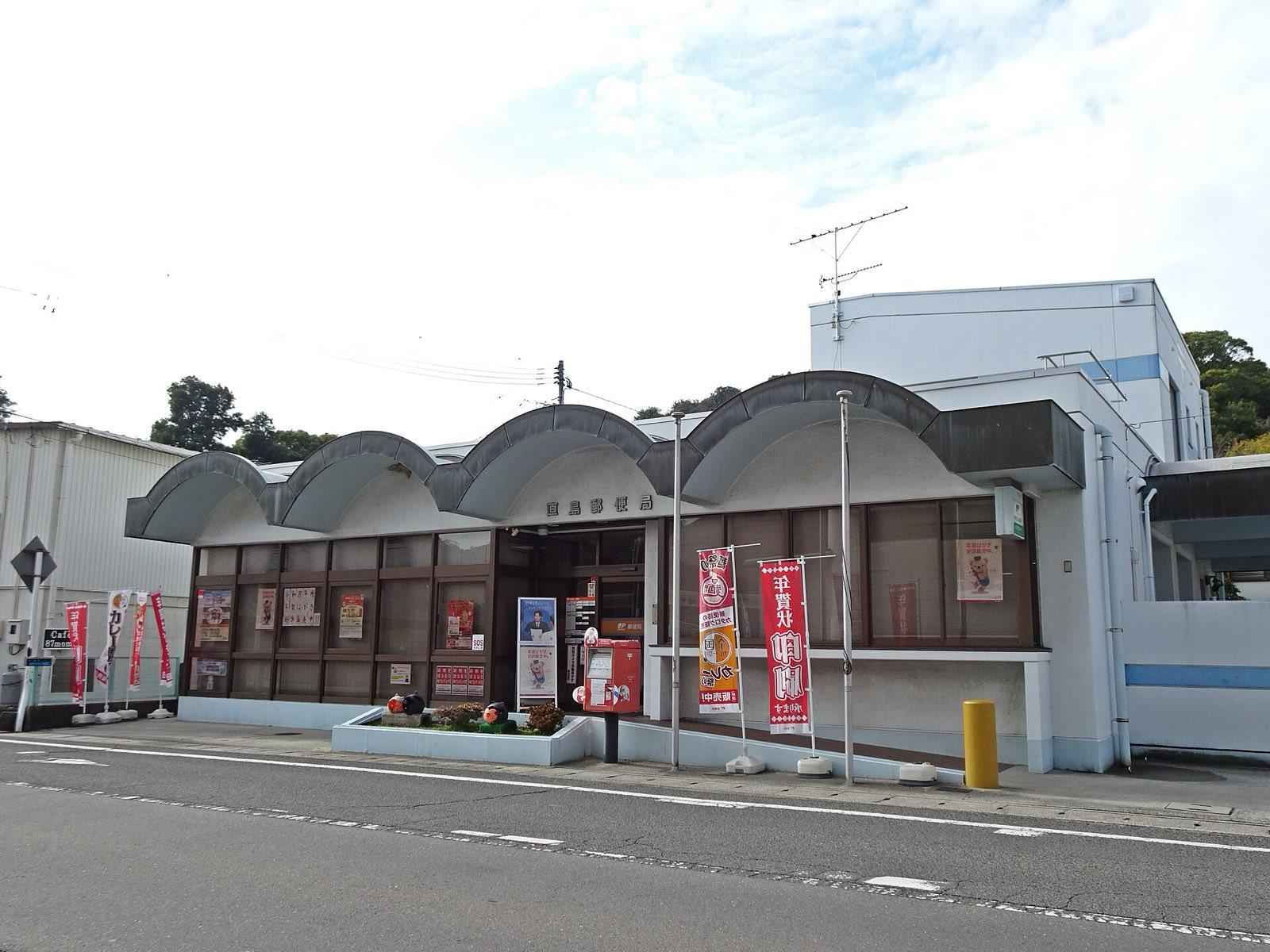
The post office in Honmura, where the afternoon walk begins Photo: ブルーノ・プラス, CC BY 4.0, via Wikimedia Commons (https://commons.wikimedia.org/wiki/File:Naoshima_post_office.jpg) Jour 8 : Teshima, then the canals of Kurashiki
Naoshima to Teshima by ferry, Teshima to Uno by ferry, then van to Kurashiki
- Environ 1 h de route
- Petit-déjeuner et repas du midi
- Nuit : Kurashiki
Détail du jour 8
A morning ferry takes us to Teshima, a greener and quieter island of rice terraces, springs and small fishing ports. From Ieura port we go by island bus up to the terraces above Karato for the Teshima Art Museum, by the architect Ryue Nishizawa and the artist Rei Naito: one low concrete shell with no columns and two open oval holes in its roof, under which water rises from the floor and runs in beads. Entry is on timed tickets, and it is a place for silence, so we take it slowly. Lunch is at an island cafe cooking with Teshima produce. Down on the shore at Karato, Les Archives du Coeur, by Christian Boltanski, keeps recordings of tens of thousands of heartbeats from around the world; you can listen, and record your own. In the mid-afternoon a ferry runs from Ieura straight to Uno port, where the van waits for the hour's drive to Kurashiki. The evening is free in the Bikan quarter, where willows line the canal and the old storehouses are lit after dark.
Compris
- Ferries from Naoshima to Teshima and from Teshima to Uno
- Teshima Art Museum, timed entry
- Les Archives du Coeur
- Lunch on Teshima
- Van from Uno to Kurashiki
Activités en option
- Record your own heartbeat at Les Archives du Coeur (paid locally)
Option plus facile : Stay on the island bus between Ieura, the art museum and Karato.
Option plus active : Ride an e-bike from Ieura over the hill to the art museum, about 5 km with a long climb.
Temps libre : Evening free in Kurashiki
Activité : Teshima Art Museum closes on Tuesdays from March to November, so departures avoid a Tuesday here.
Jour 9 : Kurashiki early, Korakuen and on to Osaka
Kurashiki to Okayama by van, then the Shinkansen to Osaka
- Environ 30 min de route
- Petit-déjeuner et repas du soir
- Nuit : Osaka
Détail du jour 9
Kurashiki's Bikan historical quarter is at its best before about 9 am, before the tour buses: white-walled storehouses with black tiles, the willow-lined canal and stone bridges, and nobody in the frame. At 9 we are at the Ohara Museum of Art, the first museum of Western art in Japan, opened in 1930 by a local textile industrialist, with paintings by El Greco, Monet and Gauguin. Mid-morning the van takes us about 30 minutes to Okayama for Korakuen, one of the Three Great Gardens of Japan, laid out for the lords of Okayama around 1700, with lawns, tea houses and the black keep of Okayama Castle borrowed into the view across the river. Lunch is your choice near the station; Okayama is known for its fruit and its barazushi. Then the Sanyo Shinkansen to Shin-Osaka, about 45 minutes, with your suitcase in seats reserved with the oversized-baggage space. The afternoon is free in Osaka. In the evening we walk to Dotonbori and Hozenji Yokocho for a farewell dinner of Osaka street food: takoyaki, okonomiyaki and kushikatsu.
Compris
- Early walk through the Kurashiki Bikan historical quarter
- Ohara Museum of Art
- Korakuen garden in Okayama
- Sanyo Shinkansen from Okayama to Shin-Osaka
- Farewell street-food dinner in Dotonbori
Temps libre : Lunch on your own in Okayama; afternoon free in Osaka
Activité : The Ohara Museum closes on Mondays, so departures avoid a Monday here.
Jour 10 : Osaka and home
Osaka to Kansai International Airport
- Environ 1 h de route
- Petit-déjeuner
Détail du jour 10
The trip ends after breakfast. If your flight leaves in the afternoon, the morning is yours: Kuromon Market for a last plate of sushi or grilled scallops, the grounds of Osaka Castle, or a walk through the shopping arcades of Shinsaibashi. Your guide checks your flight time the evening before and arranges your transfer: Kansai International Airport (KIX) is about an hour by road, and Osaka Itami (ITM), for flights within Japan, is about 30 minutes. If you are staying on, Kyoto is about 15 minutes from Shin-Osaka by shinkansen, and you can ask us about pairing this trip with our Hiroshima, Kyoto, Osaka and Kanazawa trip for a longer journey through southern and central Japan. Hotels can hold your bags after checkout if your flight is late in the day. We recommend booking a flight home that leaves after about 1 pm.
Compris
- Drop-off at Kansai International Airport (KIX) or Osaka Itami (ITM)
Temps libre : Morning free
Activité : Book a flight leaving after about 1 pm to enjoy the free morning.
Faune et météo : Spring and autumn are mild and mostly dry. Kyushu's rainy season runs from about late May or early June to mid-July, summer is hot and humid, and typhoons from August to October can cancel Inland Sea ferries and close roads on Aso. Aso and Kurokawa are cold in winter, with snow some years. The Nakadake crater rim closes whenever volcanic gas or the alert level rises, at any time of year.
9 nuits
Où vous logerez
Vos hôtels sont nommés dans la confirmation de votre voyage.
- Fukuoka2 nuits
- Nagasaki1 nuit
- Kurokawa Onsen1 nuit
- Beppu1 nuit
- Naoshima2 nuits
- Kurashiki1 nuit
- Osaka1 nuit
Un seul prix
Ce que le prix comprend
Compris
Hébergement
- 9 nights: 2 in Fukuoka near Hakata Station, 1 in central Nagasaki, 1 in a ryokan in Kurokawa Onsen, 1 in Beppu, 2 on Naoshima, 1 in Kurashiki near the Bikan quarter, 1 in Osaka near Namba
- Hotels of at least a 3-star-plus standard, named when we confirm your dates
- Rooms shared, or your own for a supplement
Transport
- Pick-up at Fukuoka Airport (FUK)
- Nishitetsu train to Dazaifu and back
- Our own vehicle and driver across Kyushu from day 3 to day 6, carrying your suitcase
- Reserved seats on the Sonic limited express from Beppu to Kokura and the Sanyo Shinkansen from Kokura to Okayama, and the train to Uno
- Ferries from Uno to Naoshima, Naoshima to Teshima and Teshima to Uno
- Island buses and the Benesse shuttle on Naoshima and Teshima
- Suitcase forwarding from Beppu to Kurashiki
- A private vehicle from Uno to Kurashiki on day 8 and from Kurashiki to Okayama on day 9
- Reserved seats on the Sanyo Shinkansen from Okayama to Shin-Osaka
- Drop-off at Kansai International Airport (KIX) or Osaka Itami (ITM)
Votre guide
- A See Sight Tours guide with the group from the first evening in Fukuoka to the last morning in Osaka
- A local peace guide in Nagasaki
Activités
- Dazaifu: Dazaifu Tenmangu
- Fukuoka: evening walk through Kushida Shrine and old Hakata to the Nakasu yatai
- Nagasaki: Atomic Bomb Museum, the hypocentre and the Peace Park, Dejima, Glover Garden and Oura Church
- Kumamoto: Kumamoto Castle
- Kurokawa Onsen: the ryokan baths and a nyuto tegata pass to three open-air baths
- Aso: Daikanbo, Kusasenri and the Nakadake crater rim when open
- Yufuin: Lake Kinrin
- Beppu: the hells (Umi, Oniishibozu and Chinoike Jigoku)
- Naoshima: Chichu Art Museum, Lee Ufan Museum, Benesse House Museum and the Art House Project
- Teshima: Teshima Art Museum and Les Archives du Coeur
- Kurashiki: the Bikan quarter and the Ohara Museum of Art
- Okayama: Korakuen garden
- All entrance fees for included sights, with timed tickets booked for you
Repas
- All 9 breakfasts
- 5 lunches: champon in Nagasaki, lunch in Kumamoto, Aso akaushi beef, a jigoku-mushi steam lunch in Beppu and an island lunch on Teshima
- 6 dinners: a welcome mizutaki dinner in Fukuoka, a yatai evening, a kaiseki dinner at the ryokan, two dinners on Naoshima and a farewell street-food dinner in Osaka
Non compris
- International flights to Fukuoka and home from Osaka
- Visa or travel authorisation fees, if your passport needs one
- Travel insurance
- Lunches on days 2, 7, 9 and 10, and dinners in Nagasaki, Beppu and Kurashiki
- Drinks
- Tips (not expected in Japan)
- Optional activities: the Mount Inasa ropeway, the Kyushu National Museum, recording your heartbeat at Les Archives du Coeur, the I Love Yu bathhouse and bike hire
- Personal expenses
Suppléments
- Chambre individuelle
- CAD 1,295 (prix estimé)

See Sight Tours offre des services de voyage partout en Amérique du Nord depuis 2006. Présente dans 20 villes au Canada et aux États-Unis, l'entreprise se spécialise dans les tours en petit groupe qui offrent des expériences personnalisées et de grande qualité aux voyageurs.


Liens rapides
Réservez votre tour
Communiquez avec nous
- Sans frais1-888-961-6584
- Local1-289-271-9767
- Courrielinfo@seesight-tours.com


© 2026 See Sight Tours. Tous droits réservés.