Cornelius Amann
October 06, 2026

5/5
15 days from Kathmandu: two acclimatisation days, a night at Tengboche for the evening light, Everest Base Camp and Kala Patthar at sunrise, with every trek meal and a backup for the Lukla flights included.
15 days · Round trip from Kathmandu · up to 12 guests
Everest and Nuptse above the Khumbu Glacier, from the Kala Patthar side Photo: Vyacheslav Argenberg, CC BY 4.0, via Wikimedia Commons (https://commons.wikimedia.org/wiki/File:Everest,_Nuptse,_Khumbu_Glacier,_Nepal,_Himalayas.jpg)
The facts
Active
Eleven trekking days of 3 to 8 hours on rough mountain trails at 2,600 to 5,550 metres, with steep climbs, long descents and cold nights. No climbing skills are needed. The Kathmandu days are easy.
Highlights
Free time and choices are marked on the days they fall.
A room of your own is + CAD 350.
Day by day
Tap any stop on the map to open that dayClick any stop on the map to open that day
Tribhuvan International Airport to your hotel
Welcome to Nepal. We meet you at Tribhuvan International Airport in Kathmandu and drive you to your hotel, your base for the first two nights.
Evening
Kathmandu sits at about 1,400 metres, low enough that you will sleep well tonight. In the early evening your See Sight Tours guide hosts a welcome dinner for the group and walks you through the trek: how the days run, what goes in your duffel and what stays in the hotel storeroom, how we watch for altitude sickness and what happens if the Lukla flights are held by weather. Bring your boots, layers and anything you are unsure about, and we start the gear check tonight so tomorrow is unhurried. If your flight lands late, your guide repeats the briefing over breakfast.
Included
Free time: Afternoon free until the welcome dinner
Swayambhunath and Pashupatinath, or the drive to Ramechhap
A gentle day to get over the flight and settle every detail before the mountains. We start early at Swayambhunath, the hilltop stupa west of the city, while monks and the first pilgrims are turning the prayer wheels and the light is soft across the valley. Then on to Pashupatinath on the Bagmati River, Nepal's most important Hindu temple. Only Hindus may enter the main temple, so we watch the riverside cremation ghats from the east bank while a local guide explains the rites.
Afternoon
The afternoon is for the gear check with your guide: your duffel, the sleeping bag and down jacket we lend you, and anything you still need to rent or buy in Thamel.
Evening
In the busiest months, when Lukla flights leave from Ramechhap instead of Kathmandu, today changes: we drive after breakfast to Manthali and sleep near the airport, so you are not on the road in the middle of the night.
Included
Free time: Afternoon free after the gear check
Activity: When flights leave from Ramechhap, the day is the road transfer to Manthali instead: about 130 km, normally 5 to 6 hours and longer while the road is under repair, and the night is near the airport.
Kathmandu or Ramechhap to Lukla by plane, then on foot to Phakding
Morning
An early start for the flight to Lukla, about 35 minutes over the foothills from Kathmandu or about 20 minutes from Ramechhap, with the snow peaks along the left side of the plane on a clear morning. Lukla's Tenzing-Hillary Airport has a short runway that slopes uphill into the mountain, and planes only fly in good visibility, which is why we book the first morning departures. On the ground you meet the porters, who carry your duffel from here on, and we set off down the valley. The first walk is short and mostly downhill: about 8 kilometres and 3 to 4 hours through Chheplung and small farms to Phakding, beside the Dudh Koshi river. Pass the carved mani stones on their left, as the Sherpa do.
Evening
Sleeping at 2,610 metres, a little lower than Lukla, makes a good first night for your body.
Included
Activity: About 8 km and 3 to 4 hours on foot, mostly downhill.
Phakding to Namche Bazaar over the Hillary Suspension Bridge
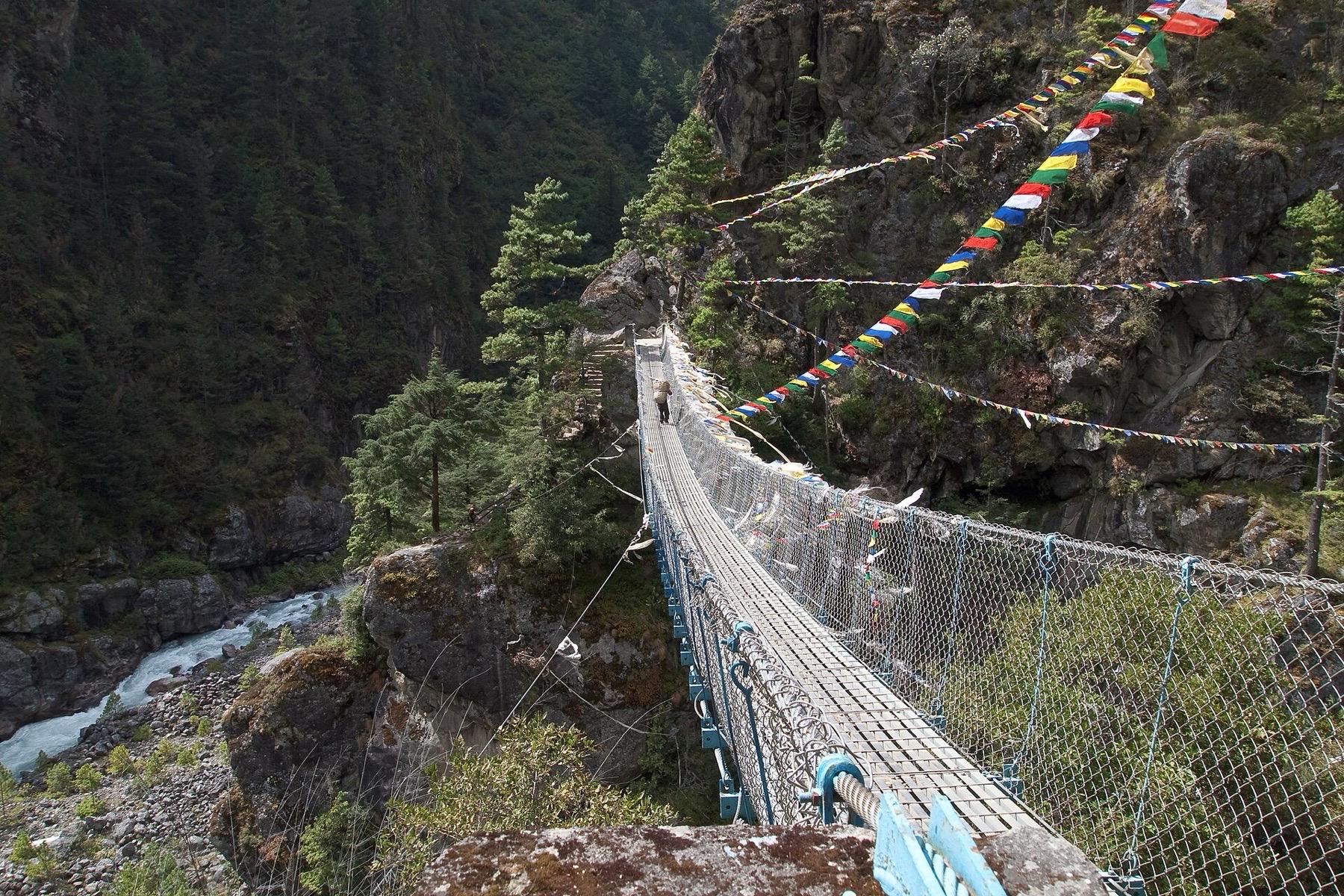
We leave Phakding early so we reach the suspension bridges before the main stream of groups. The trail follows the Dudh Koshi upstream through pine forest, crossing the milky river several times on swaying bridges strung with prayer flags, past Benkar and its waterfall to Monjo, where rangers check your permit at the Sagarmatha National Park gate.
Afternoon
After lunch at Jorsale the real climb begins. The high Hillary Suspension Bridge spans the gorge where the Bhote Koshi meets the Dudh Koshi, and from there the path zigzags about 600 metres up through the forest. On a clear day a viewpoint partway up gives your first look at the summit of Everest, far off above the Nuptse and Lhotse ridge. About 10 kilometres and 6 hours in all, ending in Namche Bazaar, the Sherpa trading town built into a horseshoe-shaped bowl at 3,440 metres.
Included
Activity: About 10 km and 6 hours on foot, with a climb of about 800 m over the day.
Sunrise ridge, Hotel Everest View and Khumjung
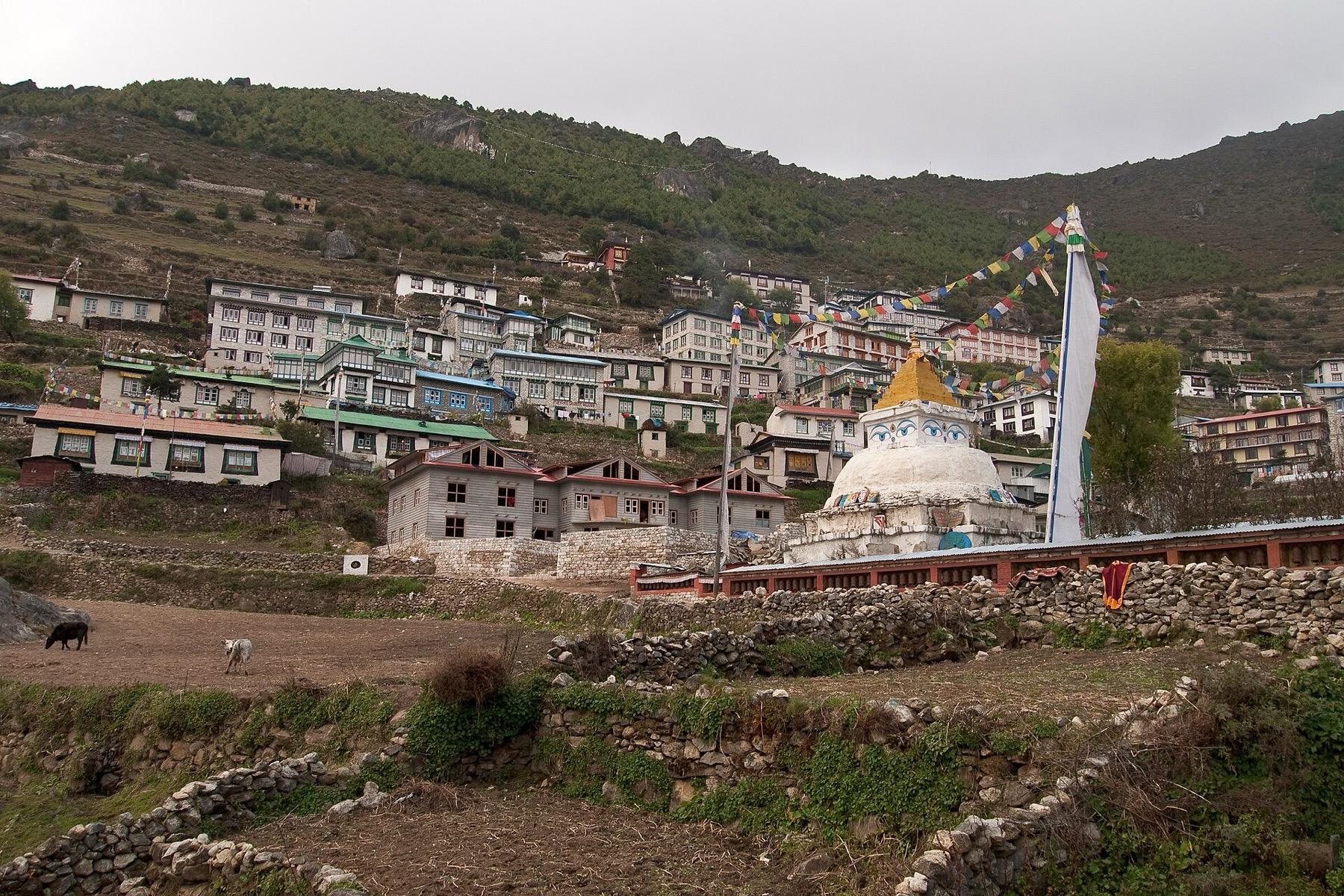
A rest day that is not spent resting: climbing high and sleeping low is the best way to acclimatise.
Morning
Before breakfast we walk up to the ridge above town by the national park visitor centre, where first light reaches Everest, Lhotse, Ama Dablam and Thamserku while Namche is still in shadow. After breakfast we climb past the Syangboche airstrip to the terrace of the Hotel Everest View, at about 3,880 metres, for tea with one of the classic views of the range, then drop down to Khumjung, a farming village of stone houses where Sir Edmund Hillary opened his first school in 1961.
Afternoon
Back in Namche by early afternoon, the rest of the day is yours for the bakeries, the Sherpa Culture Museum or a hot shower. On Saturday mornings porters and traders from the lower valleys fill the weekly market.
Included
Easier option: Stop at the sunrise ridge and spend the rest of the day in Namche.
Free time: Afternoon free in Namche
Activity: About 4 to 5 hours on foot, up to about 3,880 m and back to 3,440 m.
Namche Bazaar to Tengboche via Kyangjuma and Phunki Thenga
Morning
From Namche a contour path swings around the hillside to Kyangjuma with Ama Dablam ahead for most of the morning. Watch the slopes for Himalayan tahr and, in the forest, the Himalayan monal, Nepal's national bird, with its rainbow feathers.
Afternoon
The trail then drops to the river at Phunki Thenga for lunch before a steady climb of about 600 metres through pine and rhododendron to Tengboche, at 3,860 metres; in April the rhododendrons flower here. Many groups stop at Tengboche for an hour.
Evening
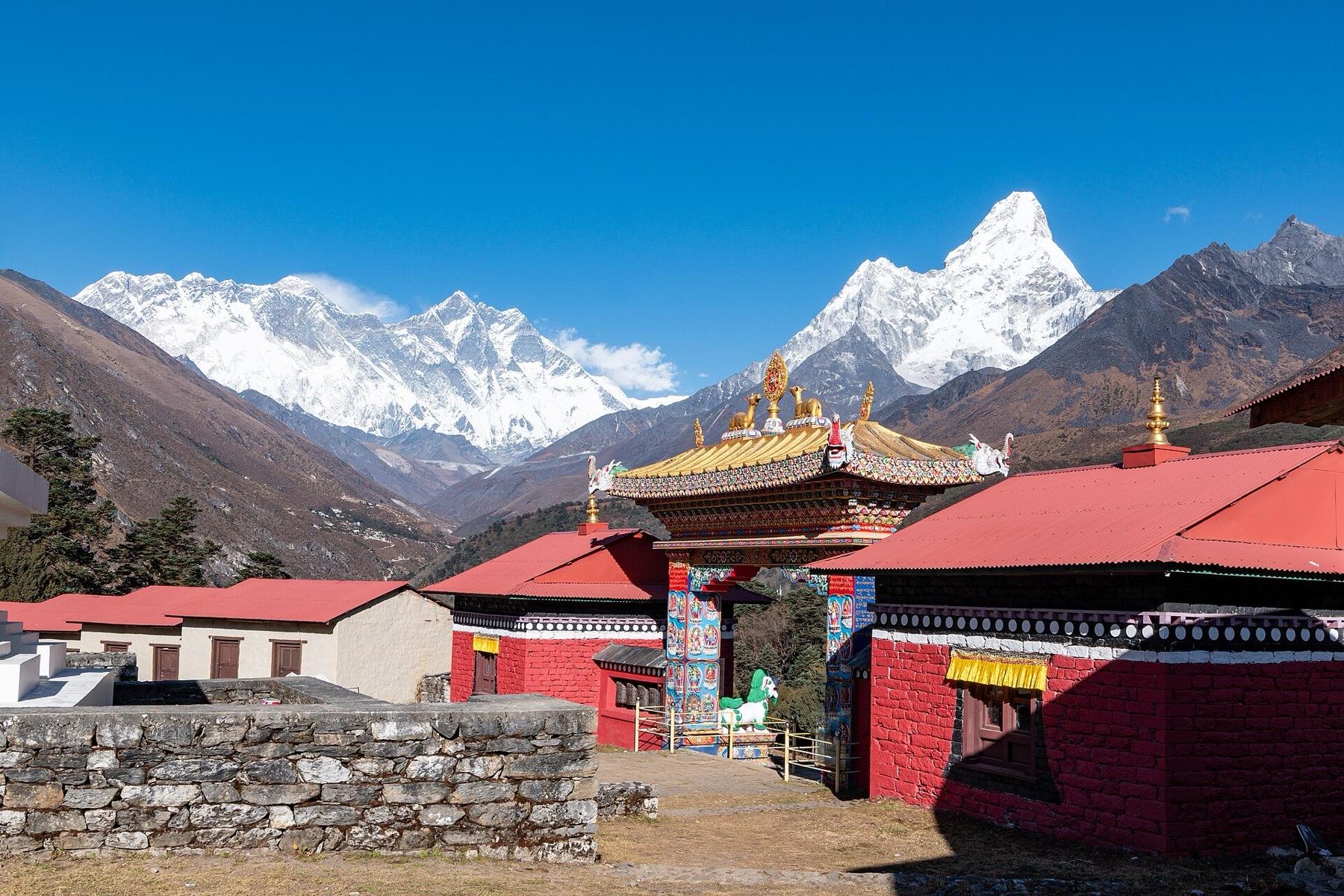
We stay the night, because the reason to come is the light. Tengboche Monastery, the largest in the Khumbu, was rebuilt after a fire in 1989, and when the doors are open you can sit quietly at the back during prayers. In the last hour of sun, Ama Dablam and the top of Everest turn gold from the monastery grounds, and you see them again at dawn. About 10 kilometres, 5 to 6 hours.
Included
Your choice: Via Tengboche / Via Phortse Included in the price.
Activity: About 10 km and 5 to 6 hours on foot.
Tengboche to Dingboche via Deboche and Pangboche
Morning
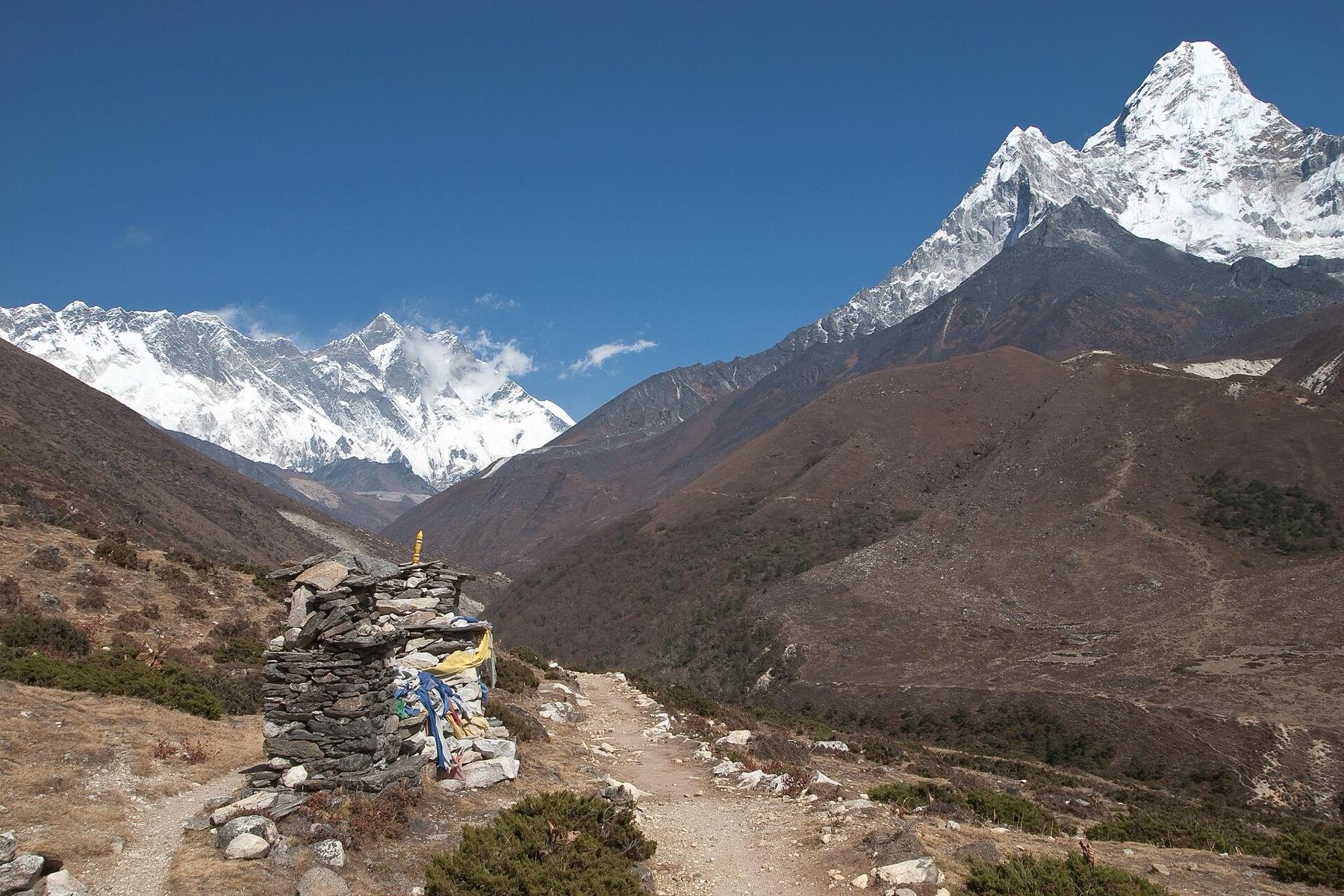
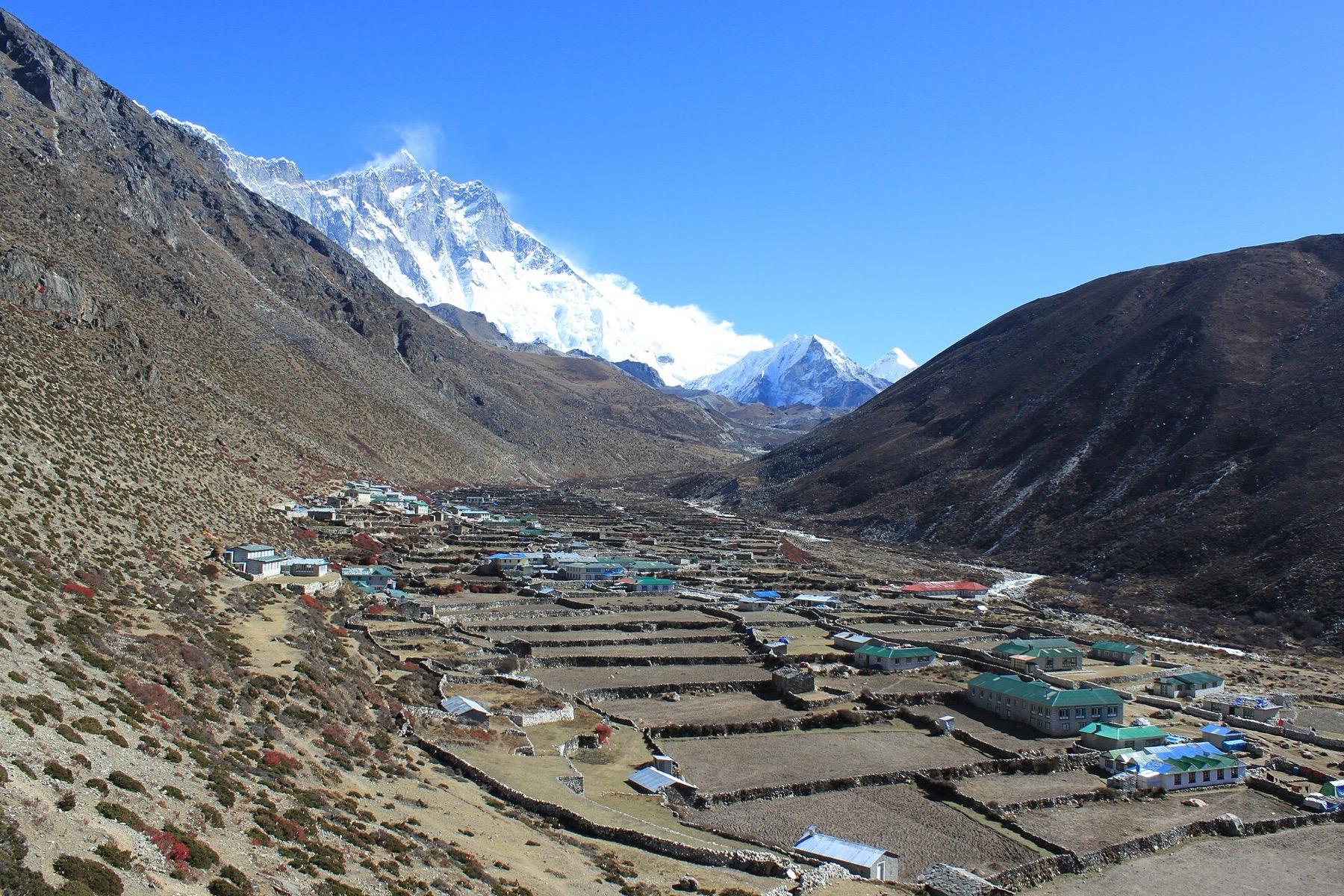
Wake for first light on Ama Dablam, which rises above the monastery, before breakfast. The trail drops through forest to Deboche, crosses the Imja Khola on a bridge above a narrow gorge and climbs to Pangboche, a Sherpa village whose small gompa is often called the oldest in the Khumbu. The trees thin out above here. We walk up the open Imja valley, past yak pastures and stone walls, with Ama Dablam now on our right and Island Peak and Lhotse ahead, to Dingboche at 4,410 metres. The village is a patchwork of fields walled with stone to keep the wind and the yaks off the barley and potatoes. About 11 kilometres and 5 to 6 hours.
Evening
From tonight your guide checks everyone's oxygen level and pulse each evening with a pulse oximeter, so small changes are noticed early and talked about openly.
Included
Activity: About 11 km and 5 to 6 hours on foot.
Acclimatisation hike above Dingboche
Evening
A second night at the same height is part of a safe plan, and the best morning view of the week is right behind the lodge. After breakfast we climb the Nangkartshang ridge above the village, slowly, at the pace of the slowest walker. Even the first chorten gives a view down the valley to Ama Dablam. Higher up, at 4,700 to about 5,000 metres depending on how the group feels, Makalu, the fifth-highest mountain in the world, appears to the east, with the south face of Lhotse, Island Peak and the Imja valley close by. We are back in Dingboche for lunch. The afternoon is free to rest, read, sort your kit and charge your batteries, and to keep drinking water. If anyone prefers an easier morning, the second guide stays lower with them at the chorten while the others carry on.
Included
Easier option: Walk to the first chorten above the village with the second guide, about 2 hours.
Free time: Afternoon free in Dingboche
Activity: About 4 to 5 hours on foot, up to between 4,700 and 5,000 m and back to 4,410 m.
Dingboche to Lobuche via Dughla and the Thukla Pass
A short day by distance, walked slowly because of the height.
Afternoon
The trail climbs above Dingboche onto the open shelf over the Pheriche valley, with wide views back to Ama Dablam and Taboche, then drops a little to Dughla, also called Thukla, for an early lunch beside the stream that flows out of the Khumbu Glacier. After lunch comes a steep climb of about 200 metres up the glacier's end moraine to the Thukla Pass, where rows of stone memorials and prayer flags remember climbers and Sherpas who died on Everest, among them Scott Fischer and Babu Chiri Sherpa. It is a quiet place and we take our time. Lobuche, at 4,940 metres, is a short walk on beside the glacier. About 8 kilometres and 5 hours.
Evening
The afternoon is for rest, a warm drink and an early dinner.
Included
Free time: Afternoon free to rest
Activity: About 8 km and 5 hours on foot.
Lobuche to Gorak Shep, then Everest Base Camp and back
The big day, timed to get the best of it. We leave Lobuche early and follow the side moraine of the Khumbu Glacier, over rocky ground with Pumori ahead, to Gorak Shep, a frozen sand flat at 5,164 metres where the last lodges stand: about 2 to 3 hours.
Afternoon
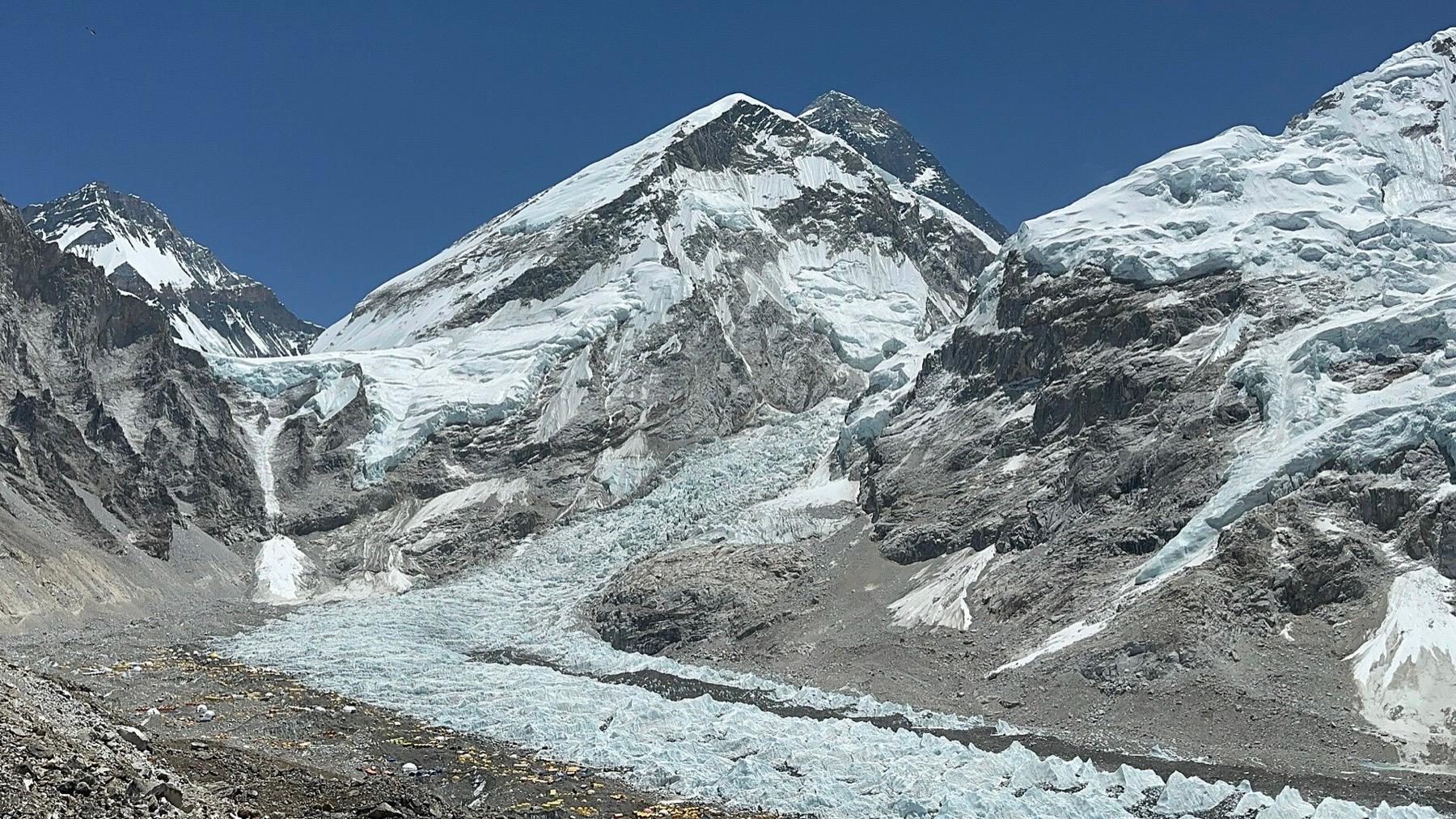
We leave everything but water, layers and cameras at the lodge, eat an early lunch and walk on along the moraine and onto the glacier to Everest Base Camp, at about 5,364 metres, arriving around the middle of the day as the morning crowd heads back. Know this before you go: you cannot see the summit of Everest from base camp, because Nuptse is in the way. What you see is the Khumbu Icefall spilling down between the peaks and, in April and May, the yellow tents of the climbing expeditions. The walk there and back takes 4 to 5 hours.
Evening
Tonight is the highest and coldest night of the trip.
Included
Your choice: Sunrise on day 11 / Late afternoon on day 10 Included in the price.
Activity: About 12 km and 7 to 8 hours on foot in all, at 4,940 to 5,364 m.
Kala Patthar, then Gorak Shep to Pheriche
Head torches on at about 4:30 am. The climb up Kala Patthar, the brown hill above Gorak Shep at about 5,550 metres, takes 1.5 to 2 hours, slowly, in the cold. This is where you see Everest properly: the dark summit pyramid above the Nuptse ridge, the Khumbu Icefall and the glacier below, and Pumori rising straight behind you.
Morning
The sun comes up behind Everest, so the first light lands on Pumori and Nuptse while Everest stands in silhouette, and then the whole basin fills with light. Keep spare camera batteries in an inside pocket, because the cold drains them fast. We aim to leave 30 to 45 minutes ahead of the main crowd. Back at Gorak Shep for a late breakfast, then down past Lobuche and Dughla to Pheriche, at about 4,370 metres, where the air feels thick again.
Afternoon
In season, the Himalayan Rescue Association aid post here gives an afternoon talk on altitude.
Included
Easier option: Skip Kala Patthar, sleep in and start down after breakfast with the second guide.
Activity: A long day of 7 to 8 hours on foot: about 2 hours up Kala Patthar, then about 12 km, almost all downhill.
Pheriche to Namche Bazaar via Pangboche and Tengboche
An easier rhythm now that the air is richer.
Afternoon
We walk down the Pheriche valley to Pangboche and through the forest to Tengboche, where we stop for lunch and a last look at the monastery with Ama Dablam behind it. From Tengboche the trail drops steeply to Phunki Thenga on the river, climbs back up through the forest below Kyangjuma and contours around to Namche, on slopes that now feel familiar. Many trekkers notice how much easier this ground feels than it did on the way up. It is a long day, about 19 kilometres and 6 to 7 hours, but mostly downhill, with the one climb above the river after lunch.
Evening
Back in Namche, the bakeries, a hot shower and a bed at 3,440 metres feel very good, and the evening is free.
Included
Free time: Evening free in Namche
Activity: About 19 km and 6 to 7 hours on foot, mostly downhill.
Namche Bazaar to Lukla along the Dudh Koshi
The last day on foot. From Namche the trail drops down the long hill to the Hillary Suspension Bridge and follows the Dudh Koshi back through Jorsale, Monjo and Phakding, past the same mani stones and waterfalls, now seen in the opposite light. The final hour climbs back up to Lukla, slow and steady at the end of a long day: about 19 kilometres and 6 to 7 hours.
Evening
In the evening we sit down to dinner with the porters and the trek crew, the people who carried your duffel over every kilometre, and this is the moment for their tips, which we explain in the pre-trip notes so you can plan the amount. Your guide confirms tomorrow's early flight and the time to be at the airport, and checks the forecast with the airline.
Included
Activity: About 19 km and 6 to 7 hours on foot, with a climb of about 300 m at the end.
Lukla to Kathmandu or Ramechhap by plane, then Boudhanath
Morning
We take the first flights of the morning back to Kathmandu, when the skies are usually clearest. This is the day the trip is built to protect. If cloud holds the planes in Lukla, we wait together and fly as soon as they run; if planes stay grounded but helicopters can fly, we move you by shared helicopter at our cost, so a weather day does not cost you money or your flight home.
Afternoon
If the flight lands at Ramechhap, we drive back to Kathmandu and the afternoon becomes the drive. Otherwise the afternoon is free for a long shower and a rest.
Evening
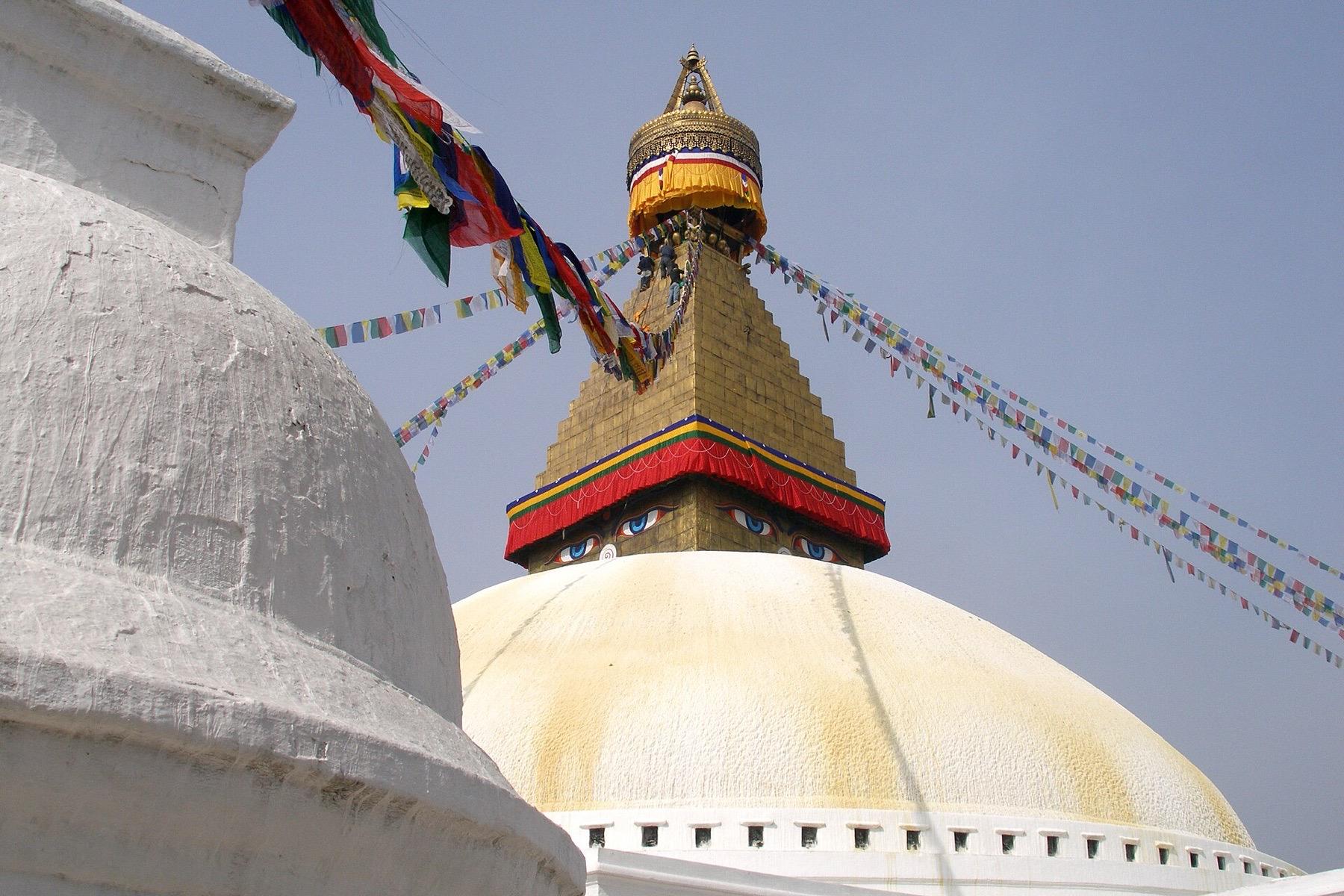
At dusk we walk around Boudhanath, one of the largest stupas in the world, with Tibetan pilgrims turning the prayer wheels and butter lamps lit around its base. The trip ends with a farewell dinner together.
Included
Free time: Afternoon free
Your hotel to Tribhuvan International Airport
Morning
A free morning in Kathmandu after a slow breakfast. Walk to a café in Thamel, buy the singing bowl or pashmina you looked at on day 2, or take a taxi to Patan Durbar Square, the old royal square of temples and courtyards south of the river. We drop you at Tribhuvan International Airport in time for your flight home.
Evening
Because Lukla flights depend on the weather, we ask you to book your flight home for the afternoon or evening of day 15 or later, ideally on a ticket you can change. If weather held your return from Lukla, this is the day that absorbs it. If you would like more time in Nepal, we can add hotel nights before or after the trek, or a few days in Pokhara or Chitwan National Park.
Included
Free time: Morning free
Wildlife and weather: October and November usually bring the clearest skies; spring is warmer, with rhododendrons in flower below Tengboche and expedition tents at base camp. Mountain weather changes fast in every season, which is why the plan keeps a spare day.
Before you book
Book flights after we confirm your seat.
14 nights
Your hotels are named in your trip confirmation.
One price
When you can go
Pick your start date when you request to book. We confirm your departure within 24 hours.
Want your own dates? We can book the same hotels, transport and city tours for you to travel independently.
Before you book
Nothing is charged now. Full terms and the cancellation schedule come with your confirmation.
Business addresses
See Sight Tours Trips (USA): 3172 N Rainbow Blvd, Las Vegas, NV 89108, United StatesSee Sight Tours Trips (Canada): 5305 50 Avenue, #1091, Red Deer, AB T4N 4B6, Canada+1-888-961-6584Guest reviews
Reviews from guests on our day tours.
5/5

5/5
5/5

5/5
5/5
5/5
Good to know
Fourteen nights: three in a Kathmandu hotel and eleven in teahouse lodges on the trek. Return flights to Lukla, airport transfers, the Ramechhap road transfer when flights leave from there, a shared helicopter if planes are grounded, your national park and local permits, every trek meal with drinking water, charging and hot showers where lodges have them, a borrowed sleeping bag and down jacket, porters, a licensed Nepali trek leader, three Kathmandu temples, two dinners and your See Sight Tours guide throughout.
Flights to and from Lukla only run in good visibility, so delays happen in every season. On the way in, we fly on the next available morning and, if planes stay grounded but helicopters are flying, we move the group by shared helicopter at our cost. On the way out, we fly from Lukla on day 14, a full day before the trip ends, so a held flight eats into that day, not your flight home. You never pay a surprise helicopter bill.
In the busiest spring and autumn months, Lukla flights often leave from Ramechhap (Manthali) airport to ease congestion in Kathmandu. When that happens, we drive you there on day 2 and you sleep near the airport, instead of leaving Kathmandu in the middle of the night. The transfer is included.
The plan climbs slowly, with second nights in Namche Bazaar and Dingboche and hikes higher on those days so you sleep lower than you walked. From Dingboche your guides check every guest's oxygen level and pulse each evening. With two guides, one can walk down with anyone who needs to while the group carries on. Talk to your doctor about altitude medicine before you travel.
Not the summit: Nuptse blocks it from the camp itself. Base camp shows you the Khumbu Icefall and, in April and May, the expedition tents. The classic view of Everest's summit is from Kala Patthar, which we climb at sunrise the next morning.
Active. Eleven walking days of 3 to 8 hours on rough trails, with steep climbs, long descents and nights up to 5,164 metres. If you can hike for five or six hours on hills at home and do it again the next day, you will be fine. Training on stairs and hills with a light pack helps most.
Family-run lodges with twin rooms, simple beds and blankets, and usually shared bathrooms. Rooms are unheated, so the dining room with its stove is where everyone gathers. Above Dingboche, the lodges get more basic. We include charging each evening and hot showers at the lodges that have them.
The small-group trip runs with 7 to 12 guests, with a See Sight Tours guide, a licensed Nepali trek leader and porters. Mainstream Everest Base Camp treks take up to 14 to 16.
Yes. Besides the small group, the trip comes as a private trip for your party only, on a date you choose, with your own guides and porters. If you would rather trek independently on your own dates, ask us from the dates section: we can book the same flights, lodges, permits, trek leader and porters for you.
October and November usually have the clearest skies and are the busiest months. March to May is warmer, with rhododendrons below Tengboche and the expedition tents at base camp. We do not run June to August, when the monsoon brings heavy rain and cancelled flights.
Book your international flight for the afternoon or evening of day 15 or later, ideally on a ticket you can change. The flight out of Lukla is on day 14, a full day before the trip ends, to leave room for weather, and we can add hotel nights in Kathmandu if you would like more time.
Prices are per person sharing a room, with taxes, and differ by style: small group or private. The small group starts from CAD 2,455 per person, and a room of your own is from CAD 350 more. Pick your start date when you request to book, and we confirm your trip within 24 hours. Nothing is charged until then.

See Sight Tours has been providing travel services across North America since 2006. Operating in 20 cities across Canada and the USA, the company specializes in small group tours that offer personalized, high-quality experiences for travelers.


© 2026 See Sight Tours. All rights reserved.

