Printable itinerary
Nepal and Bhutan: Kathmandu, Pokhara and the Tiger's Nest
14 days · Kathmandu to Paro · up to 12 guests
From CAD 7,645 per person, sharing a room (estimated price. Estimated price. The itinerary, hotels and availability are proposed and subject to confirmation. Your quote will set out the booking conditions; sending a request does not confirm a booking.)
Black Friday offer: 15% off the small-group price for requests received by Dec 1, 2026. From CAD 7,645 per person. Dec 2 to Dec 31: from CAD 8,275. From Jan 1, 2027: from CAD 8,995. The offer ends at 11:59 pm Toronto time and is for the small-group style only.
Day by day
Itinerary
The longest drive is 4.5 h, on day 12.
- Kathmandu3 nights
- Pokhara3 nights
- Kathmandu1 night
- Thimphu2 nights
- Punakha2 nights
- Paro2 nights
- Overnight stop
- Day trip
- By boat or train
Day 1: Arrive in Kathmandu
Tribhuvan International Airport to your hotel in central Kathmandu, then Kathesimbhu stupa
- Drive about 30 min
- Welcome dinner
- Stay in Kathmandu
Day 1 details
Fly into Tribhuvan International Airport (KTM) on the eastern edge of Kathmandu. Most visitors buy a tourist visa on arrival in the hall before immigration, so allow time for that queue and have US dollars ready. A driver meets you outside arrivals for the 30-minute transfer to a central hotel within walking distance of Thamel and the old bazaar of Asan. Kathmandu sits at about 1,400 m, and evenings from November to February are cool. Rest after the flight, or walk to the Garden of Dreams, a restored early 20th-century garden near Thamel, for a quiet hour. At about 6 pm your See Sight Tours guide meets the group for a briefing on the two weeks ahead. Then we walk a few minutes south to Kathesimbhu, a 17th-century stupa modelled on Swayambhunath and tucked into a square of shrines, pigeons and prayer flags, before a welcome dinner of Nepali dishes nearby.
Included
- Pick-up at Tribhuvan International Airport (KTM)
- Welcome briefing with your See Sight Tours guide
- Evening walk to Kathesimbhu stupa
- Welcome dinner
Free time: Time to rest before the evening briefing
Activity: Plan to land by about 4 pm to join the briefing; later arrivals are met and join at dinner or the next morning.
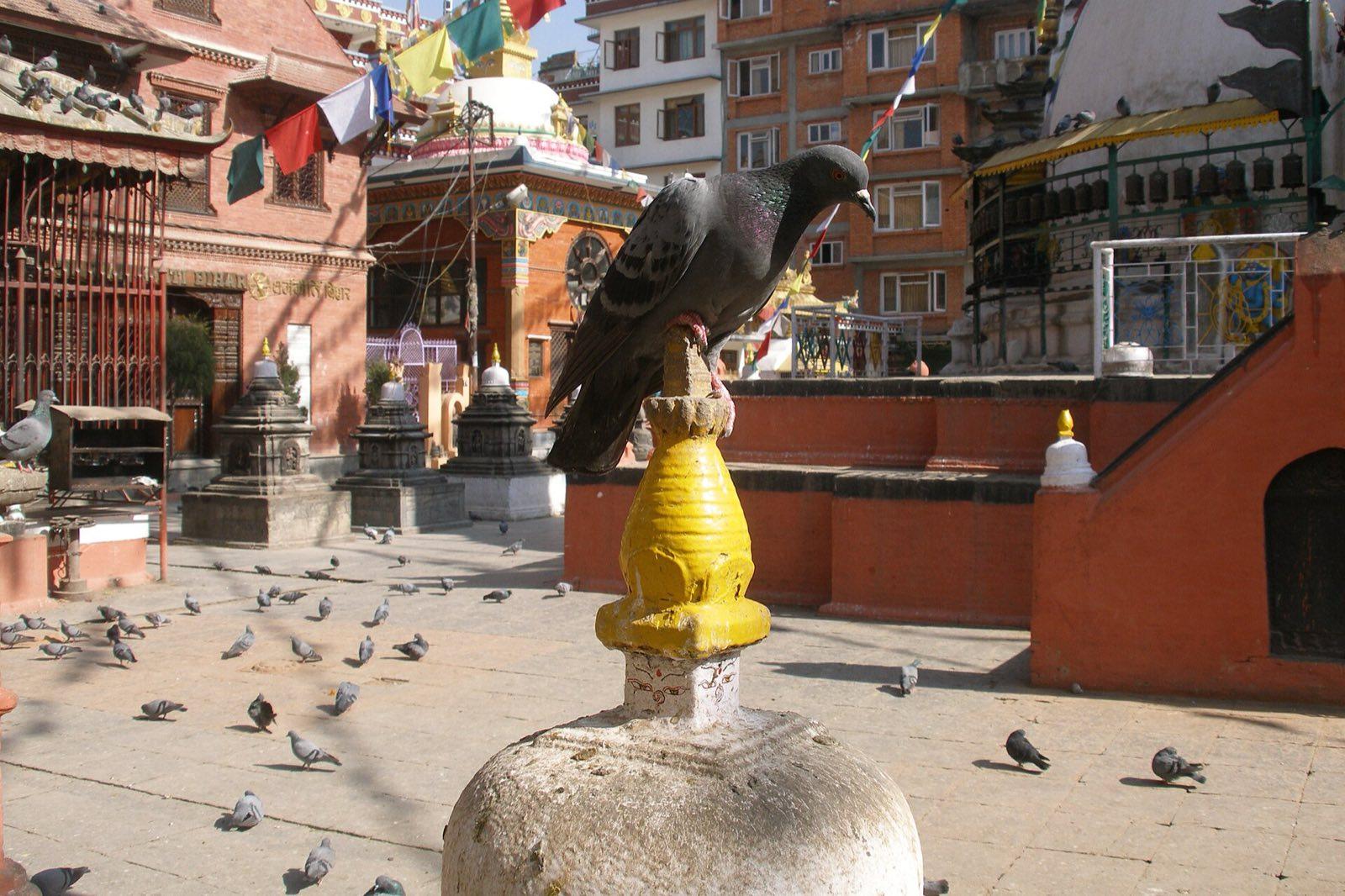
Kathesimbhu stupa, a short walk from Thamel Photo: Vyacheslav Argenberg, CC BY 4.0, via Wikimedia Commons (https://commons.wikimedia.org/wiki/File:Kathmandu,_Nepal,_Kaathe_Swyambhu,_Pigeon.jpg) Day 2: Swayambhunath and old Kathmandu
Swayambhunath, then on foot through Asan and Indra Chowk to Kathmandu Durbar Square
- Drive about 1 h
- Breakfast and lunch
- Stay in Kathmandu
Day 2 details
We start early at Swayambhunath, the stupa on a wooded hill west of the city, before the tour groups arrive and while the morning light is on the valley. Climb the eastern stairway, about 365 steps past monkeys and stone Buddhas, to the white dome and the painted eyes on its gilded tower, where pilgrims spin the prayer wheels clockwise. Then we drive back to the old city and walk with the guide through Asan Tole, the market crossroads where spice, brass and textile sellers have traded for centuries, and Indra Chowk to Kathmandu Durbar Square: the Hanuman Dhoka palace, the Kasthamandap pavilion rebuilt after the 2015 earthquake, and the Kumari Ghar, home of the girl worshipped as a living goddess. Lunch is a sit-down Newari meal near the square. The afternoon and evening are free, with your guide's list of rooftop cafés and craft shops.
Included
- Swayambhunath, early
- Guided walk through Asan Tole and Indra Chowk
- Kathmandu Durbar Square, Kasthamandap and the Kumari Ghar
- Newari lunch
Optional experiences
- Everest scenic flight at dawn, about an hour, weather permitting (paid locally)
Free time: Afternoon and evening free; dinner on your own
Activity: About 3 to 4 hours on foot, including the Swayambhunath steps; the van can take you to the upper car park instead.
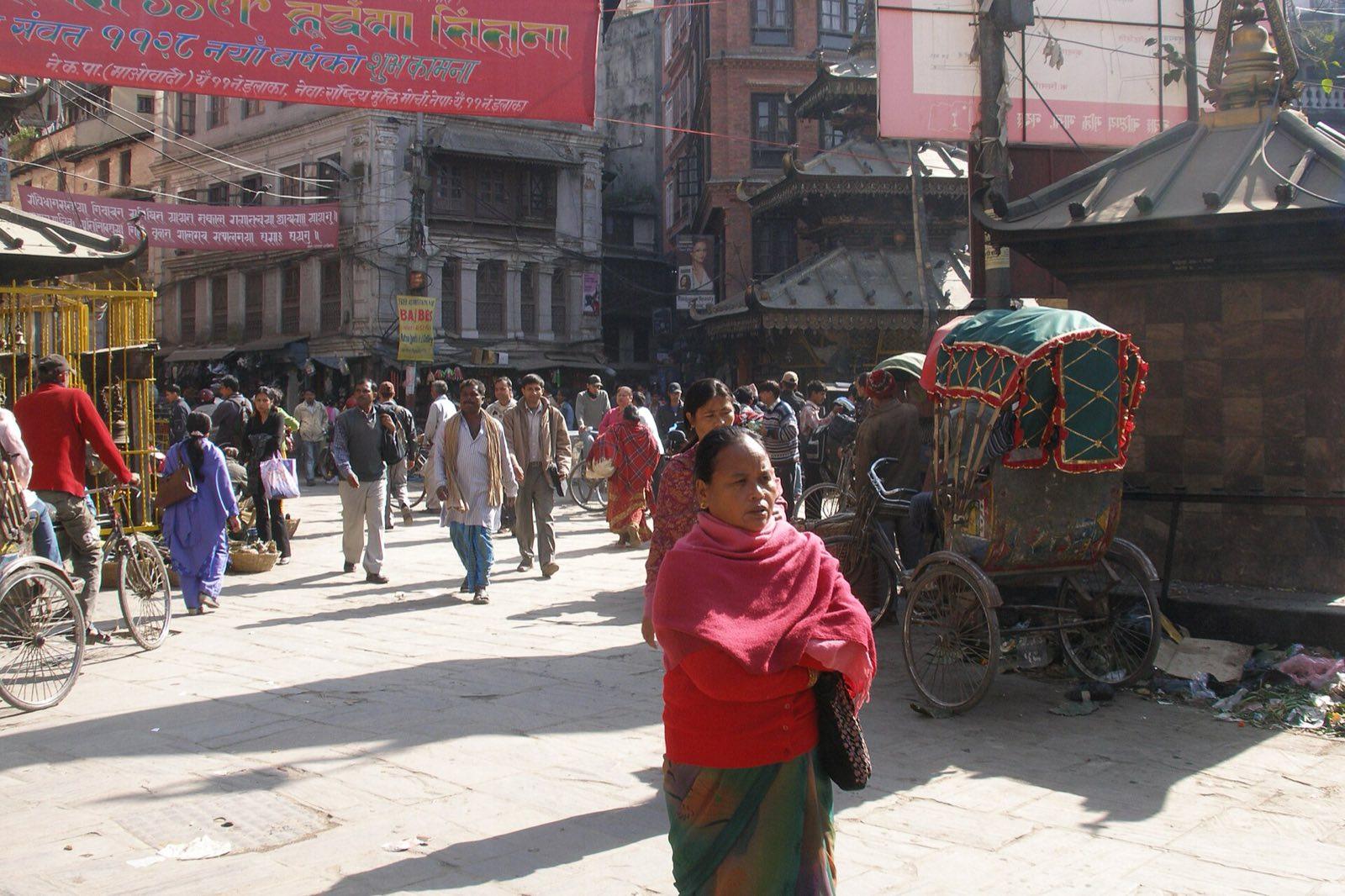
A street in old Kathmandu Photo: Vyacheslav Argenberg, CC BY 4.0, via Wikimedia Commons (https://commons.wikimedia.org/wiki/File:Kathmandu,_Nepal,_Streets_of_Kathmandu.jpg) Day 3: Bhaktapur, Pashupatinath and Boudhanath
Kathmandu to Bhaktapur, then Pashupatinath and Boudhanath
- Drive about 2 h
- Breakfast and lunch
- Stay in Kathmandu
Day 3 details
We leave at about 8 am for Bhaktapur, about 13 km east, to reach its squares before the day visitors. The old Newar city has kept more of its brick lanes and carved wooden windows than anywhere else in the valley. Walk through Durbar Square to the Golden Gate and the 55-Window Palace, on to Taumadhi Square, where the five-tiered Nyatapola temple of 1702 stands on its stepped plinth, and down to Pottery Square, where potters still throw pots on wheels and dry them in rows. After a sit-down lunch, try juju dhau, Bhaktapur's sweet set curd. In the afternoon we drive back west to Pashupatinath on the Bagmati River, Nepal's most important Hindu temple; non-Hindus cannot enter the main temple, so we watch the ghats quietly from the east bank. We end at Boudhanath as the light goes, walking the kora clockwise with the pilgrims while butter lamps are lit.
Included
- Bhaktapur Durbar Square, Taumadhi Square and Pottery Square
- Lunch in Bhaktapur
- Pashupatinath, from the east bank of the Bagmati
- Boudhanath at dusk
- All Kathmandu Valley site entries
Free time: Evening free around Boudhanath or back at the hotel
Activity: Please do not photograph cremations at Pashupatinath; your guide explains what is happening and where to stand.
Day 4: Fly to Pokhara and Phewa Lake
Kathmandu to Pokhara by air, then Lakeside and a boat to Tal Barahi
- Drive about 45 min
- Breakfast and lunch
- Stay in Pokhara
Day 4 details
After breakfast we transfer to the domestic terminal for the flight to Pokhara, about 25 minutes west along the hills. By road the same trip is about 200 km and six to seven hours on the Prithvi Highway, so the flight gives you back most of a day. On a clear morning, sit on the right-hand side for the Annapurnas and Manaslu to the north. Pokhara sits at about 800 m, warmer than Kathmandu, on the shore of Phewa Lake, and our hotel for three nights is at Lakeside, walking distance from the water. After lunch we take a wooden rowing boat across to Tal Barahi, the small two-tiered pagoda on its island, and drift along the shore past rice fields while the boatman points out the fishtail summit of Machhapuchhre when the cloud lifts. The late afternoon and evening are free for a walk along the lakeshore path and dinner in one of Lakeside's restaurants.
Included
- Flight from Kathmandu to Pokhara
- Lunch at Lakeside
- Rowing boat on Phewa Lake to Tal Barahi temple
Free time: Late afternoon and evening free at Lakeside
Activity: If cloud grounds the flight, we drive instead, with lunch on the way, and the boat moves to day 5.
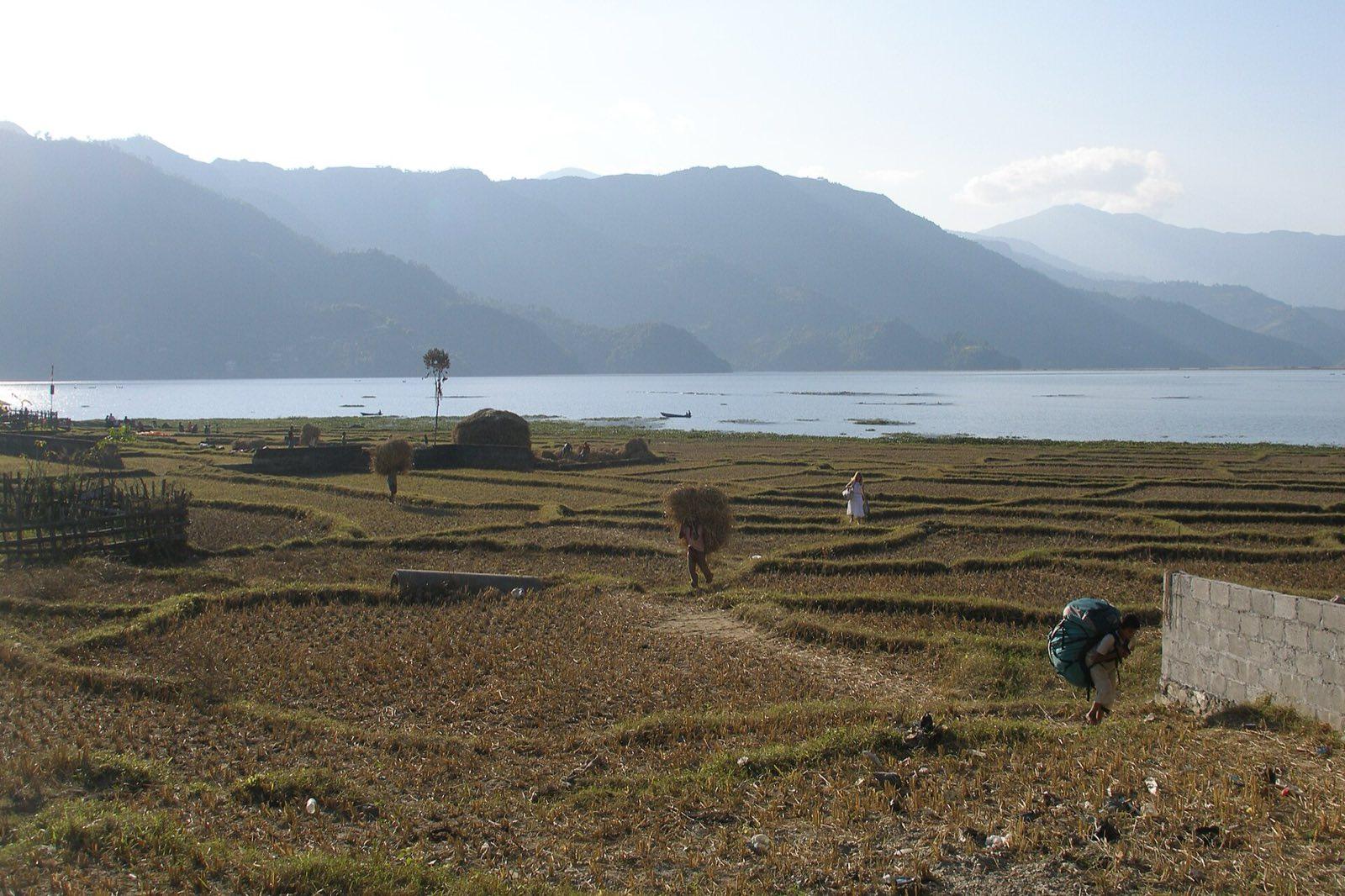
Fields on the shore of Phewa Lake at Pokhara Photo: Vyacheslav Argenberg, CC BY 4.0, via Wikimedia Commons (https://commons.wikimedia.org/wiki/File:Pokhara,_Phewa_Lake,_Nepal.jpg) Day 5: Sunrise at Sarangkot and the Peace Pagoda
Pokhara to Sarangkot and back, then the World Peace Pagoda
- Drive about 1 h
- Breakfast and lunch
- Stay in Pokhara
Day 5 details
We leave the hotel before dawn, the exact time set by the season's sunrise, for the 30 to 40 minute drive up to Sarangkot, a ridge at about 1,600 m above Pokhara. This is the one early start in Nepal, and it is worth it: from the viewpoint the Annapurna range lights up from the summits down, with Dhaulagiri far to the west, Annapurna South, the fishtail peak of Machhapuchhre almost straight ahead, and Annapurna II and Lamjung Himal to the east, while Phewa Lake lies in mist below. Back at the hotel for breakfast and a rest. Late morning we cross the lake by boat and walk up about 30 to 60 minutes through forest to the World Peace Pagoda, a white stupa on the ridge south of the lake, for the view back over Pokhara and the mountains. Lunch is by the water, and the afternoon is free.
Included
- Sunrise at Sarangkot viewpoint
- Boat across Phewa Lake and walk to the World Peace Pagoda
- Lunch at Lakeside
Optional experiences
- Tandem paragliding from Sarangkot, about 30 minutes in the air (paid locally, with a licensed operator)
- International Mountain Museum
Easier option: Skip the walk to the pagoda and spend the late morning by the lake; the van can take you to the pagoda by road.
More active option: Walk down from the pagoda to Lakeside instead of taking the boat back, about an hour.
Free time: Afternoon and evening free; dinner on your own
Activity: Mornings at Sarangkot are cold from November to February; bring a warm layer and a hat.
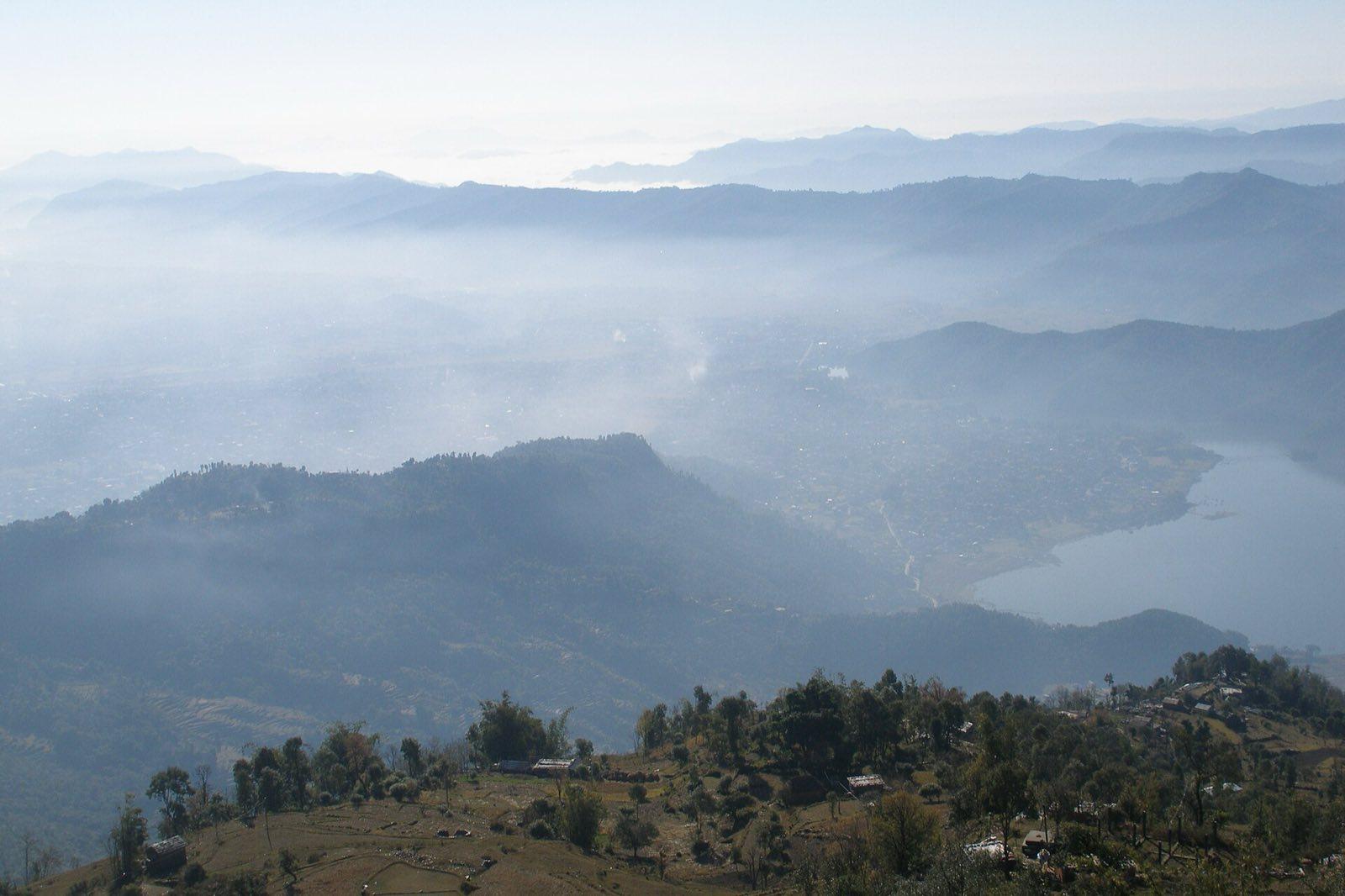
Phewa Lake and the Pokhara valley from the hills above the town Photo: Vyacheslav Argenberg, CC BY 4.0, via Wikimedia Commons (https://commons.wikimedia.org/wiki/File:Pokhara,_Lake,_Nepal.jpg) Day 6: A day hike in the Annapurna foothills
Pokhara to Kande, on foot to Australian Camp and Dhampus, then back to Pokhara
- Drive about 1.5 h
- Breakfast and lunch
- Stay in Pokhara
Day 6 details
Today is a walk in the foothills of the Annapurnas, without a multi-day trek. We leave at about 7:30 am for the hour's drive west of Pokhara on the Baglung road to Kande, at about 1,770 m, and start up a forest trail to Australian Camp, at about 2,060 m: roughly an hour and a half of steady climbing on stone steps and dirt paths. The camp is an open grassy ridge with a few lodges and a close view of Annapurna South, Hiunchuli and Machhapuchhre, best in the morning before cloud builds. We stop for lunch at a lodge there. Then we walk on, mostly downhill, through the small settlement of Pothana and rhododendron and oak forest to the Gurung village of Dhampus, where the van meets us for the drive back to Pokhara by late afternoon. The Annapurna Conservation Area permit the walk needs is included.
Included
- Guided day hike from Kande to Australian Camp and Dhampus
- Lunch at a lodge at Australian Camp
- Annapurna Conservation Area permit
Easier option: Walk up to Australian Camp, have lunch with the group, and walk back down to Kande with an assistant guide (about 5 km), or stay in Pokhara for a lake day.
More active option: The full walk to Dhampus, about 9 km and 4 to 5 hours with about 300 m up and 400 m down.
Free time: Evening free at Lakeside
Activity: Wear walking shoes with grip; the stone steps are uneven and can be dusty. Poles help on the descent.
Day 7: Back to Kathmandu and Patan
Pokhara to Kathmandu by air, then Patan Durbar Square
- Drive about 1 h
- Breakfast and lunch
- Stay in Kathmandu
Day 7 details
A slower morning by the lake, then the flight back to Kathmandu, about 25 minutes. Flying east, sit on the left side of the plane for the Himalaya along the northern horizon on a clear day. If cloud grounds the flight, we drive instead, about six to seven hours with lunch on the way, and the afternoon becomes a travel day; we stay in Kathmandu tonight so tomorrow's flight to Paro never depends on a same-day connection. On a normal day we cross the Bagmati River to Patan for lunch and an afternoon in Patan Durbar Square, the most complete of the valley's royal squares, with the stone Krishna Mandir and the Patan Museum, whose galleries of bronzes and woodcarving fill a former palace. We walk back through the lanes past the Golden Temple, a 12th-century Buddhist monastery courtyard, and return to the hotel in central Kathmandu. The evening is free for last shopping and dinner.
Included
- Flight from Pokhara to Kathmandu
- Lunch in Patan
- Patan Durbar Square, the Krishna Mandir and the Patan Museum
- The Golden Temple (Hiranya Varna Mahavihar)
Free time: Evening free in Kathmandu; dinner on your own
Activity: Pack for Bhutan tonight: tomorrow's Paro flight has a checked-bag limit and leaves in the morning.
Day 8: Fly to Paro and drive to Thimphu
Kathmandu to Paro by air, then by road to Thimphu via Tachog Lhakhang and Chuzom
- Drive about 2 h
- Breakfast, lunch and dinner
- Stay in Thimphu
Day 8 details
An early transfer to the airport for the flight to Paro, about an hour east along the Himalaya. On a clear morning, ask for a seat on the left-hand side: Everest, Kanchenjunga and the peaks between can line the horizon, though the view depends on the weather and the route flown. The landing in the narrow Paro valley is one of the steepest approaches in the region. Our licensed Bhutanese guide meets the group in arrivals, and your See Sight Tours guide stays with you. Set your watch 15 minutes forward. We drive east along the Paro Chhu, stopping at Tachog Lhakhang, where an iron chain bridge crosses the river to a small temple, and at Chuzom, where the Paro and Thimphu rivers meet below three chortens. We reach Thimphu, Bhutan's capital at about 2,300 m, in time for a late lunch, then visit the National Memorial Chorten, where older residents circle and spin prayer wheels into the evening.
Included
- Flight from Kathmandu to Paro
- Bhutan visa and Sustainable Development Fee
- Tachog Lhakhang and its iron chain bridge
- Chuzom, the confluence of the Paro and Thimphu rivers
- National Memorial Chorten
Free time: An hour free at the hotel before dinner
Activity: Thimphu sits at about 2,300 m, higher than anywhere so far; drink water and take the evening slowly.
Day 9: Thimphu, the capital
Buddha Dordenma, the Takin Preserve and the Folk Heritage Museum, then Tashichho Dzong
- Drive about 45 min
- Breakfast and lunch
- Stay in Thimphu
Day 9 details
A morning of Thimphu's main sights and an afternoon that is mostly yours. We start at Buddha Dordenma, the giant gilded Buddha on the ridge south of the city, for the view down the Wang Chhu valley, then drive up to Sangaygang, where prayer flags frame the whole city, and the Motithang Takin Preserve just below, a fenced forest where Bhutan's national animal grazes. Back in town we visit the Folk Heritage Museum, a restored three-storey farmhouse of rammed earth and timber, and, on weekdays when classes run, the National Institute for Zorig Chusum, where students train in the thirteen traditional arts. After lunch together the afternoon is free for the craft shops and cafés of Norzin Lam. Late in the day we meet again for Tashichho Dzong, which opens to visitors after office hours, when the government offices inside close for the day. Dinner tonight is your choice.
Included
- Buddha Dordenma (Buddha Point)
- Sangaygang viewpoint and the Motithang Takin Preserve
- Folk Heritage Museum
- National Institute for Zorig Chusum (weekdays)
- Tashichho Dzong after office hours
Easier option: Spend the free afternoon at the hotel or in the cafés of the town centre.
More active option: Walk with your guide from Sangaygang through pine forest to Wangditse Lhakhang, about 1.5 to 2 hours with gentle climbs.
Free time: Afternoon free; dinner on your own
Activity: Tashichho Dzong's after-hours slot is short and changes by season; on weekends and holidays we visit at the hours ops confirms. Dress for the dzong: long sleeves, long trousers or skirt.
Day 10: Over the Dochula Pass to Punakha
Thimphu to the Dochula Pass, Sopsokha and Chimi Lhakhang, then Punakha
- Drive about 3 h
- Breakfast, lunch and dinner
- Stay in Punakha
Day 10 details
Cloud usually builds over the pass by late morning, so we leave Thimphu at 8 am to reach Dochula, at about 3,100 m, while the northern horizon is clearest. On a good day, most often in autumn and winter, the snow peaks of the high Himalaya line up beyond the 108 Druk Wangyal chortens on the saddle. There is time for tea and a walk among the chortens before the road drops through forest, about 1,900 m in all, into the warm Punakha valley, where rice terraces line the rivers at about 1,200 m. Lunch is at a farm restaurant near Sopsokha. Then we walk about 20 to 30 minutes through the village and between terraced paddies to the low hill of Chimi Lhakhang, the temple founded in 1499 beside the chorten of Drukpa Kunley, the Divine Madman, where couples still come for fertility blessings. We reach our hotel by mid-afternoon, and the rest of the day is free.
Included
- Dochula Pass and the 108 Druk Wangyal chortens
- Lunch near Sopsokha
- Walk through the rice fields to Chimi Lhakhang
Free time: Late afternoon free at the hotel
Activity: The road is narrow and winding on both sides of the pass; if you are prone to motion sickness, take a front seat and medication before we leave.
Day 11: Punakha Dzong and the valley
Punakha Dzong, the Punakha Suspension Bridge and Khamsum Yulley Namgyal Chorten
- Drive about 1 h
- Breakfast, lunch and dinner
- Stay in Punakha
Day 11 details
The light on Punakha Dzong's whitewashed walls is best in the morning, so we cross the wooden cantilever bridge over the Mo Chhu soon after it opens to visitors. Built in 1637 and 1638 by Zhabdrung Ngawang Namgyal where the Pho Chhu and Mo Chhu rivers meet, it was the seat of government until the capital moved to Thimphu in the 1950s, and the central monk body still spends the winter here. Inside, the courtyards open one after another, the first with a great bodhi tree beside a white chorten, and our Bhutanese guide explains the murals in the assembly hall. Then a short drive upriver to the Punakha Suspension Bridge, strung with prayer flags high over the Pho Chhu. The active option climbs about 45 minutes through rice fields to Khamsum Yulley Namgyal Chorten for the view up the valley; the easy option visits the Sangchhen Dorji Lhuendrup Nunnery by road. A picnic lunch by the river, then a free afternoon.
Included
- Punakha Dzong with your guides
- Punakha Suspension Bridge
- Khamsum Yulley Namgyal Chorten or Sangchhen Dorji Lhuendrup Nunnery
- Picnic lunch by the river
Easier option: Drive up to the Sangchhen Dorji Lhuendrup Nunnery for the valley view instead of the chorten hike.
More active option: Hike about 45 minutes up through rice fields to Khamsum Yulley Namgyal Chorten and climb to its roof for the view.
Free time: Afternoon free
Activity: Punakha is warmer than Thimphu and Paro; bring sun protection.
Day 12: Back over the pass to Paro
Punakha to the Dochula Pass and Thimphu, then Paro and Rinpung Dzong
- Drive about 4.5 h
- Breakfast, lunch and dinner
- Stay in Paro
Day 12 details
This is the trip's one long drive, about 135 km and four to four and a half hours on a winding road, and there is no shorter way: Punakha and Paro lie on either side of the Dochula Pass and the Thimphu valley. We break it into three parts. After breakfast we climb back to Dochula for tea and a stretch among the chortens, with another look at the mountains if the sky is clear. Then we carry on down to Thimphu, about two thirds of the way and three hours in, for a sit-down lunch, and finish the last hour and a half along the Paro Chhu, reaching Paro by mid-afternoon. Before dinner we walk down to the covered wooden bridge below Rinpung Dzong, the fortress-monastery completed in 1646 that still houses the district's monks and offices, and visit its courtyards, then drive up to the round Ta Dzong watchtower above it, now the National Museum, for an hour before it closes. Dinner is at the hotel.
Included
- Tea stop at the Dochula Pass
- Sit-down lunch in Thimphu
- Rinpung Dzong and the covered bridge over the Paro Chhu
- Ta Dzong National Museum
Free time: An hour free in Paro before dinner
Activity: The longest day in the vehicle, a little over our 4-hour cap, broken by tea at Dochula and lunch in Thimphu.
Day 13: The Tiger's Nest walk
Paro to the Taktsang trailhead, the cafeteria viewpoint and the monastery, then Kyichu Lhakhang and a farmhouse
- Drive about 1 h
- Breakfast, lunch and dinner
- Stay in Paro
Day 13 details
We leave the hotel at about 7:30 am for the 20-minute drive to the trailhead at about 2,600 m, so we are on the path before the heat and the main flow of walkers. Paro Taktsang, the Tiger's Nest, clings to a cliff about 900 m above the valley floor, around the cave where, by tradition, Guru Rinpoche meditated in the 8th century. The trail climbs through blue pine and oak hung with prayer flags to the cafeteria viewpoint, about an hour and a half up, facing the monastery across the gorge. Everyone can stop here. Those who want to go on walk about another hour, down and up several hundred steps past a waterfall, to the monastery itself, where bags and cameras are left at the gate. We meet for lunch at the cafeteria, walk down together, and stop at Kyichu Lhakhang, one of Bhutan's oldest temples. In the evening a Paro farmhouse heats river stones for a hot stone bath, then serves our farewell dinner.
Included
- Guided walk to the Tiger's Nest (Paro Taktsang) cafeteria viewpoint, with the option to continue to the monastery
- Lunch at the Tiger's Nest cafeteria
- Kyichu Lhakhang
- Hot stone bath and farewell dinner at a Paro farmhouse
Optional experiences
- A pony from the trailhead to the cafeteria (uphill only, paid locally)
Easier option: Stop at the cafeteria viewpoint: tea and the full view of the monastery across the gorge while the others go on, then lunch together.
More active option: Continue from the cafeteria to the monastery, about an hour each way on steps, and go inside the temples with our Bhutanese guide.
Free time: Late afternoon free at the hotel before the farmhouse evening
Activity: The hardest morning of the trip: about 4 to 6 hours on the trail for the full walk, or about 3 hours to the cafeteria and back. Walking poles and layers help; the descent is steep and dusty.
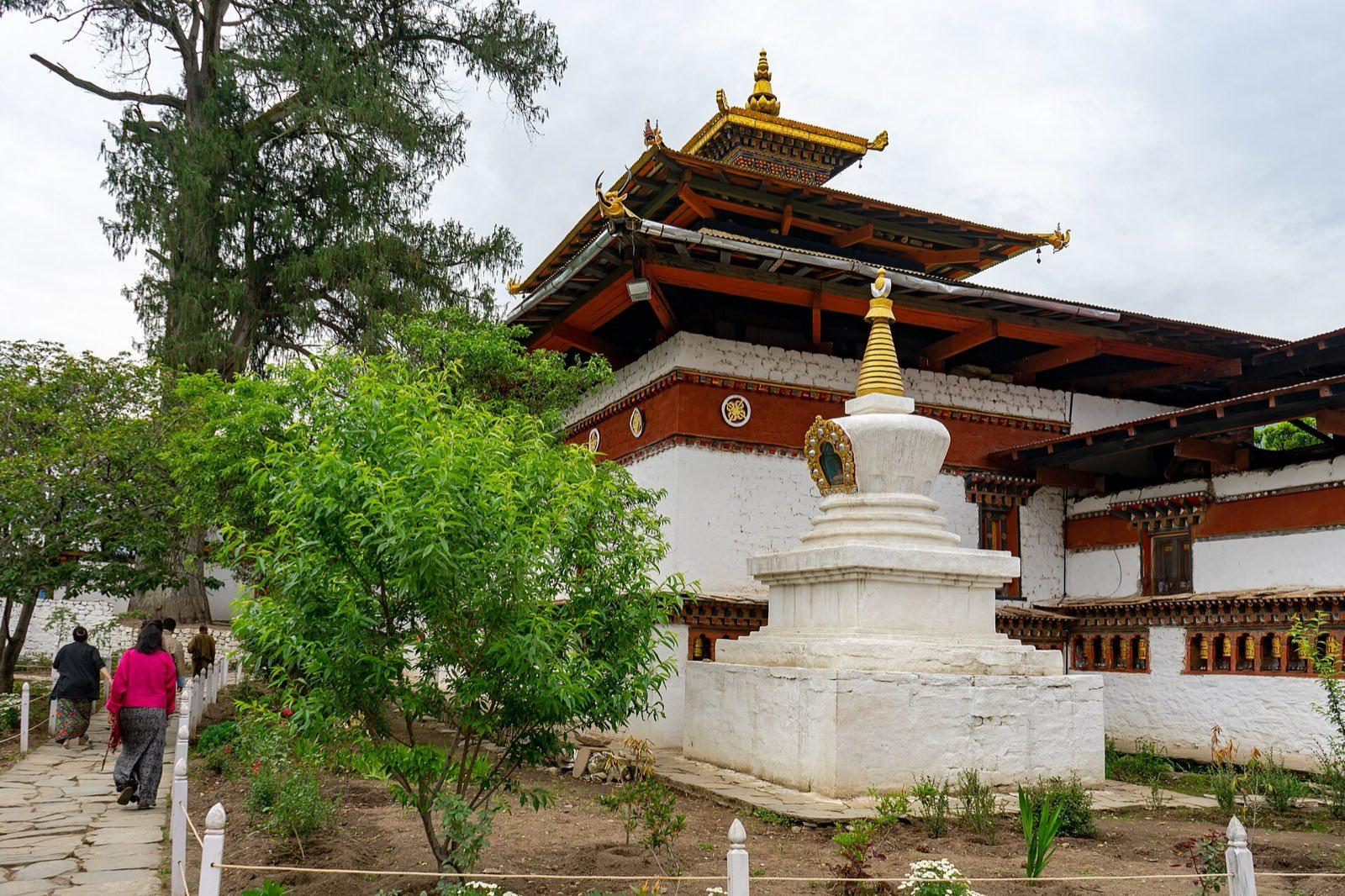
Kyichu Lhakhang, our stop on the way down from the Tiger's Nest Photo: Nina R from Africa, CC BY 2.0, via Wikimedia Commons (https://commons.wikimedia.org/wiki/File:Paro,_Bhutan_(49701696878).jpg) Day 14: Leave from Paro
Your hotel in Paro to Paro International Airport
- Drive about 15 min
- Breakfast
Day 14 details
Breakfast at the hotel, then a transfer of about ten minutes to Paro International Airport. Flights out of Paro operate in daylight only and most leave in the morning, so plan to be at the airport about two hours before departure; your guides see you to the terminal and help with check-in before saying goodbye. Paro has direct flights to cities such as Delhi, Bangkok, Singapore and Kathmandu, so book an onward connection with a generous gap, as Paro departures can be delayed by weather. If you fly back to Kathmandu, ask for a window on the right-hand side for the mountains on a clear morning. If your flight leaves later in the day, the morning is free in Paro, and your guide can suggest a short walk in the valley or a last look at the shops on the main street, with a later transfer. If you would like extra nights in Bhutan, ask us when you book; each extra night also carries the Sustainable Development Fee.
Included
- Drop-off at Paro International Airport (PBH)
Free time: Morning free if your flight leaves later
Activity: Book any flight out of Paro; all departures are in daylight and the airport is about ten minutes from the hotel. Leave at least four hours for an onward international connection.
Wildlife and weather: October and November bring the clearest skies and the best chance of seeing the Annapurnas from Sarangkot and the Himalaya from the Paro flight and Dochula. December to February are dry and clear, with near-freezing nights in Kathmandu, Paro and Thimphu, while Punakha stays mild. March and April are warmer, with rhododendrons in flower and more haze over the peaks. From May to September the heat and then the monsoon bring cloud, cancelled flights and landslides, so we do not run departures then.
13 nights
Where you'll stay
Your hotels are named in your trip confirmation.
- Kathmandu3 nights
- Pokhara3 nights
- Kathmandu1 night
- Thimphu2 nights
- Punakha2 nights
- Paro2 nights
One price
What's in the price
Included
Accommodation
- 13 nights: 3 in Kathmandu, 3 in Pokhara, 1 more in Kathmandu, 2 in Thimphu, 2 in Punakha and 2 in Paro
- Hotels of a 3-star-plus standard, central where the town has a centre (Punakha's hotels are spread along the valley), certified for international visitors in Bhutan; we name each hotel when we confirm your dates
- Rooms shared, or your own for a supplement
Transport
- Pick-up at Tribhuvan International Airport (KTM) and drop-off at Paro International Airport (PBH)
- Flights from Kathmandu to Pokhara, Pokhara to Kathmandu, and Kathmandu to Paro
- Our own vehicle and driver for the group in Nepal and in Bhutan, with drives of about 1 to 3 hours, and one day of about 4.5 hours (a little over our 4-hour cap) from Punakha to Paro
- Boats on Phewa Lake
Your guide
- A See Sight Tours guide with the group from day 1 to day 14
- A licensed Bhutanese guide throughout Bhutan (Bhutan requires a licensed guide for most tours)
- Local guides at heritage sites where we use them
Activities
- Kathmandu: Kathesimbhu stupa, Swayambhunath, Kathmandu Durbar Square, Pashupatinath and Boudhanath
- Bhaktapur's squares and Patan Durbar Square with the Patan Museum and the Golden Temple
- Pokhara: the Phewa Lake boat to Tal Barahi, the Sarangkot sunrise and the World Peace Pagoda
- The Kande to Australian Camp and Dhampus day hike, with the Annapurna Conservation Area permit
- On the road to Thimphu: Tachog Lhakhang and Chuzom
- Thimphu: the National Memorial Chorten, Buddha Dordenma, Sangaygang, the Takin Preserve, the Folk Heritage Museum, the Zorig Chusum institute and Tashichho Dzong
- The Dochula Pass and its 108 chortens
- Punakha: Chimi Lhakhang, Punakha Dzong, the suspension bridge and Khamsum Yulley Namgyal Chorten or the Sangchhen Dorji Lhuendrup Nunnery
- Paro: Rinpung Dzong, the Ta Dzong National Museum, the Tiger's Nest walk (Paro Taktsang) and Kyichu Lhakhang
- A hot stone bath at a Paro farmhouse
- Bhutan's Sustainable Development Fee for 6 nights (currently USD 100 per person per night) and the Bhutan visa fee
- All entrance fees for included sights
Meals
- 13 breakfasts
- 12 lunches, including a lodge lunch on the hike and lunch at the Tiger's Nest cafeteria
- 6 dinners, including a welcome dinner in Kathmandu and a farewell dinner at a Paro farmhouse
Not included
- International flights into Kathmandu and out of Paro
- Nepal visa on arrival (currently USD 30 for 15 days)
- Travel insurance
- Meals not listed (7 dinners)
- Drinks
- Tips for guides and drivers
- Optional activities, such as the Everest scenic flight, paragliding at Sarangkot or a pony to the Tiger's Nest cafeteria
- Extra baggage charges on domestic flights
- Personal expenses
Extras
- Room of your own
- CAD 1,530 (estimated price)

See Sight Tours has been providing travel services across North America since 2006. Operating in 20 cities across Canada and the USA, the company specializes in small group tours that offer personalized, high-quality experiences for travelers.


Book your Tour
Get in Touch
- Toll Free1-888-961-6584
- Local1-289-271-9767


© 2026 See Sight Tours. All rights reserved.