Printable itinerary
Korea and Japan: Seoul, Busan, the Night Ferry, Kyoto and Tokyo
15 days · Seoul to Tokyo · up to 12 guests
From CAD 9,995 per person, sharing a room (estimated price. Estimated price. The itinerary, hotels and availability are proposed and subject to confirmation. Your quote will set out the booking conditions; sending a request does not confirm a booking.)
Day by day
Itinerary
- Seoul3 nights
- Gyeongju1 night
- Busan2 nights
- Overnight ferry to Fukuoka1 night
- Hiroshima1 night
- Kyoto3 nights
- Hakone1 night
- Tokyo2 nights
- Overnight stop
- Day trip
- By boat or train
Day 1: Arrive in Seoul
Incheon International Airport to your hotel in central Seoul
- Drive about 1.5 h
- Welcome dinner
- Stay in Seoul
Day 1 details
Fly into Incheon International Airport (ICN), on an island about 55 km west of central Seoul. A driver meets you in the arrivals hall for the drive in, about an hour and a quarter depending on traffic, to a central hotel within walking distance of the old palaces. Plan to land by about 3 pm to make the evening meeting; the exact time comes with your final itinerary. At 6 pm your See Sight Tours guide, who stays with you all the way to Tokyo, meets the group for a short briefing on the two countries ahead, hands out transit cards for the metro and explains how the train days and the sea crossing work. Then we walk along Cheonggyecheon, a stream restored in 2005 that runs below street level through downtown, to a welcome dinner of Korean barbecue, grilled at the table and served with banchan, the small side dishes that come with every Korean meal.
Included
- Pick-up at Incheon International Airport (ICN)
- Welcome briefing with your guide and a Seoul transit card
- Evening walk along Cheonggyecheon stream
- Welcome dinner of Korean barbecue
Free time: Free until the 6 pm meeting
Activity: If you land late, the driver still meets you and your guide catches up with you at breakfast.
Day 2: Changdeokgung, the Secret Garden and Bukchon
Changdeokgung to Bukchon, then Gwangjang Market
- Drive about 30 min
- Breakfast and lunch
- Stay in Seoul
Day 2 details
We are at the gate of Changdeokgung when it opens at 9 am. Built in 1405 as a secondary palace of the Joseon kings and listed by UNESCO in 1997, it follows the slope of the hill rather than a straight axis, and at this hour you can stand almost alone in front of Injeongjeon, the throne hall. Next is Huwon, the Secret Garden behind the palace, seen only on a guided tour with timed tickets; we book an early one. Its paths lead past pavilions and old trees to the lotus pond of Buyongji. From the palace we walk up into Bukchon, a hillside of lived-in hanok houses, keeping voices low for the residents. Lunch is at Gwangjang Market, sitting at the stall counters over bindaetteok, a crisp mung bean pancake, and small rolls of gimbap. The afternoon and evening are yours, with ideas from your guide.
Included
- Changdeokgung at opening with your guide
- Guided tour of Huwon, the Secret Garden
- Walk through Bukchon's hanok lanes
- Street-food lunch at Gwangjang Market
Optional experiences
- National Museum of Korea
- N Seoul Tower on Namsan
Easier option: Go back to the hotel after lunch, or take a short taxi ride instead of walking Bukchon's hill lanes.
More active option: In the late afternoon, walk the Seoul city wall trail from Heunginjimun gate up to Naksan Park for the city at sunset; your guide shows you where to start.
Free time: Afternoon and evening free
Activity: Changdeokgung is closed on Mondays, so departures are set so this day never falls on one. About 6 km on foot, with hill lanes in Bukchon.
Day 3: The DMZ, then Gyeongbokgung
Seoul to Imjingak, the Third Tunnel and Dora Observatory, then back to Gyeongbokgung
- Drive about 3 h
- Breakfast and lunch
- Stay in Seoul
Day 3 details
We leave at about 8 am for the Demilitarized Zone, the strip about 4 km wide that has divided the peninsula since the 1953 armistice. Sites here are visited on registered tours, so a licensed DMZ guide joins us and passports are checked on the way in. At Imjingak we see the Freedom Bridge and the ribbons tied to the fences by families divided by the war. Then we walk down the steep access slope into the Third Tunnel, dug from the North and found in 1978, and stand at Dora Observatory, where on a clear day you look across into North Korea. After a sit-down lunch near the border we drive back to Seoul by about 3 pm and walk through Gyeongbokgung, the main palace of the Joseon dynasty, as the day-trippers thin, from the throne hall to Gyeonghoeru, the banquet pavilion standing in its pond. The evening is free.
Included
- DMZ tour with a licensed DMZ guide: Imjingak and the Freedom Bridge, the Third Tunnel and Dora Observatory
- Sit-down lunch near the border
- Gyeongbokgung in the afternoon with your guide
Optional experiences
- The War Memorial of Korea
Easier option: Skip the walk down into the Third Tunnel and wait at the visitor centre at the top; skip Gyeongbokgung and go back to the hotel.
Free time: Evening free
Activity: Bring your passport. DMZ tours do not run on Mondays and can be cancelled at short notice for military reasons; if that happens we visit the War Memorial of Korea instead. Gyeongbokgung is closed on Tuesdays and closes at 5 pm from November, so on November departures the DMZ leaves earlier or the palace moves to 9 am on day 4 before a later train.
Day 4: KTX to Gyeongju, the Silla capital
Seoul to Gyeongju by KTX, then Daereungwon, Cheomseongdae and Wolji Pond
- Drive about 30 min
- Breakfast and lunch
- Stay in Gyeongju
Day 4 details
After breakfast our vehicle heads south by road with the luggage, and we ride the KTX high-speed train from Seoul Station to Gyeongju, about two hours, with just a day bag. Gyeongju was the capital of the Silla kingdom for close to a thousand years, and much of it is listed by UNESCO as the Gyeongju Historic Areas. The vehicle meets us at the station and lunch is ssambap, rice wrapped in fresh leaves with a spread of small dishes. In the afternoon we walk among the grass-covered royal tomb mounds of Daereungwon and step inside Cheonmachong, where a painted saddle flap of a flying horse was found. Then we pass Cheomseongdae, the 7th-century stone observatory, and end at dusk at Wolji Pond, when the reconstructed pavilions of Donggung Palace are lit on the water. Dinner is free among the cafés and small restaurants of Hwangnidan-gil, a few minutes from the hotel.
Included
- KTX from Seoul to Gyeongju, with your luggage sent ahead by road
- Ssambap lunch
- Daereungwon tomb park and the Cheonmachong tomb
- Cheomseongdae observatory
- Donggung Palace and Wolji Pond at dusk
Optional experiences
- Gyeongju National Museum
Easier option: Ride between the tomb park and Wolji Pond instead of walking, about 2 km.
Free time: Late afternoon and dinner free
Activity: About 5 km on foot on flat paths. One night only in Gyeongju: we start the next day at Bulguksa's opening, so nothing is lost by moving on.
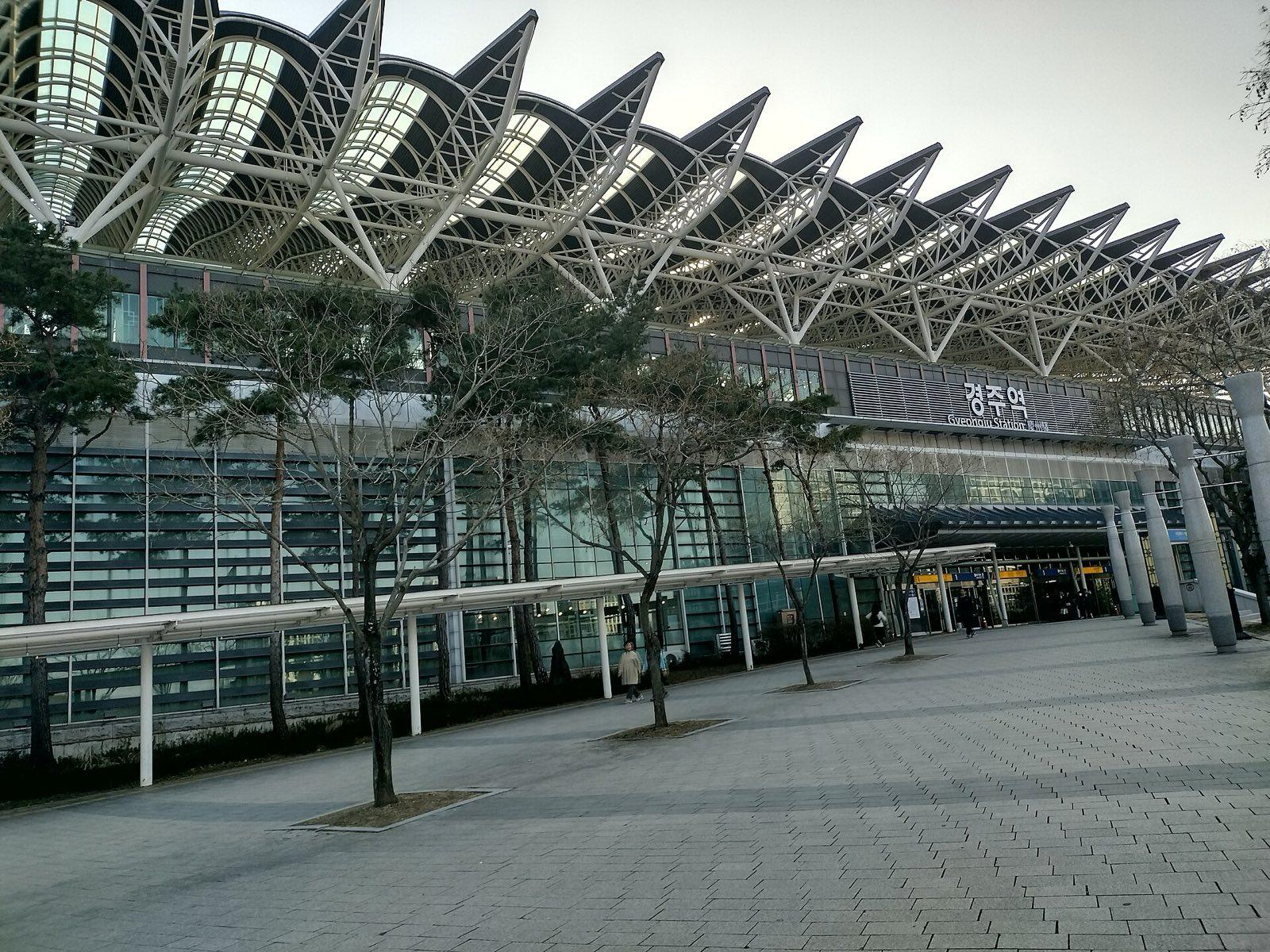
Gyeongju Station, where the KTX from Seoul arrives Photo: にのへ, CC0, via Wikimedia Commons (https://commons.wikimedia.org/wiki/File:Gyeongju_Station_2025-03.jpg) Day 5: Bulguksa, Seokguram and down to Busan
Gyeongju to Bulguksa and Seokguram, then to Busan: Haeundae and Dongbaekseom
- Drive about 2 h
- Breakfast and lunch
- Stay in Busan
Day 5 details
We reach Bulguksa close to opening, before the school groups. Rebuilt in the 8th century and listed by UNESCO in 1995 with Seokguram, it rises on stone terraces reached by two double stairways, with the stone pagodas Dabotap and Seokgatap in its main courtyard. Higher on Tohamsan, Seokguram is a granite Buddha in a man-made grotto, seen through a glass screen. We drive up through the forest, and anyone who likes can walk the trail between the two instead. From Bulguksa it is about an hour and a quarter to Busan, Korea's second city and biggest port, for a late lunch of milmyeon, cold wheat noodles, a Busan dish. We check in near Haeundae beach, and in the late afternoon your guide walks you round Dongbaekseom, a small wooded headland at the end of the beach, on a path above the rocks. The evening is free among the seafood restaurants on the beach streets.
Included
- Bulguksa close to opening with your guide
- Seokguram grotto
- Milmyeon lunch in Busan
- Walk around Dongbaekseom and along Haeundae beach
Optional experiences
- A jjimjilbang, a Korean bathhouse and sauna
Easier option: Ride both ways between Bulguksa and Seokguram, and skip the Dongbaekseom walk for a seat on the beach.
More active option: Walk the forest trail from Bulguksa up to Seokguram, about 3 km and an hour's steady climb, and meet the group at the top.
Free time: Evening free
Activity: About 6 km on foot with steps at Bulguksa. No photos inside the Seokguram grotto.
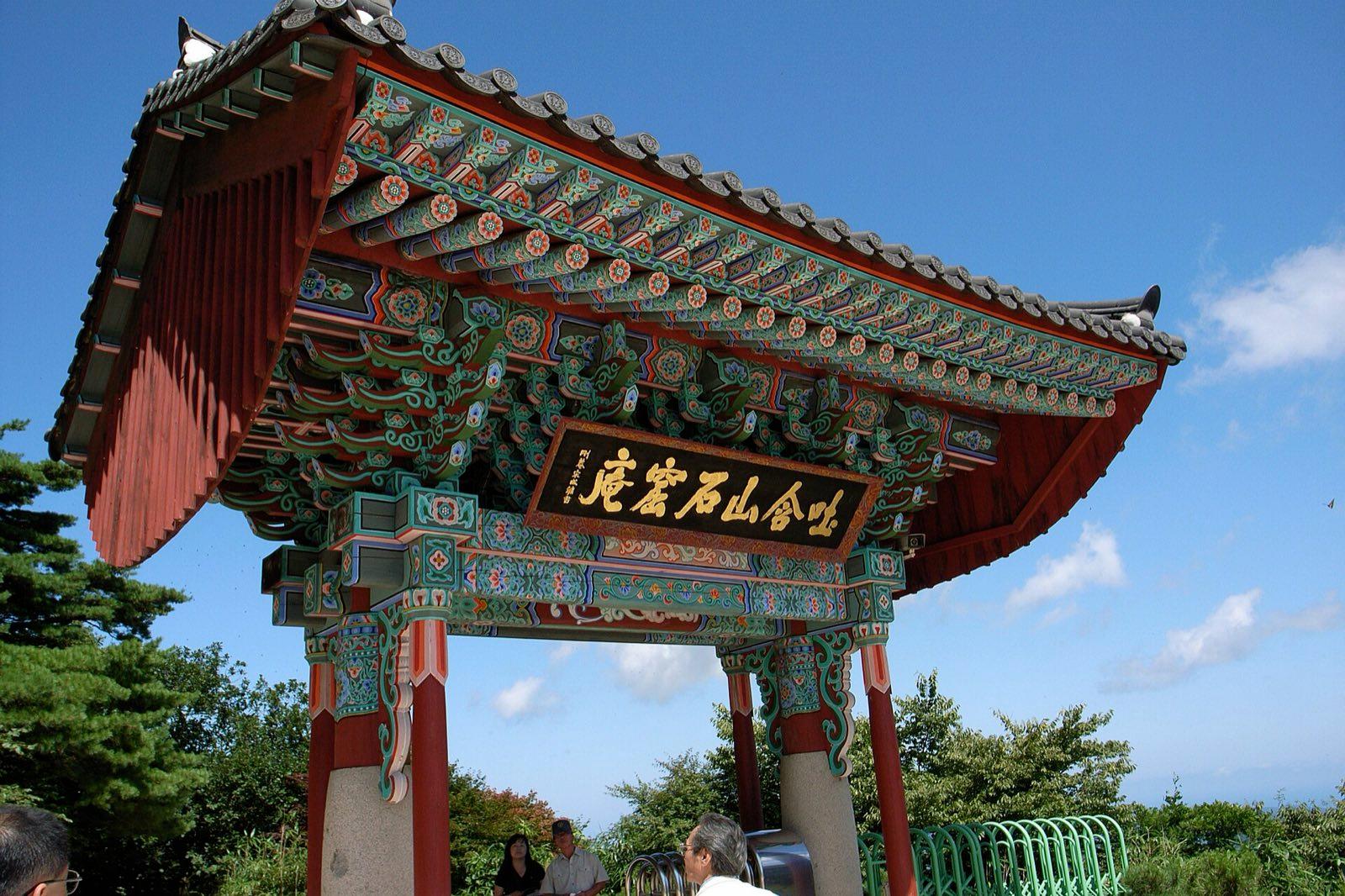
The entrance gate on the path to Seokguram grotto Photo: hiro kobashi from Japan, CC BY 2.0, via Wikimedia Commons (https://commons.wikimedia.org/wiki/File:Korea-Gyeongju-Seokguram_grotto-Iljumun_gate-01.jpg) Day 6: Haedong Yonggungsa and a free afternoon
Haeundae to Haedong Yonggungsa, then back to Haeundae and Gwangalli at dusk
- Drive about 1 h
- Breakfast
- Stay in Busan
Day 6 details
We are at Haedong Yonggungsa by about 8 am, before the tour coaches. First founded in the 14th century and rebuilt in the 20th, it is one of the few Korean temples built on the sea rather than in the mountains, and the steps lead down to halls on the rocks with the waves breaking below. Your guide explains the zodiac statues along the path and the custom of tossing coins for luck. We are back at the hotel by late morning, and the rest of the day is yours: the first fully free stretch of the trip, placed here so that the evening ferry tomorrow comes after a rested day. Your guide suggests the Haeundae Blueline Park beach train along the old coastal railway, the Busan Museum of Art or simply the beach. At dusk we meet and drive about 15 minutes to Gwangalli, the next beach west, to see the Gwangan Bridge lit over the bay.
Included
- Haedong Yonggungsa early, before the coaches
- Gwangalli beach and the Gwangan Bridge lit at dusk
Optional experiences
- Haeundae Blueline Park beach train or sky capsule
- An evening cruise past the Gwangan Bridge
Easier option: At Yonggungsa, the view from the top of the steps takes in the whole temple; you need not walk down.
More active option: Walk the coastal path from Mipo to Cheongsapo, about 2 km above the sea, with your guide's directions.
Free time: Late morning, afternoon and dinner free
Activity: About 108 steps down to Yonggungsa and back up.
Day 7: Gamcheon, Jagalchi and the night ferry to Japan
Haeundae to Gamcheon Culture Village and Jagalchi, then Busan Port by overnight ferry to Hakata, Fukuoka
- Drive about 1.5 h
- Breakfast, lunch and dinner
- Stay in Overnight ferry to Fukuoka
Day 7 details
After breakfast we check out and cross the city to Gamcheon Culture Village, a hillside of small houses built by refugees during the Korean War and painted in bright colours, and walk its lanes and stairways with your guide. A short hop down the hill brings us to lunch at Jagalchi, Korea's best-known fish market: choose fish, octopus or shellfish from the tanks downstairs and have it cooked upstairs. Then we walk through Gukje Market's covered lanes and stop for ssiat hotteok, a pancake filled with seeds and syrup. In the late afternoon our vehicle takes us and the luggage to the Busan Port International Passenger Terminal, a few minutes away, for dinner and the evening sailing across the Korea Strait to Hakata port in Fukuoka. This is our preferred crossing: you sleep in a cabin and wake up in Japan. If the sailing is cancelled or does not fit the dates, we fly from Gimhae to Fukuoka, about an hour, and stay in a Fukuoka hotel.
Included
- Gamcheon Culture Village with your guide
- Seafood lunch at Jagalchi fish market
- Walk through Gukje Market and a ssiat hotteok
- Dinner before or after boarding, timed to the sailing
- Overnight ferry from Busan to Hakata, Fukuoka, in cabins shared as your hotel rooms are
Optional experiences
- Busan Tower in Yongdusan Park
Easier option: At Gamcheon, stay on the main lane along the top of the hill instead of the stairways down into the village.
Free time: Free hour before boarding
Activity: Bring your passport for departure checks at the terminal. Cabins are compact; pack what you need for the night in your day bag. The ferry depends on the weather, and the flight fallback is booked by us at no extra cost if a sailing is cancelled.
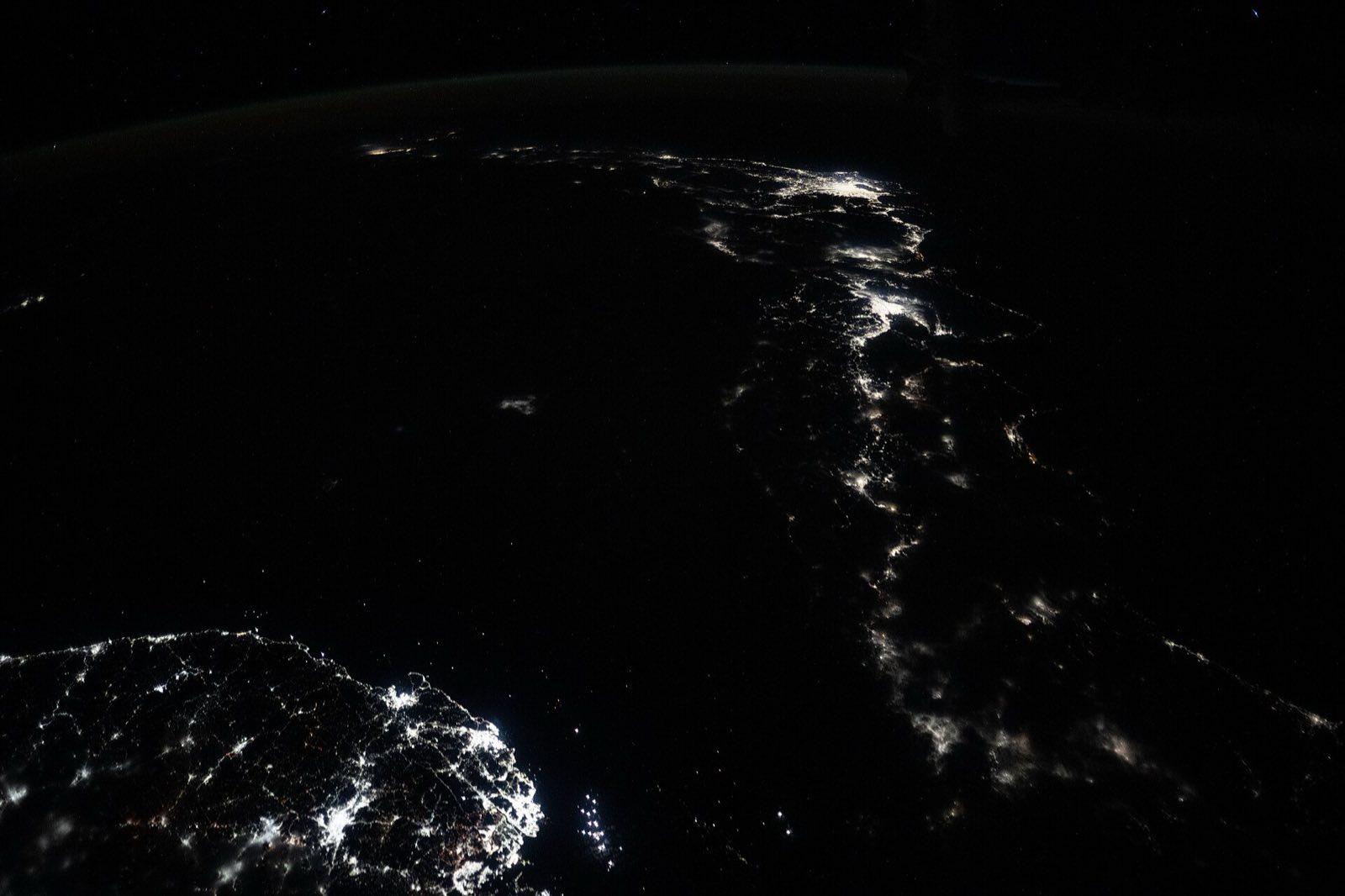
The Korea Strait at night from orbit, with Busan and Fukuoka on either shore Photo: NASA Johnson Space Center, Public domain, via Wikimedia Commons (https://commons.wikimedia.org/wiki/File:The_Korea_Strait_separates_Busan,_Korea,_and_Fukuoka,_Japan_(iss072e436132).jpg) Day 8: Hakata to Hiroshima and the Peace Park
Hakata port to Hakata Station, then shinkansen to Hiroshima: Peace Memorial Park and Museum
- Drive about 15 min
- Breakfast and lunch
- Stay in Hiroshima
Day 8 details
The ferry docks at Hakata port in the early morning and we clear Japanese immigration and customs. After breakfast at Hakata Station we take the shinkansen to Hiroshima, about an hour and five minutes, in reserved seats with room for our bags. We leave the luggage at the hotel and walk to Peace Memorial Park, laid out where the city centre stood before the atomic bomb of 6 August 1945. Your guide takes you from the Atomic Bomb Dome, listed by UNESCO in 1996, past the Children's Peace Monument and the cenotaph to the Peace Memorial Museum, where we spend about two hours. Where one can be arranged, we hear a testimony from a survivor or one of the trained successors who now tell their stories. Lunch is Hiroshima okonomiyaki, layered with noodles and cabbage and cooked on the griddle in front of you. The afternoon is free to rest after the night at sea.
Included
- Transfer from Hakata port to Hakata Station
- Shinkansen from Hakata to Hiroshima
- Peace Memorial Park and the Atomic Bomb Dome with your guide
- Hiroshima Peace Memorial Museum
- A testimony talk, where one can be arranged
- Okonomiyaki lunch
Optional experiences
- Shukkeien garden
- The grounds of Hiroshima Castle
Easier option: Sit out part of the museum in the park outside; it is a heavy visit and you can take it at your own pace.
Free time: Afternoon and evening free
Activity: On the flight fallback you wake in a Fukuoka hotel and take the same train. About 4 km on foot, all flat. Japan's arrival forms can be filled in ahead on Visit Japan Web.
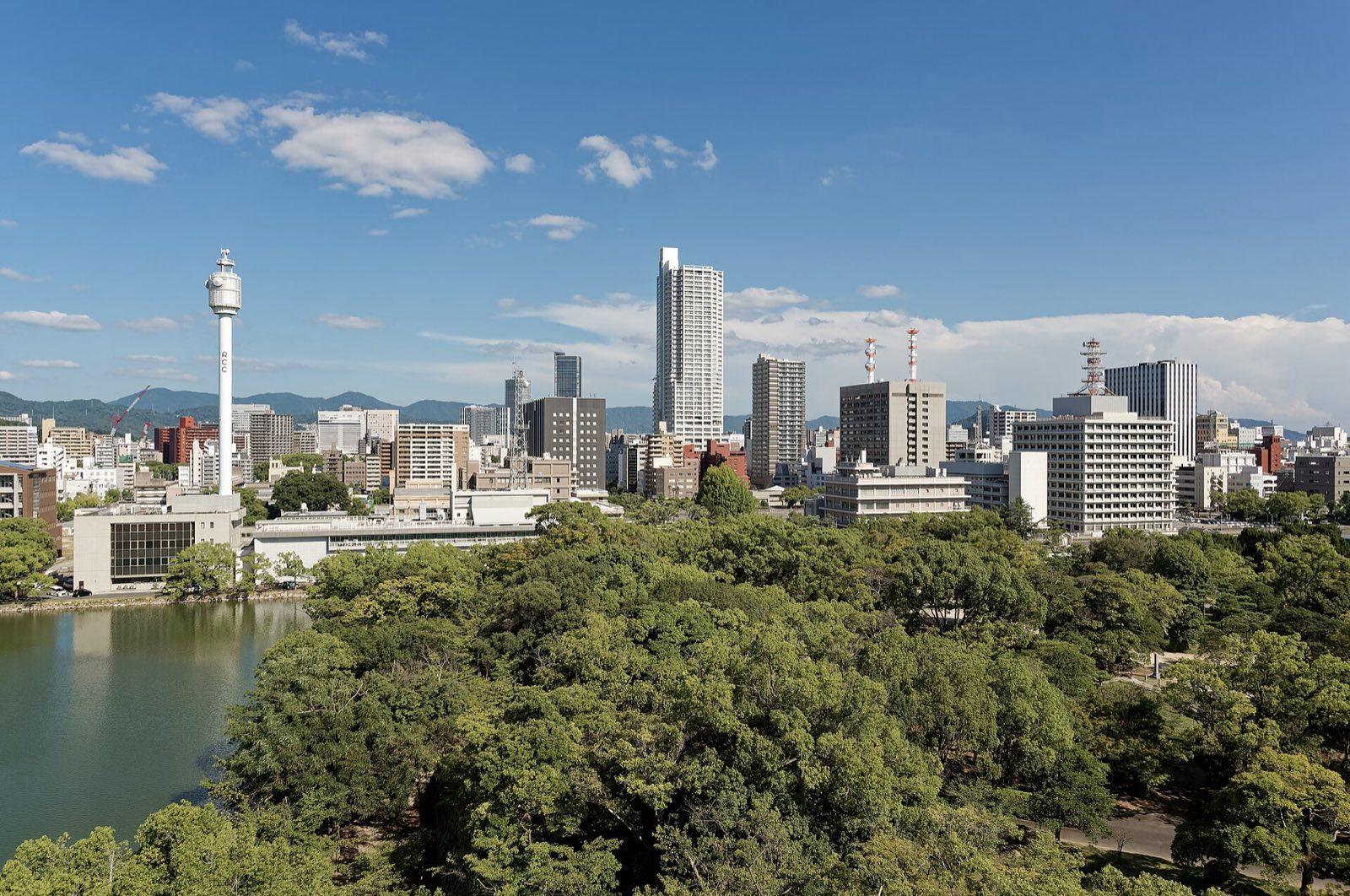
Central Hiroshima from above, with the hills behind Photo: Jakub Hałun, CC BY 4.0, via Wikimedia Commons (https://commons.wikimedia.org/wiki/File:View_from_Hiroshima_Castle_Keep_Tower,_20240817_1532_4320.jpg) Day 9: Miyajima early, then the shinkansen to Kyoto
Hiroshima to Miyajima by train and ferry, then shinkansen to Kyoto
- By train
- Breakfast and lunch
- Stay in Kyoto
Day 9 details
We leave early by train to Miyajimaguchi and take the ten-minute ferry across to Miyajima, so that we are on the island before the day-trippers. Itsukushima Shrine, listed by UNESCO in 1996, is built on piers over the tidal flats, and its great vermilion torii stands in the water at high tide; at low tide you can walk out to it on the sand. We see the shrine as it opens, then climb the lanes to Daisho-in, a temple on the slope of Mount Misen with rows of small stone figures and a path lined with prayer wheels. The island's deer wander the streets, so keep snacks out of sight. Lunch is anago-meshi, grilled conger eel on rice, a local dish. We are back in Hiroshima by about 1:30 to collect the bags and take the shinkansen to Kyoto, about an hour and three quarters, arriving at about 4:30 pm. The evening is free.
Included
- Train and ferry to Miyajima
- Itsukushima Shrine with your guide
- Daisho-in temple
- Anago-meshi lunch on the island
- Shinkansen from Hiroshima to Kyoto
Optional experiences
- The Mount Misen ropeway
Easier option: Stay on the flat seafront by the shrine and the shopping street instead of climbing to Daisho-in.
More active option: Climb a short way up the Daisho-in trail on Mount Misen for the view over the shrine and the sea before lunch.
Free time: Evening free in Kyoto
Activity: Tide times change the look of the torii; your guide checks them for the day. Miyajima charges a small visitor tax, included. About 5 km on foot with steps at Daisho-in.
Day 10: Fushimi Inari, Kiyomizu-dera and Gion
Kyoto: Fushimi Inari, then Higashiyama, Kiyomizu-dera and an evening walk in Gion
- By train
- Breakfast
- Stay in Kyoto
Day 10 details
We start at Fushimi Inari Taisha at about 7:30 am, when the tunnels of vermilion torii gates on the hill behind the shrine are still quiet and the light comes in low through the trees. The path is open day and night; most visitors turn back at the first viewpoint, and we go a little further, to where the gates thin out and the city opens below. From there we cross to Higashiyama and walk up to Kiyomizu-dera, a temple listed by UNESCO in 1994 whose wooden stage stands on tall pillars above the trees. We walk down the stepped lanes of Sannenzaka and Ninenzaka, past old wooden shopfronts, to lunch. The afternoon is free. In the early evening your guide leads a walk through Gion and along Hanamikoji and the Shirakawa canal, the old teahouse district, explaining the rules that now protect its private lanes and how to behave if you meet a geiko or maiko.
Included
- Fushimi Inari Taisha early with your guide
- Kiyomizu-dera
- Walk down Sannenzaka and Ninenzaka
- Evening walk through Gion and the Shirakawa canal
Optional experiences
- A tea ceremony
- A bike tour along the Kamo river
Easier option: Turn back at the first viewpoint at Fushimi Inari, about 30 minutes up, and take a taxi between Fushimi and Kiyomizu-dera.
More active option: Carry on to the summit of Inari-yama, about 2 to 3 hours up and down with many steps, and meet the group at lunch.
Free time: Afternoon free; dinner free
Activity: About 8 km on foot with many steps at Fushimi Inari and Kiyomizu-dera; both have shorter ways round.
Day 11: Nara: Todai-ji, the deer park and Kasuga Taisha
Kyoto to Nara by train and back
- By train
- Breakfast and lunch
- Stay in Kyoto
Day 11 details
Nara was Japan's capital in the 8th century, before Kyoto, and its temples and shrines are listed by UNESCO as the Historic Monuments of Ancient Nara. The train takes about 45 minutes, and we start at Todai-ji soon after it opens, when the Great Buddha Hall, one of the largest wooden buildings in the world, is still calm inside. The bronze Buddha sits about 15 metres high. From there we walk through Nara Park, where more than a thousand deer roam free and bow for the special crackers sold by the paths. A forest path lined with stone lanterns leads to Kasuga Taisha, the shrine of the Fujiwara clan, with hundreds of bronze lanterns hanging from its vermilion corridors. Lunch is in Naramachi, the old merchant quarter, then we take the train back to Kyoto by mid-afternoon. The rest of the day is free, perhaps for Nishiki Market or a temple of your choice.
Included
- Train from Kyoto to Nara and back
- Todai-ji and the Great Buddha Hall with your guide
- Nara Park and its deer
- Kasuga Taisha
- Lunch in Naramachi
Optional experiences
- Nishiki Market food walk in Kyoto
Easier option: Take a taxi between Todai-ji and Kasuga Taisha, about 2 km, and wait in Naramachi for lunch.
Free time: Mid-afternoon and evening free
Activity: About 7 km on foot on gravel and forest paths. The deer can nip if you hold crackers too long; your guide shows you how to feed them.
Day 12: Arashiyama, then to Hakone and a ryokan night
Kyoto: Arashiyama and Tenryu-ji, then shinkansen to Odawara and on to Hakone
- Drive about 1 h
- Breakfast, lunch and dinner
- Stay in Hakone
Day 12 details
We are in the Arashiyama bamboo grove by about 8 am, before the crowds that fill it later in the morning, then walk to Tenryu-ji, a Zen temple listed by UNESCO in 1994, whose 14th-century garden of a pond and rocks borrows the hills behind it as scenery. Your main suitcase goes ahead to Tokyo by luggage delivery this morning, so you travel with only an overnight bag. Late in the morning we take the shinkansen east from Kyoto to Odawara, about two hours, with a bento lunch on board, and on clear days Mount Fuji appears on the left side of the train. At Odawara our vehicle takes us up into Hakone, about 45 minutes, to a ryokan, a traditional inn with its own hot-spring baths. Change into a yukata, try the onsen before dinner, and sit down to a kaiseki dinner, a sequence of small seasonal courses served in your room or a private dining room.
Included
- Arashiyama bamboo grove early
- Tenryu-ji and its garden
- Shinkansen from Kyoto to Odawara with a bento lunch
- Luggage delivery of your main suitcase from Kyoto to Tokyo
- Ryokan night in Hakone with its onsen
- Kaiseki dinner
Easier option: Skip Tenryu-ji's garden and wait at a café by the bamboo grove.
Free time: Late afternoon free at the ryokan
Activity: Onsen bathing is usually separate for men and women and without swimwear; private baths can be requested at booking where the ryokan has them. Some onsen do not admit guests with large tattoos; tell us when you book. About 4 km on foot.
Day 13: Lake Ashi, Owakudani and on to Tokyo
Hakone: Owakudani and Lake Ashi, then Odawara to Tokyo by shinkansen
- Drive about 1.5 h
- Breakfast and lunch
- Stay in Tokyo
Day 13 details
After a Japanese breakfast at the ryokan, our vehicle takes us round the Hakone loop. We ride the Hakone Ropeway over Owakudani, a volcanic valley where steam and sulphur vents rise from the hillside, and stop to try a kuro-tamago, an egg boiled black in the hot springs. Then we cross Lake Ashi by sightseeing boat, with Mount Fuji visible across the water on clear mornings, often in the cooler months. At Moto-Hakone we walk through Onshi Hakone Park, a small hill park on a point of the lake with a view of the water and, on clear days, Fuji. Lunch is in Moto-Hakone, then the vehicle takes us down to Odawara for the shinkansen to Tokyo, about 35 minutes. We reach the hotel by about 4 pm, where your suitcase is waiting. In the early evening your guide takes you to Shibuya to cross the famous scramble at dusk.
Included
- Hakone Ropeway over Owakudani
- Lake Ashi sightseeing boat
- Onshi Hakone Park
- Lunch in Moto-Hakone
- Shinkansen from Odawara to Tokyo
- Shibuya crossing at dusk with your guide
Optional experiences
- Hakone Open-Air Museum on request, instead of the ropeway
Easier option: Stay on the boat and in the park, and skip the evening in Shibuya.
Free time: Evening free after Shibuya
Activity: The ropeway closes in high winds or when volcanic activity at Owakudani rises; then we take the road round the lake instead. Fuji is often hidden by cloud; it is never a promise.
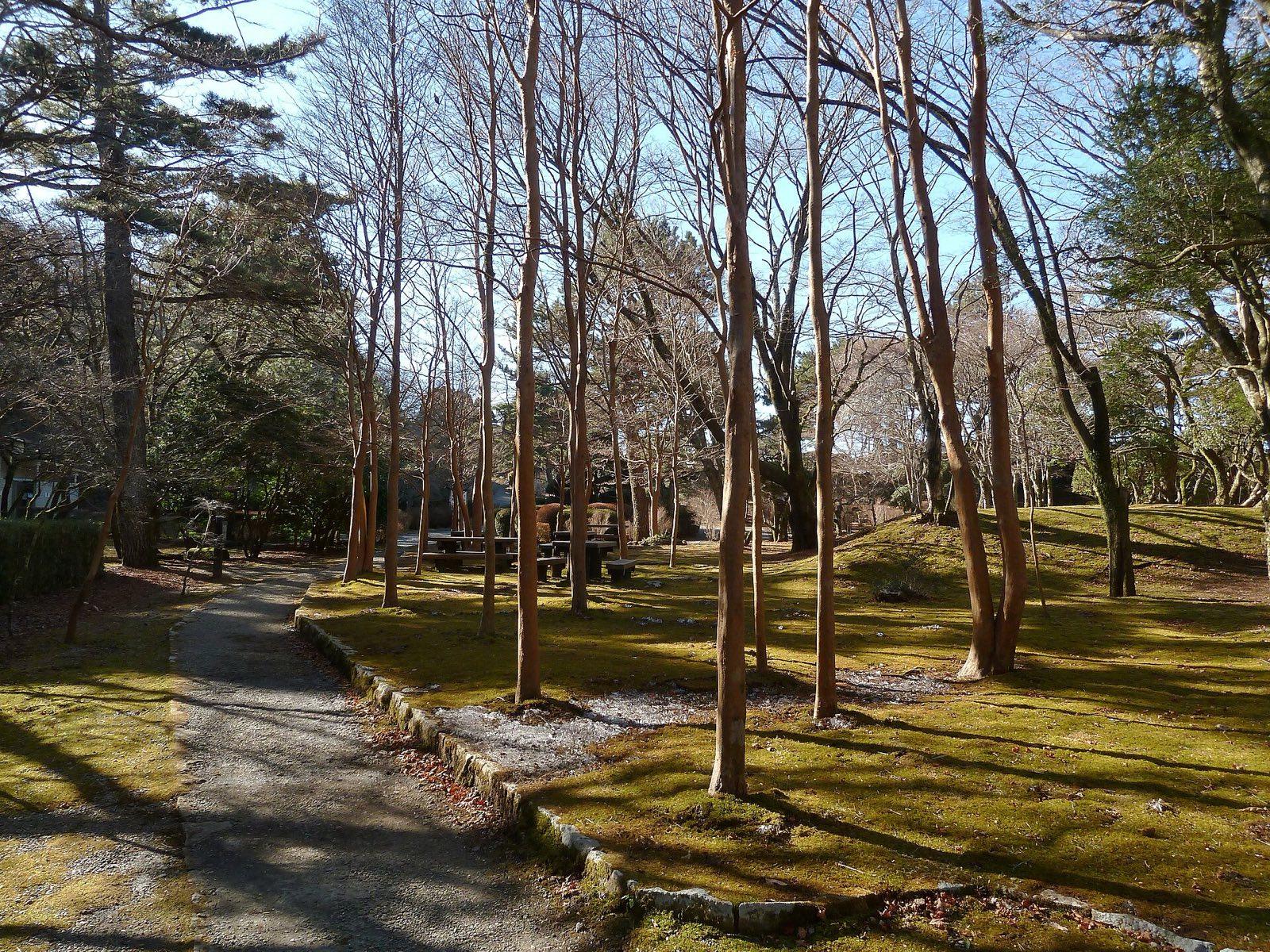
Woodland in Onshi Hakone Park, on a point of Lake Ashi Photo: Quercus acuta, CC0, via Wikimedia Commons (https://commons.wikimedia.org/wiki/File:Onshi-Hakone-Park_-_03.jpg) Day 14: Asakusa, Tsukiji and a farewell dinner
Tokyo: Senso-ji in Asakusa, Tsukiji Outer Market, then Meiji Jingu
- By train
- Breakfast, lunch and dinner
- Stay in Tokyo
Day 14 details
We are at Senso-ji in Asakusa by about 7:30 am, when the Thunder Gate and Nakamise street are quiet and locals stop to pray before work. It is Tokyo's oldest temple, founded in the 7th century, and the main hall is open from early morning. Then we ride the metro to the Tsukiji Outer Market, the lanes of food stalls and knife shops that stayed when the wholesale fish market moved to Toyosu in 2018, and eat our way through lunch: tamagoyaki, grilled scallops, a bowl of fresh fish on rice. In the early afternoon we walk the gravel paths through the forest to Meiji Jingu, the shrine to the Meiji emperor, then the rest of the afternoon is free for Harajuku, the Imperial Palace East Gardens or the museums of Ueno. In the evening we meet for a farewell dinner at an izakaya, sharing small plates around one table.
Included
- Senso-ji early with your guide
- Tsukiji Outer Market food walk and lunch
- Meiji Jingu
- Farewell dinner at an izakaya
Optional experiences
- Imperial Palace East Gardens
- Ueno Park and the Tokyo National Museum
- A sumo morning practice, when one can be booked
Easier option: Ride the metro and taxis between stops; skip Meiji Jingu and go back to the hotel after lunch.
More active option: Walk from Asakusa along the Sumida river to the Tokyo Skytree area, about 2 km, before the metro.
Free time: Afternoon free
Activity: Many Tsukiji Outer Market shops close on Sundays and some Wednesdays, so we set the day around them. About 8 km on foot.
Day 15: Depart from Tokyo
Tokyo hotel to Haneda (HND) or Narita (NRT) airport
- Drive about 45 min
- Breakfast
Day 15 details
Your trip ends after breakfast. Your guide says goodbye at the hotel, and a transfer takes you to the airport at a time set by your flight: Haneda (HND) is about 30 to 45 minutes away, Narita (NRT) about 75 to 90 minutes, depending on traffic. If your flight leaves late, the hotel holds your bags after check-out, and your guide will have suggestions for a last morning in the city, such as the Imperial Palace East Gardens or a walk through Ginza. If you would like to stay on in Tokyo, or add a few days in Osaka or elsewhere in Japan, ask us for extra hotel nights and a plan when you book. Leftover yen can be used on your transit card for snacks and drinks before you fly; Japan charges a departure tax that is added to your airline ticket, not paid at the airport.
Included
- Transfer to Haneda (HND) or Narita (NRT) airport
Activity: Flying from Haneda: book a flight after about 11 am. Flying from Narita: book a flight after about 1 pm.
Wildlife and weather: Spring brings cherry blossom from late March in Japan and early April in Korea, with the biggest crowds of the year in Kyoto, and mild days through May. Autumn is clear and dry, with maple colour in Korea's mountains from mid October and in Kyoto from mid November; Mount Fuji shows most often on cool, clear autumn mornings. From November Seoul's palaces close an hour earlier, at 5 pm. June to mid July is the rainy season in both countries, summer is hot and humid, and typhoons can disrupt the ferry from August to October.
14 nights
Where you'll stay
Your hotels are named in your trip confirmation.
- Seoul3 nights
- Gyeongju1 night
- Busan2 nights
- Overnight ferry to Fukuoka1 night
- Hiroshima1 night
- Kyoto3 nights
- Hakone1 night
- Tokyo2 nights
One price
What's in the price
Included
Accommodation
- 14 nights: 3 in central Seoul near the palaces, 1 in central Gyeongju, 2 near Haeundae beach in Busan, 1 on the overnight ferry to Fukuoka (or a Fukuoka hotel on the flight fallback), 1 in central Hiroshima, 3 in central Kyoto, 1 in a Hakone ryokan with hot-spring baths and 2 in central Tokyo
- Central hotels of a 3-star-plus standard or better, named when we confirm your dates
- Rooms and ferry cabins shared, or your own for a supplement
Transport
- Pick-up at Incheon International Airport (ICN) on day 1 and a transfer to Haneda (HND) or Narita (NRT) on day 15
- A private air-conditioned vehicle and driver in Korea, which carries your luggage by road on the KTX day
- KTX high-speed train from Seoul to Gyeongju
- Overnight ferry from Busan to Hakata, Fukuoka, or a flight from Gimhae to Fukuoka if the sailing is cancelled or does not fit the dates
- Shinkansen from Hakata to Hiroshima, Hiroshima to Kyoto, Kyoto to Odawara and Odawara to Tokyo, in reserved seats
- Trains to Miyajimaguchi and Nara, the Miyajima ferry, the Hakone Ropeway and the Lake Ashi boat
- A private vehicle in Hakone
- Luggage delivery of your main suitcase from Kyoto to Tokyo
- Transit cards for the Seoul and Tokyo metros
Your guide
- A See Sight Tours guide with the group from arrival in Seoul to the last morning in Tokyo, across both countries and on the ferry
- A licensed DMZ guide on day 3
- Local guides at Huwon, the Secret Garden, and where other sites require them
Activities
- Seoul: Changdeokgung and a guided Huwon (Secret Garden) tour, Bukchon, Gwangjang Market and Gyeongbokgung
- DMZ: Imjingak and the Freedom Bridge, the Third Tunnel and Dora Observatory
- Gyeongju: Daereungwon and Cheonmachong, Cheomseongdae, Donggung Palace and Wolji Pond at dusk, Bulguksa and Seokguram
- Busan: Dongbaekseom and Haeundae, Haedong Yonggungsa, Gwangalli at dusk, Gamcheon Culture Village, Jagalchi and Gukje markets
- Hiroshima: Peace Memorial Park, the Atomic Bomb Dome and the Peace Memorial Museum, with a testimony talk where one can be arranged
- Miyajima: Itsukushima Shrine and Daisho-in, and the visitor tax
- Kyoto: Fushimi Inari Taisha, Kiyomizu-dera, Sannenzaka and Ninenzaka, an evening walk in Gion, the Arashiyama bamboo grove and Tenryu-ji
- Nara: Todai-ji, Nara Park and Kasuga Taisha
- Hakone: Owakudani, Lake Ashi and Onshi Hakone Park, with a night in a ryokan with an onsen
- Tokyo: Shibuya crossing, Senso-ji, a Tsukiji Outer Market food walk and Meiji Jingu
Meals
- 14 breakfasts
- 11 lunches, including Gwangjang Market street food, seafood at Jagalchi, Hiroshima okonomiyaki, anago-meshi on Miyajima, a shinkansen bento and a Tsukiji food walk
- 4 dinners: a welcome Korean barbecue in Seoul, dinner on the ferry day, a kaiseki dinner at the Hakone ryokan and a farewell izakaya dinner in Tokyo
Not included
- International flights into Seoul (Incheon) and out of Tokyo (Haneda or Narita)
- K-ETA travel authorisation for Korea, if your passport needs one
- Travel insurance
- Lunches and dinners not listed above
- Drinks
- Tips for your guide, local guides and drivers (tipping is not expected in Japan)
- Optional activities: the National Museum of Korea, N Seoul Tower, the War Memorial of Korea, the Gyeongju National Museum, a jjimjilbang, the Blueline Park beach train, a Busan evening cruise, Busan Tower, Shukkeien, the Mount Misen ropeway, a tea ceremony, a Kyoto bike tour, the Hakone Open-Air Museum, the Imperial Palace East Gardens, Ueno museums and a sumo morning practice
- Extra luggage delivery beyond one suitcase per person
- Personal expenses such as laundry and shopping
Extras
- Room of your own
- CAD 1,700 (estimated price)

See Sight Tours has been providing travel services across North America since 2006. Operating in 20 cities across Canada and the USA, the company specializes in small group tours that offer personalized, high-quality experiences for travelers.


Book your Tour
Get in Touch
- Toll Free1-888-961-6584
- Local1-289-271-9767


© 2026 See Sight Tours. All rights reserved.