Printable itinerary
Ecuador and the Galapagos: Quito, Cotopaxi, Banos and three islands
14 days · Quito to San Cristobal · up to 12 guests
From CAD 6,710 per person, sharing a room (estimated price. Estimated price. The itinerary, hotels and availability are proposed and subject to confirmation. Your quote will set out the booking conditions; sending a request does not confirm a booking.)
Black Friday offer: 15% off the small-group price for requests received by Dec 1, 2026. From CAD 6,710 per person. Dec 2 to Dec 31: from CAD 7,265. From Jan 1, 2027: from CAD 7,895. The offer ends at 11:59 pm Toronto time and is for the small-group style only.
Day by day
Itinerary
- Quito2 nights
- Otavalo1 night
- Cotopaxi1 night
- Banos1 night
- Quito1 night
- Puerto Ayora3 nights
- Puerto Villamil3 nights
- Puerto Baquerizo Moreno1 night
- San Cristobalend
- Overnight stop
- Day trip
- By boat or train
Day 1: Arrive in Quito
Mariscal Sucre International Airport to your hotel by Quito's Old Town
- Drive about 1 h
- Welcome dinner
- Stay in Quito
Day 1 details
Fly into Mariscal Sucre International Airport (UIO) at Tababela, about an hour east of the city, where a driver meets you in arrivals and takes you to your hotel in or beside the Old Town. Quito sits at about 2,850 m in a long Andean valley under the Pichincha volcano, so the first day is gentle on purpose: walk slowly, drink plenty of water and go easy on alcohol tonight. If you land early, the Plaza Grande is a few minutes' walk from the hotel and a good place to sit in the sun while shoe-shiners and office workers cross the square. At about 7 pm your See Sight Tours guide meets the group for a short briefing on the two weeks ahead, from how the altitude feels in the Andes to the biosecurity rules for the Galapagos flight. Then we walk to a welcome dinner of Ecuadorian dishes such as locro de papa, a potato and cheese soup served with avocado. If your flight lands after about 5 pm, your guide catches up with you at breakfast.
Included
- Pick-up at Mariscal Sucre International Airport (UIO)
- Welcome briefing with your guide
- Welcome dinner in the Old Town
Free time: Free until the evening briefing
Activity: Quito is at about 2,850 m. Rest, drink water and keep the first evening light.
Day 2: Quito's Old Town and the equator
Quito's Old Town on foot, then north to the Mitad del Mundo and back
- Drive about 1.5 h
- Breakfast and lunch
- Stay in Quito
Day 2 details
We start in the Old Town at 8:30 am, while the streets are still quiet and the light is soft on the facades. Quito's historic centre was among the first places on the UNESCO list, in 1978, and it is still a lived-in city of churches, convents and balconied streets. Your guide walks you across the Plaza Grande, past the Presidential Palace and the cathedral, to the broad plaza of San Francisco. Once the churches open, from about 9:30 (we confirm entry times for your date), we go into La Compania de Jesus, whose nave is covered in gold leaf, and climb the towers of the Basilica del Voto Nacional for the view over red roofs to El Panecillo. Lunch is a sit-down meal in the Old Town. In the afternoon we drive about 45 minutes north to the Ciudad Mitad del Mundo, where a 30 m monument marks the equator line measured by the French Geodesic Mission in the 1730s, a couple of hundred metres from where GPS puts it today. A short walk away, the private Intinan museum demonstrates the equator experiments. We are back at the hotel by about 5 pm, and the evening is yours.
Included
- Quito Old Town walk with your guide: Plaza Grande, the cathedral and the plaza of San Francisco
- La Compania de Jesus, inside
- The towers of the Basilica del Voto Nacional
- Sit-down lunch in the Old Town
- Ciudad Mitad del Mundo equator monument
- Intinan museum
Easier option: Skip the Basilica tower climb and wait in the plaza below, or rest at the hotel instead of the equator visit.
Free time: Evening free in Quito
Activity: About 2 to 3 km on foot in the Old Town, with hills and steep steps inside the Basilica towers.
Day 3: Otavalo market, Cotacachi and Cuicocha
Quito north to Otavalo, then Cotacachi and the Cuicocha crater lake
- Drive about 3 h
- Breakfast, lunch and dinner
- Stay in Otavalo
Day 3 details
We leave at 8 am and drive about two hours north on the Pan-American Highway, past the flower farms around Cayambe and, on a clear morning, the snow cap of Cayambe volcano. In Otavalo, at about 2,550 m, we walk the Plaza de los Ponchos, the craft market that runs every day and spreads into the surrounding streets on Saturdays: woven ponchos and blankets, alpaca wool, embroidered blouses and tagua-nut carvings. Your guide explains how bargaining works here, then leaves you an hour to browse. After a sit-down lunch we drive 20 minutes to Cotacachi, a small town whose main street is lined with leather workshops, then up to Laguna Cuicocha, a crater lake at about 3,070 m in the Cotacachi-Cayapas reserve, with two wooded islands in the middle. A short walk along the rim trail gives the classic view across the water to Cotacachi volcano. We settle into a country hotel in the Otavalo valley by late afternoon, with time to rest before dinner at the hotel.
Included
- Plaza de los Ponchos craft market in Otavalo, with time to browse
- Sit-down lunch in the Otavalo valley
- Cotacachi and its leather street
- Laguna Cuicocha crater lake and a rim walk
- Dinner at the hotel
Easier option: Stay at the Cuicocha viewpoint by the visitor centre instead of walking the rim path.
More active option: Walk a longer section of the Cuicocha rim trail, up to about two hours, while the group waits in Cotacachi; the full loop is about 14 km and takes most of a day, so it is not on this trip.
Free time: Late afternoon free at the hotel
Activity: Cuicocha is at about 3,070 m, higher than Quito; walk slowly on the rim.
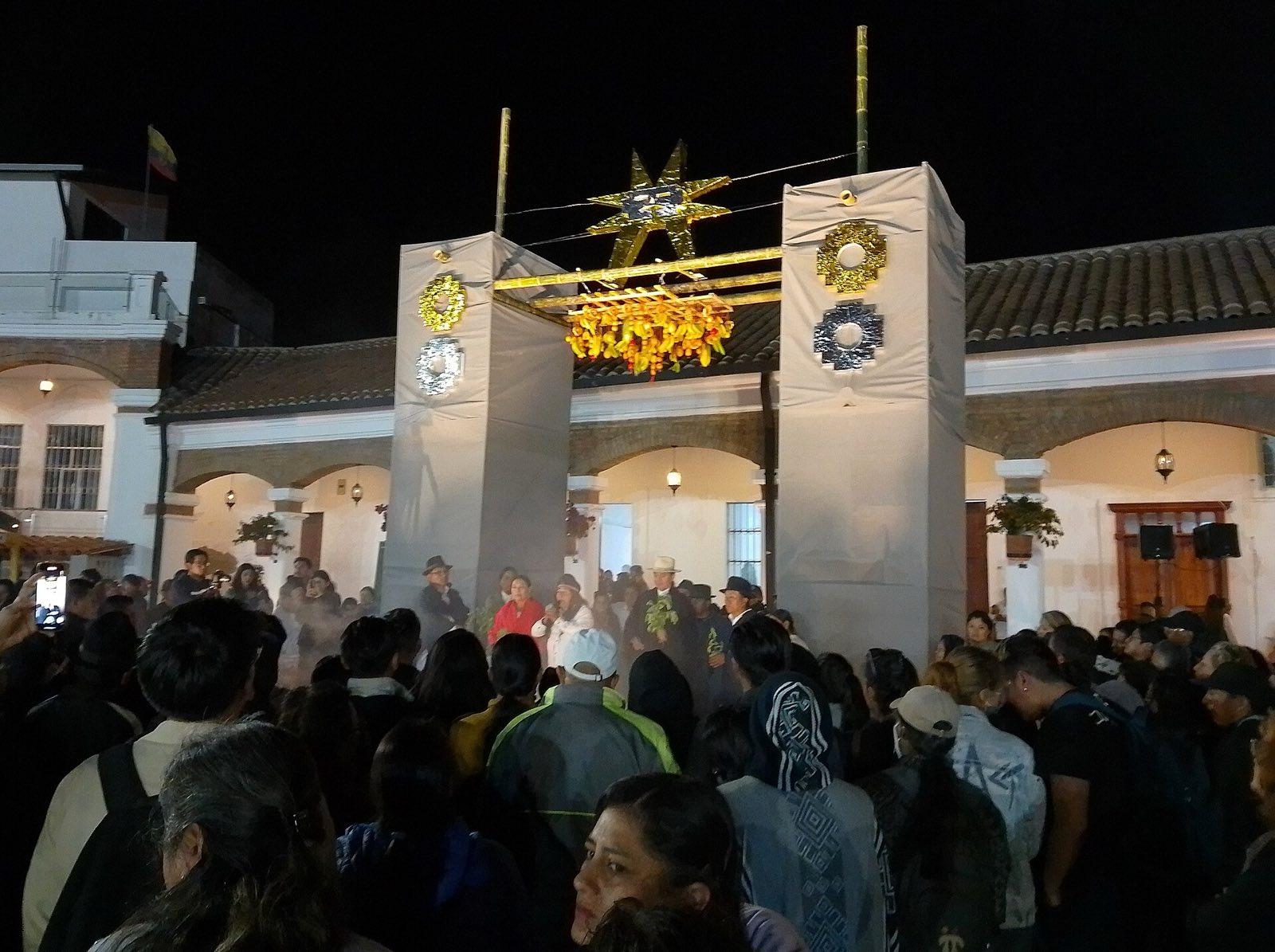
Otavalo during the June Inti Raymi festival; on market days the same streets fill with stalls Photo: Arabsalam, CC BY 4.0, via Wikimedia Commons (https://commons.wikimedia.org/wiki/File:Inti_Raymi_Otavalo_Ecuador_1685.jpg) Day 4: Peguche waterfall, then south to Cotopaxi
Otavalo to the Peguche waterfall, then south via Cayambe and the Machachi valley to a country hotel near Cotopaxi National Park
- Drive about 4 h
- Breakfast, lunch and dinner
- Stay in Cotopaxi
Day 4 details
We start at 8 am with a short walk through eucalyptus to the Peguche waterfall, a sacred site for the Kichwa communities of the valley, while it is still quiet. Then comes the longest drive of the mainland week, about four hours in all, kept to our cap by using the highway that skirts east of Quito rather than crossing the city. We break it after an hour in Cayambe, a market town known for its bizcochos, crisp butter biscuits baked in wood ovens and eaten with fresh cheese, and again for a sit-down lunch on the way south. The road then turns onto what the explorer Alexander von Humboldt is said to have called the Avenue of the Volcanoes, with Rumiñahui, the Illinizas and, if the cloud lifts, Cotopaxi itself ahead. We reach a country hotel near the park in the mid-afternoon, chosen for heating or a fireplace and a height at or below about 3,500 m. The rest of the afternoon is free to rest, walk the grounds or sit by the fire, and dinner is at the hotel.
Included
- Peguche waterfall walk
- Bizcocho stop in Cayambe
- Sit-down lunch on the way south
- Dinner at the country hotel near Cotopaxi
Easier option: Skip the Peguche walk and have a slow breakfast at the hotel.
Free time: Late afternoon free at the hotel
Activity: About four hours of driving, broken by Cayambe and lunch. Tonight you sleep higher than Quito, so keep drinking water.
Day 5: Cotopaxi at opening, then down to Banos
Cotopaxi National Park and Limpiopungo lagoon, then south via Latacunga and Ambato to Banos
- Drive about 3.5 h
- Breakfast and lunch
- Stay in Banos
Day 5 details
After an early breakfast we enter Cotopaxi National Park as it opens, when the cone is most often clear of cloud. Cotopaxi rises to 5,897 m and is one of the highest active volcanoes in the world, with eruptive phases as recently as 2015 and 2022 to 2023. Our walk is the easy loop around Limpiopungo lagoon at about 3,800 m on the open paramo: about 3 km, flat and slow, with the glaciers above and a good chance of wild horses, Andean gulls and lapwings, and with luck a white-tailed deer or a condor. Your guide sets the pace and watches how everyone is breathing. Those who want more can drive up to the car park at about 4,600 m and climb to the Jose Rivas refuge at 4,864 m, about an hour of steep zigzags on volcanic sand, when the park has that route open. We meet for lunch near the park, then drive about two and a half hours south through Latacunga and Ambato, dropping some 2,000 m to Banos, a spa town in a green gorge under Tungurahua volcano. The evening is free.
Included
- Cotopaxi National Park at opening with your guide
- Limpiopungo lagoon walk, about 3 km
- Sit-down lunch near the park
Easier option: Walk part of the lagoon loop, or stay with the vehicle at the viewpoints and the park's small interpretation centre.
More active option: Climb from the car park at about 4,600 m to the Jose Rivas refuge at 4,864 m, about an hour up, when the park has the route open.
Free time: Evening free in Banos
Activity: The highest day of the trip, at about 3,800 m on the lagoon walk. If the park closes because of volcanic activity, your guide leads a paramo walk nearby instead.
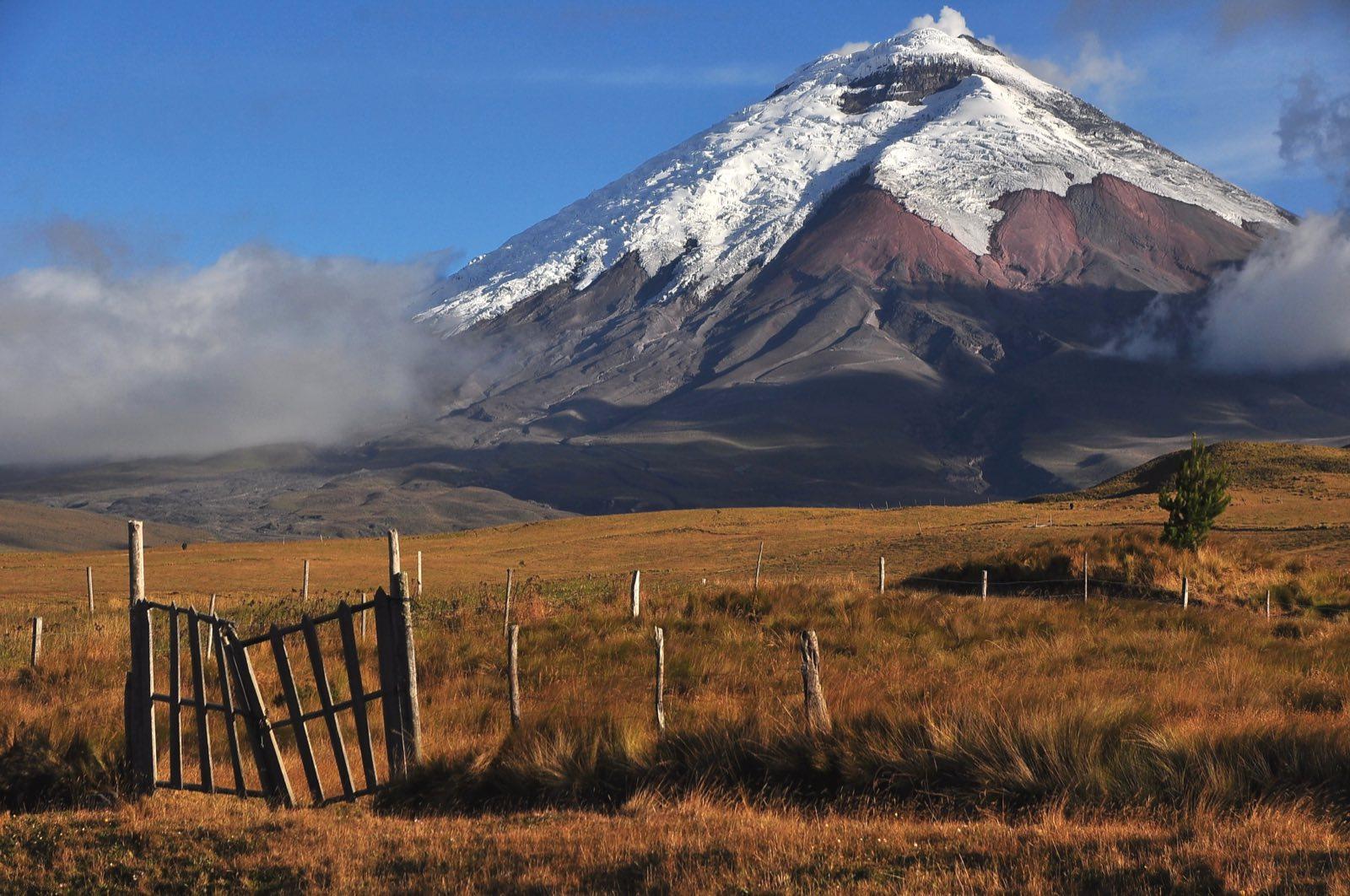
Cotopaxi on a clear day over the paramo Photo: Rinaldo Wurglitsch from Vienna, Austria, CC BY 2.0, via Wikimedia Commons (https://commons.wikimedia.org/wiki/File:Cotopaxi_(37399959476).jpg) Day 6: The Pailon del Diablo, then back to Quito
Banos down the Pastaza gorge to the Pailon del Diablo at Rio Verde, then north via Ambato and Latacunga to Quito
- Drive about 4.5 h
- Breakfast and lunch
- Stay in Quito
Day 6 details
We leave Banos at about 7:30 am to reach the Pailon del Diablo at Rio Verde, 18 km down the Pastaza gorge, before the day's visitors. A path of about 20 to 30 minutes, with steps, leads down through the forest to the falls, around 80 m high, where the river crashes into a rock bowl; ledges and a suspension bridge put you close enough to get wet, so bring a rain jacket. On the way back we stop above the Manto de la Novia falls, where small cable cars cross the gorge. After an early sit-down lunch in Banos we drive north to Quito, about three and a half hours. That makes this the one mainland day over our four-hour cap, by about half an hour, because the flight to the Galapagos leaves from Quito in the morning and a second night in Banos would mean a pre-dawn drive to the airport. A coffee stop in the highlands breaks the drive, and we reach the hotel in the late afternoon with the evening free to repack: one soft bag for the islands.
Included
- Pailon del Diablo waterfall at Rio Verde, early
- Manto de la Novia viewpoint
- Sit-down lunch in Banos
Easier option: See the falls from the viewpoint at the top of the path instead of walking down the steps.
Free time: Evening free in Quito
Activity: About four and a half hours of driving in two legs, either side of lunch. The path to the Pailon has steps both ways and is wet near the falls; wear shoes with grip.
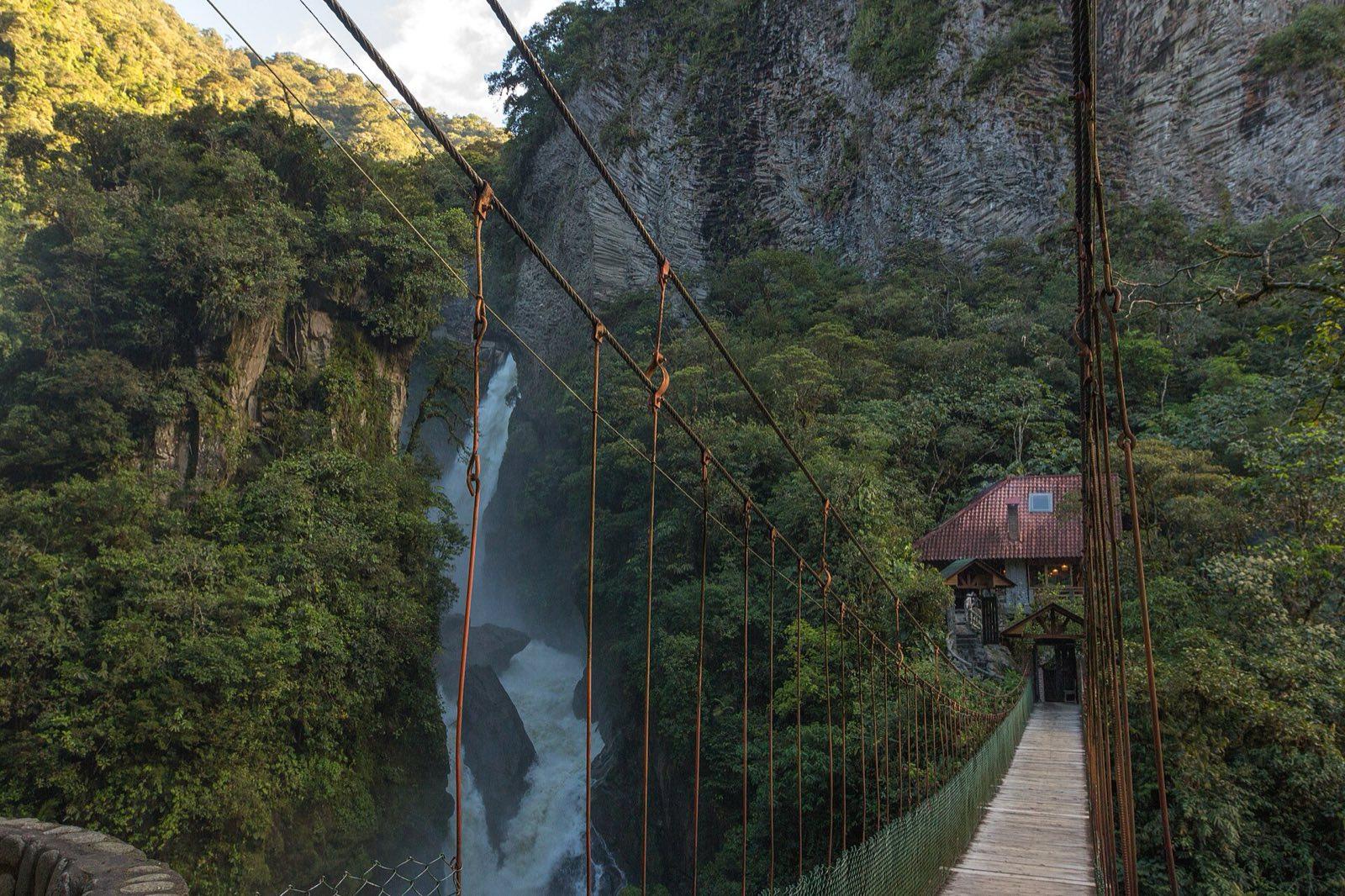
The suspension bridge across the gorge at the Pailon del Diablo near Banos Photo: Sebastian Reategui, CC0, via Wikimedia Commons (https://commons.wikimedia.org/wiki/File:Pail%C3%B3n_del_Diablo,_cerca_a_Ba%C3%B1os,_Ecuador_(3258).jpg) Day 7: Fly to the Galapagos, tortoises in the highlands
Quito to Baltra by air, across the Itabaca Channel and through the Santa Cruz highlands to Puerto Ayora
- Drive about 2 h
- Breakfast and lunch
- Stay in Puerto Ayora
Day 7 details
An early transfer to the airport, where we pay the Transit Control Card and check bags through the biosecurity scan, then the flight to Baltra, about two and a half hours, sometimes with a stop in Guayaquil. On landing you pay the national park fee and meet your park naturalist guide, who joins your See Sight Tours guide on every island visit. A short bus ride and a ferry across the Itabaca Channel bring us onto Santa Cruz. We break the drive south in the highlands, where giant tortoises roam free in the grassland and mud pools of a private reserve, and you can walk through a lava tunnel. Lunch is a sit-down meal in the highlands. We reach Puerto Ayora in the afternoon and check in for three nights. Before dinner, walk down to the fish market on the waterfront, where pelicans and a sea lion or two wait beside the fishermen's tables.
Included
- Flight from Quito to Baltra (GPS)
- Baltra bus and Itabaca Channel crossing
- Giant tortoises in the wild at a highland reserve, with a lava tunnel
- Sit-down lunch in the Santa Cruz highlands
Free time: Evening free in Puerto Ayora
Activity: Flight times are set by the airline; the start may be before 7 am. Bring US cash for the transit card and the park fee paid at Baltra.
Day 8: Tortuga Bay at opening, the Darwin Station
Puerto Ayora to Tortuga Bay on foot, then the Charles Darwin Research Station
- Breakfast
- Stay in Puerto Ayora
Day 8 details
For those who want it, we are at the start of the Tortuga Bay trail when it opens, around 6 am, and walk the 2.5 km stone path through a forest of giant prickly-pear cactus while it is still cool. The trail ends at Playa Brava, a long white beach where the surf is too strong to swim but marine iguanas cross the sand in the early light. Walk to its far end and the calm lagoon of Playa Mansa opens up, sheltered by mangroves, where you can swim or snorkel with small reef sharks, rays and turtles in the shallows. Breakfast is packed for the beach so we do not lose the quiet hours. We walk back before midday, and the afternoon is free for a nap, a cafe on the waterfront or the shops along Avenida Charles Darwin. In the late afternoon we visit the Charles Darwin Research Station and the Fausto Llerena tortoise centre, where young tortoises are reared for release, and see the preserved body of Lonesome George.
Included
- Tortuga Bay walk at opening, with time to swim and snorkel at Playa Mansa
- Charles Darwin Research Station and the Fausto Llerena tortoise centre
- Snorkel gear and a wetsuit for the island days
Easier option: Skip the 6 am start: breakfast at the hotel and join the group for the afternoon and the Darwin Station, or take the water taxi back from Playa Mansa instead of walking, when it runs.
Free time: Afternoon and evening free in Puerto Ayora
Activity: About 5 km of walking in total, on a stone path and soft sand. Swim only at Playa Mansa; Playa Brava has strong currents.
Day 9: A day boat to an uninhabited island
Puerto Ayora to the Itabaca Channel, then by boat to North Seymour, South Plaza, Santa Fe or Bartolome
- Drive about 1.5 h
- Breakfast and lunch
- Stay in Puerto Ayora
Day 9 details
Today is a full day at sea with a park naturalist guide, aboard a licensed day-tour boat. The national park sets which island each boat may visit on each date, so we confirm yours when your departure is booked: North Seymour, with its nesting frigatebirds and blue-footed boobies; South Plaza, with land iguanas under the cactus and a sea lion colony on the cliffs; Santa Fe, with its tall opuntia forest and clear water; or Bartolome, with the climb to the view over Pinnacle Rock. Each visit is a guided walk on the island trail, with a snorkel from the boat where the site allows. The crossing is about an hour or two each way, often with dolphins or seabirds alongside, and lunch is served on board. We are back in Puerto Ayora in the late afternoon, with the evening free in town for a last dinner of your choice on Santa Cruz.
Included
- Full-day boat to one uninhabited island (North Seymour, South Plaza, Santa Fe or Bartolome, set by the park for your date) with a park naturalist guide
- Guided island walk, and a snorkel from the boat where the site allows
- Lunch on board
Easier option: Stay on the boat during the snorkel; the island walk is on a marked trail of 1 to 3 km.
Free time: Evening free in Puerto Ayora
Activity: The day boat may carry other travellers as well as our group. Crossings can be bumpy; take seasickness tablets before you board if you need them.
Day 10: Speedboat to Isabela, Las Tintoreras
Puerto Ayora to Puerto Villamil by speedboat, then Las Tintoreras and the flamingo lagoon
- By ferry
- Breakfast and lunch
- Stay in Puerto Villamil
Day 10 details
The morning speedboat to Isabela takes about two to two and a half hours, past the southern coast of Santa Cruz and out across open water to Puerto Villamil, a sand-street village behind a long beach. We check in for three nights, pay the small municipal fee at the dock and sit down to lunch. In the early afternoon a short boat ride takes us to Las Tintoreras, a cluster of lava islets across the bay. A trail over black lava leads past marine iguana nests to a narrow channel where whitetip reef sharks rest on the sandy bottom; Galapagos penguins and blue-footed boobies often sit on the rocks nearby. Then we snorkel in the sheltered water with turtles and sea lions. Late in the afternoon we walk the boardwalk past the flamingo lagoon to the Arnaldo Tupiza tortoise breeding centre, and finish on the beach for sunset, with the evening free in the village.
Included
- Speedboat from Santa Cruz to Isabela
- Sit-down lunch in Puerto Villamil
- Las Tintoreras boat trip, lava walk and snorkel
- Flamingo lagoon and the Arnaldo Tupiza tortoise breeding centre
Easier option: Skip the snorkel at Las Tintoreras and watch from the boat.
Free time: Evening free in Puerto Villamil
Activity: The speedboat is a shared public boat of about two hours that can be bumpy. The boardwalk to the breeding centre is about 1.5 km each way on flat ground.
Day 11: Sierra Negra and the Volcan Chico lava fields
Puerto Villamil to the Sierra Negra trailhead and back
- Drive about 1.5 h
- Breakfast and lunch
- Stay in Puerto Villamil
Day 11 details
We leave early for the drive of about 40 minutes each way, up through farmland and misty highland forest to the Sierra Negra trailhead, so we walk before the midday heat. The trail climbs gently, often in cloud at first, to the rim of the caldera, one of the largest in the archipelago at about 10 km across, its floor black with lava from recent eruptions. Mockingbirds and finches follow walkers along the path. From the rim the trail continues around the edge and down onto the lava fields of Volcan Chico, a landscape of red and black cinder cones, spatter vents and lava spires, with views on a clear day across to Fernandina and the other volcanoes of Isabela. Your naturalist guide explains how this young island is still building. We are back in the village for a sit-down lunch in the early afternoon, and the rest of the day is yours: rest, swim or walk to Concha de Perla for a snorkel.
Included
- Sierra Negra caldera rim and the Volcan Chico lava fields with your guides
- Sit-down lunch in Puerto Villamil
Easier option: Walk only to the caldera rim viewpoint and back, a much shorter walk, then wait at the trailhead shelter or return with the vehicle.
More active option: The full hike to Volcan Chico, about 16 km round trip on rocky volcanic ground, 5 to 6 hours.
Free time: Afternoon and evening free in Puerto Villamil
Activity: About 1.5 hours and 40 km of driving in total, there and back. Bring walking shoes, a hat, sunscreen and at least 2 litres of water. The trail is exposed once out of the cloud.
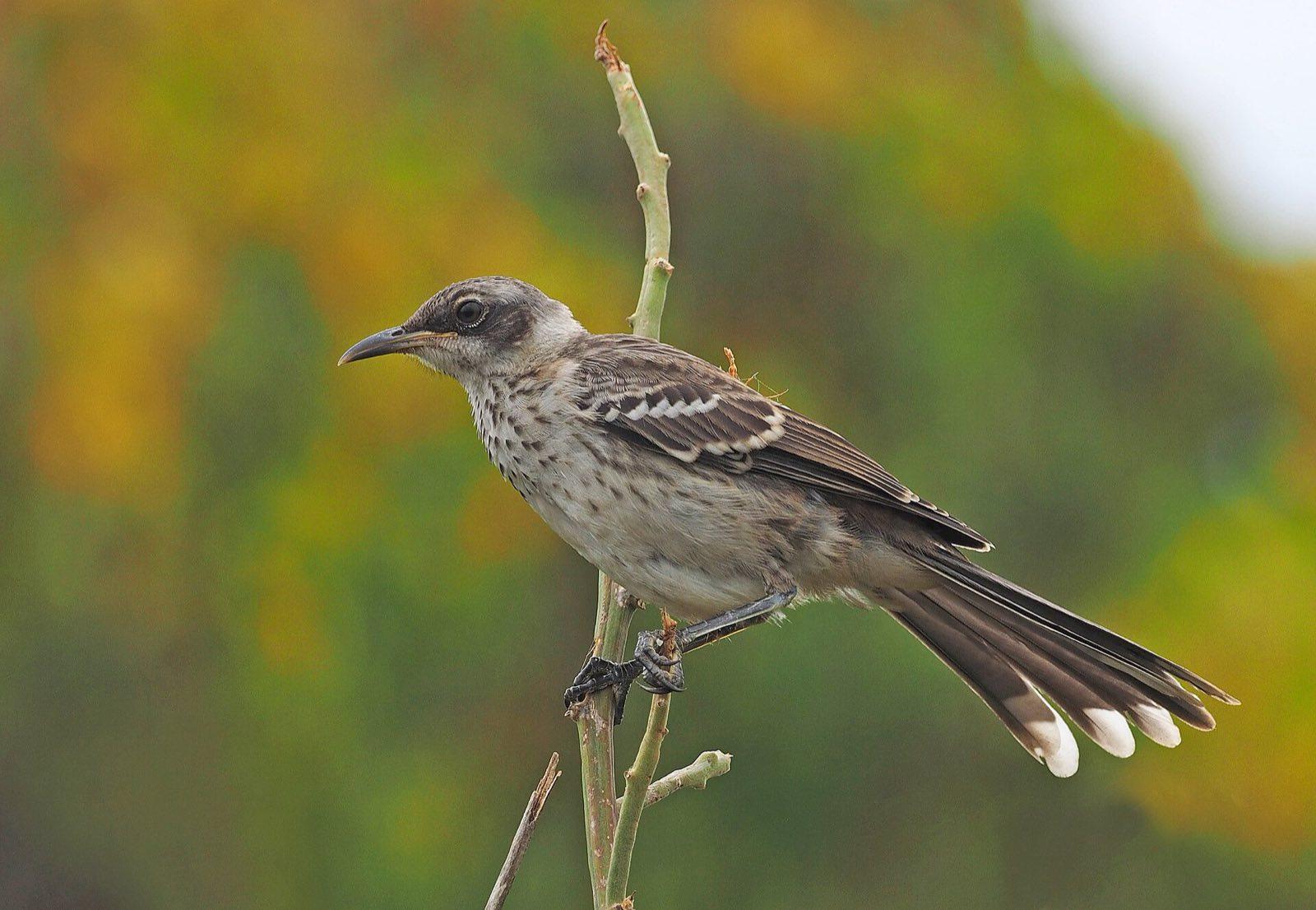
A Galapagos mockingbird on Isabela, a common sight on the walk up Sierra Negra Photo: Judy Gallagher, CC BY 2.0, via Wikimedia Commons (https://commons.wikimedia.org/wiki/File:365_Galapagos_Mockingbird_-_Mimus_parvulus,_Isabela_Island,_Galapagos,_July_9,_2021.jpg) Day 12: Los Tuneles by boat, a free afternoon
Puerto Villamil by boat along the south coast of Isabela to Los Tuneles at Cabo Rosa, then back to the village
- By boat
- Breakfast and lunch
- Stay in Puerto Villamil
Day 12 details
Today mixes a morning at sea with an afternoon on land at your own pace. A licensed day-tour boat with a park naturalist takes us west along the south coast, about 45 minutes each way, to Los Tuneles at Cabo Rosa, where old lava flows have collapsed into arches and tunnels over clear, shallow channels. We walk over the lava where blue-footed boobies often nest, then snorkel the channels with sea turtles, whitetip reef sharks resting in the caves and, with luck, seahorses or a passing manta ray. Entering the channels depends on the swell at the reef mouth; if the park or the captain judges it unsafe, we snorkel a sheltered site instead and tell you on the day. We are back in Puerto Villamil for a sit-down lunch. The afternoon is free: rent a bike and ride the flat track of about 6 km to the Wall of Tears, a penal-colony wall from the 1940s and 1950s, or rest on the beach.
Included
- Los Tuneles boat trip with a park naturalist: lava walk and snorkel
- Sit-down lunch in Puerto Villamil
Optional experiences
- Bike hire for the Wall of Tears track, paid locally
Easier option: Stay on the boat while the group snorkels, or skip the boat and spend the morning at Concha de Perla in the village.
More active option: Cycle to the Wall of Tears in the afternoon, about 12 km there and back on a flat gravel track, with side trails to viewpoints and lagoons.
Free time: Afternoon and evening free in Puerto Villamil
Activity: The boat ride is about 45 minutes each way and can be rough over the swell; take seasickness tablets if you need them. Wetsuits are provided.
Day 13: Two boats to San Cristobal, Las Grietas between
Puerto Villamil to Puerto Ayora by speedboat, then on to Puerto Baquerizo Moreno
- By ferry
- Breakfast, lunch and dinner
- Stay in Puerto Baquerizo Moreno
Day 13 details
There is no regular direct boat between Isabela and San Cristobal, so today we cross by way of Santa Cruz, and it starts early. The Isabela speedboat usually leaves around 6 am, so breakfast is packed, and it reaches Puerto Ayora in about two hours. We then have the middle of the day in Puerto Ayora: take the water taxi across Academy Bay with your guide and a short walk over lava and cactus to Las Grietas, a deep, clear fissure of fresh and salt water between rock walls, for a swim, or rest at a cafe on the waterfront. Lunch is a sit-down meal in Puerto Ayora, then the afternoon speedboat, usually around 3 pm, takes about two hours more to Puerto Baquerizo Moreno, the capital of the islands. We arrive in time to walk the Malecon, where sea lions sleep on benches and on the beach, and catch the last light from Playa Mann. The last evening is a farewell dinner with the group on the waterfront. Departure times are set by the boat operators and confirmed with your final itinerary.
Included
- Speedboats from Isabela to Santa Cruz and from Santa Cruz to San Cristobal
- Las Grietas swim, with the water taxi
- Sit-down lunch in Puerto Ayora
- Sea lions on the Malecon and sunset at Playa Mann
- Farewell dinner
Easier option: Skip Las Grietas and spend the middle of the day at a cafe on the Puerto Ayora waterfront. In rough-sea seasons we can swap the two boats for the short Isabela to San Cristobal flight, at extra cost, confirmed at booking.
Free time: A few hours free in Puerto Ayora between boats
Activity: An early start and about four hours on boats in two crossings. Boat times are set by the operators and can change.
Day 14: Frigatebird Hill and the flight home
Puerto Baquerizo Moreno to Cerro Tijeretas, then San Cristobal airport to Quito or Guayaquil
- By plane
- Breakfast
Day 14 details
A last early walk while the air is cool: along the bay past the statue of Darwin to the San Cristobal Interpretation Center, which tells the story of the islands from volcanic birth to whalers, settlers and the conservation work of today, then up the trail to Cerro Tijeretas, Frigatebird Hill. From the lookout you see the bay where Darwin first landed in 1835, and frigatebirds hang in the wind overhead. Below the hill is a small cove where you can snorkel one more time with sea lions and turtles if the flight allows. We walk back to town for your bags; the airport is a few minutes' drive from the centre. Our flight to Quito or Guayaquil, included in the price, usually leaves around midday or early afternoon, and your guide sees you through check-in. Book your flight home from the mainland for the evening or the next day, or ask us to arrange a night in Quito or Guayaquil.
Included
- San Cristobal Interpretation Center
- Cerro Tijeretas lookout and cove
- Flight from San Cristobal (SCY) to Quito (UIO) or Guayaquil (GYE)
Easier option: Skip the climb to the lookout and wait in the Interpretation Center garden.
Free time: Free until the airport transfer
Activity: Book a homeward flight from Quito or Guayaquil leaving after about 8 pm, or stay a night on the mainland.
Wildlife and weather: The highlands are drier roughly June to September, with the clearest views of Cotopaxi but cold wind on the paramo; October to May brings more afternoon cloud. In the Galapagos, December to May has warmer water, calmer seas and short tropical showers; June to November brings the cool Humboldt current, mist, choppier crossings and colder water (wetsuits are included), with more active marine life and seabird courtship.
13 nights
Where you'll stay
Your hotels are named in your trip confirmation.
- Quito2 nights
- Otavalo1 night
- Cotopaxi1 night
- Banos1 night
- Quito1 night
- Puerto Ayora3 nights
- Puerto Villamil3 nights
- Puerto Baquerizo Moreno1 night
One price
What's in the price
Included
Accommodation
- 13 nights: 2 in Quito, 1 in the Otavalo valley, 1 at a country hotel near Cotopaxi National Park, 1 in Banos, 1 more in Quito, 3 in Puerto Ayora on Santa Cruz, 3 in Puerto Villamil on Isabela and 1 in Puerto Baquerizo Moreno on San Cristobal
- Central hotels of a 3-star-plus standard, with country hotels near Otavalo and Cotopaxi; we name each one when we confirm your dates
- Rooms shared, or your own for a supplement
Transport
- Pick-up at Mariscal Sucre International Airport (UIO) on day 1
- Our own vehicle and driver on the mainland from day 1 to day 7
- Flights from Quito to Baltra and from San Cristobal to Quito or Guayaquil
- The Baltra bus, the Itabaca Channel crossing and transfers on the islands
- Public speedboats from Santa Cruz to Isabela, Isabela to Santa Cruz and Santa Cruz to San Cristobal
- The day boat to an uninhabited island, the Las Tintoreras and Los Tuneles boats and the Las Grietas water taxi
Your guide
- A See Sight Tours guide with the group from day 1 to day 14, including on the flights and boats
- Galapagos National Park naturalist guides on every island visit, as park rules require
Activities
- Quito: Old Town walk with La Compania de Jesus, San Francisco and the Basilica del Voto Nacional towers
- Quito: the Ciudad Mitad del Mundo monument and the Intinan museum
- Otavalo valley: the Plaza de los Ponchos market, Cotacachi, Laguna Cuicocha and the Peguche waterfall
- Cotopaxi National Park: the Limpiopungo lagoon walk, or the Jose Rivas refuge climb when open
- Banos: the Pailon del Diablo waterfall and the Manto de la Novia viewpoint
- Santa Cruz: giant tortoises in the highlands, Tortuga Bay, the Charles Darwin Research Station and Las Grietas
- A full-day boat to North Seymour, South Plaza, Santa Fe or Bartolome, set by the park for your date
- Isabela: Las Tintoreras with snorkelling, the flamingo lagoon and tortoise breeding centre, the Sierra Negra hike and the Los Tuneles boat and snorkel
- San Cristobal: the Interpretation Center and Cerro Tijeretas
- Snorkel gear and a wetsuit for the island days
Meals
- 13 breakfasts
- 11 lunches, including lunch on the day boat
- 4 dinners: a welcome dinner in Quito, dinners at the country hotels near Otavalo and Cotopaxi, and a farewell dinner on San Cristobal
Not included
- International flights to Quito and home from Quito or Guayaquil
- Galapagos National Park entrance fee (USD 200 for foreign adults at the time of writing), paid on arrival at Baltra
- Transit Control Card (USD 20), paid at Quito airport
- Isabela municipal arrival fee
- Visa, where your nationality needs one
- Travel insurance
- Meals not listed above
- Drinks
- Tips for guides, drivers and boat crews
- Optional activities in your free time, such as bike hire on Isabela or the thermal pools in Banos
- Personal expenses
Local fees
- Galapagos National Park entrance fee (USD 200 for foreign adults at the time of writing), Transit Control Card (USD 20) and the Isabela arrival fee, paid by you on the way.
Extras
- Room of your own
- CAD 1,345 (estimated price)

See Sight Tours has been providing travel services across North America since 2006. Operating in 20 cities across Canada and the USA, the company specializes in small group tours that offer personalized, high-quality experiences for travelers.


Book your Tour
Get in Touch
- Toll Free1-888-961-6584
- Local1-289-271-9767


© 2026 See Sight Tours. All rights reserved.