Printable itinerary
Costa Rica: Birds and Nature with a Naturalist
10 days · Round trip from San José · up to 12 guests
From CAD 2,985 per person, sharing a room (estimated price. Estimated price. The itinerary, hotels and availability are proposed and subject to confirmation. Your quote will set out the booking conditions; sending a request does not confirm a booking.)
Day by day
Itinerary
The longest drive is 3.5 h, on day 10.
- San José1 night
- Sarapiquí2 nights
- La Fortuna2 nights
- Monteverde2 nights
- Tárcoles1 night
- Manuel Antonio1 night
- San Joséend
- Overnight stop
- Day trip
- By boat or train
Day 1: Arrive in San José
Juan Santamaría International Airport to your hotel in San José
- Drive about 45 min
- Welcome dinner
- Stay in San José
Day 1 details
Fly into Juan Santamaría International Airport (SJO), about 20 km west of San José, at any time of day. A driver meets you in the arrivals hall for the 30 to 45 minute drive to the hotel. San José sits at about 1,150 m in the Central Valley, so the evenings are mild. Even here the birding starts: clay-coloured thrushes, the national bird, sing from the gardens, and great-tailed grackles patrol the parks. At about 6 pm your See Sight Tours guide and the group's birding naturalist meet everyone for a briefing. You collect the binoculars you will use all trip, learn how to find a bird in them quickly, and hear how the days run: which mornings start at dawn, which are optional, and what to pack for the cloud forest. Then we walk to a local restaurant for a welcome dinner of Costa Rican dishes. Tomorrow we leave after breakfast, at about 8 am.
Included
- Pick-up at Juan Santamaría International Airport (SJO)
- Welcome briefing with your guide and naturalist; binoculars handed out
- Welcome dinner
Free time: Free until the evening briefing
Activity: Land by about 4 pm to join the briefing; later arrivals are met and briefed the next morning.
Day 2: Over the mountains to Sarapiquí
San José to Vara Blanca and Cinchona, then Sarapiquí
- Drive about 2.5 h
- Breakfast, lunch and dinner
- Stay in Sarapiquí
Day 2 details
We leave at about 8 am and climb north past Heredia into the mountains between Poás and Barva volcanoes, through the dairy and strawberry country of Vara Blanca. Mid-morning we stop at Cinchona, where a roadside café looks across a forested gorge to a waterfall and keeps fruit and sugar-water feeders. It is one of the easiest places in the country to photograph hummingbirds, tanagers and, often, emerald toucanets at a few metres' distance, so we stay for lunch and take our time. From there the road drops steeply through the cloud into the Caribbean lowlands, and the air turns hot and humid. We reach our lodge in Sarapiquí, base for two nights, by mid-afternoon, about two and a half hours of driving in all. At about 4 pm, when the heat eases, the naturalist walks the lodge grounds with the group: oropendola nests, toucans and the first poison dart frogs. Dinner is at the lodge.
Included
- Drive from San José to Sarapiquí with your guide and naturalist
- Feeder stop and lunch at Cinchona
- Late-afternoon birding walk on the lodge grounds
- Dinner at the lodge
Easier option: Skip the afternoon walk and watch from the lodge veranda.
Free time: Free evening at the lodge
Activity: The road from Cinchona to the lowlands is steep and winding; tell us if you are prone to car sickness and sit at the front.
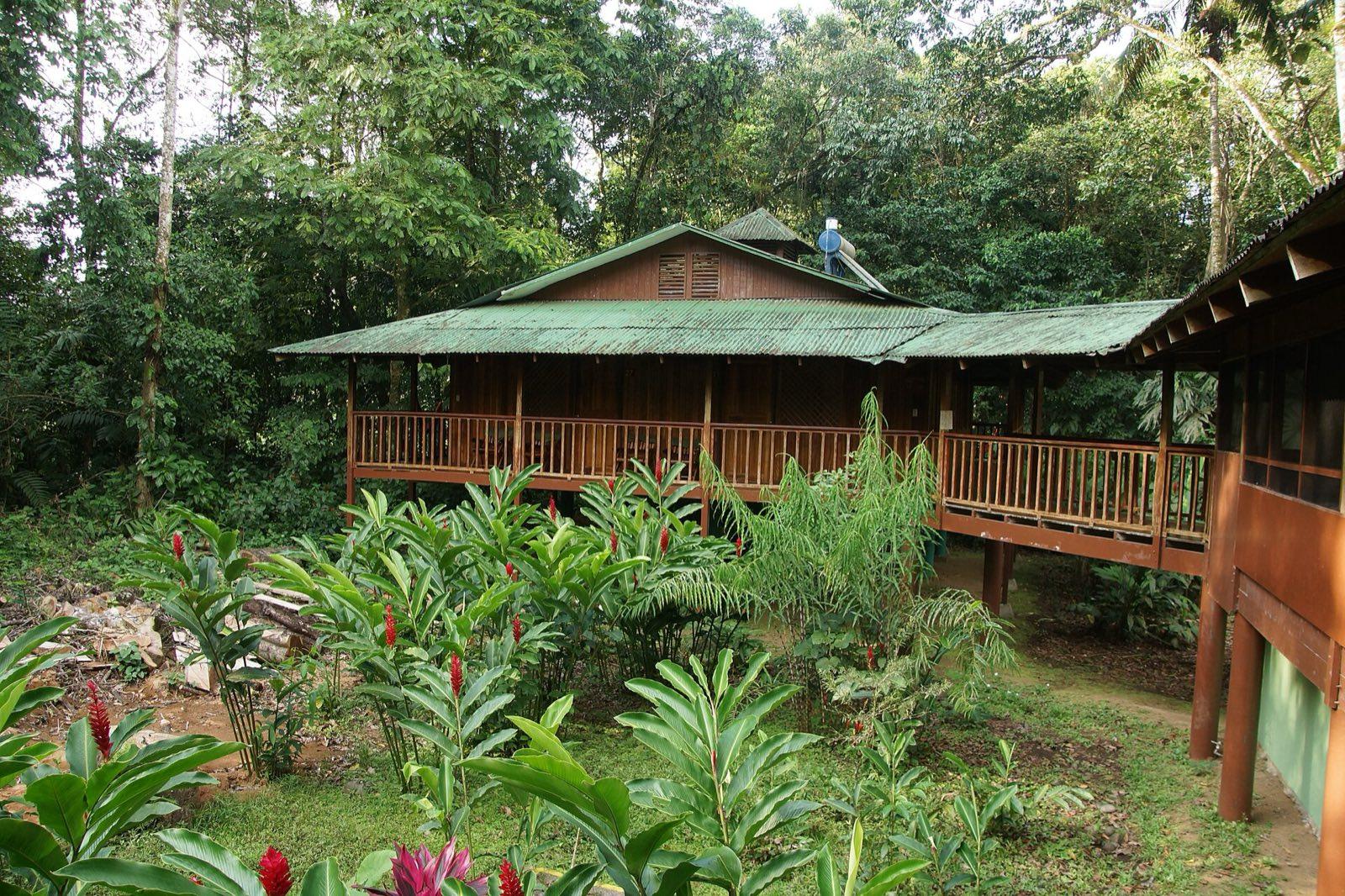
Selva Verde, one of the rainforest lodges on the Sarapiquí River; we name our lodge when we confirm your dates Photo: rob Stoeltje from loenen, netherlands, CC BY 2.0, via Wikimedia Commons (https://commons.wikimedia.org/wiki/File:Lodge_selva_verde_(8440075484).jpg) Day 3: Dawn birding and La Selva
The lodge grounds at dawn, then La Selva Biological Station
- Drive about 30 min
- Breakfast, lunch and dinner
- Stay in Sarapiquí
Day 3 details
The lowland forest is loudest in the first two hours of light, so the naturalist is on the lodge grounds at about 5:45 am with coffee and the scope. Join for as long as you like; parrots and toucans cross the river, and tanagers and woodpeckers work the fruiting trees by the buildings. After breakfast we drive about 15 minutes to La Selva Biological Station, a working research station where scientists have studied lowland rainforest since the 1960s. A station naturalist leads the morning walk with ours, over the suspension bridge across the river and along paved and earth trails through old forest. Possible sightings include chestnut-mandibled and keel-billed toucans, trogons, motmots, collared peccaries, sloths and strawberry poison dart frogs; the endangered great green macaw feeds in this region but is never certain. Lunch is at the station. The hot afternoon is free for a siesta, the lodge trails, or an optional boat trip on the Sarapiquí River. Dinner is at the lodge.
Included
- Dawn birding walk on the lodge grounds with the naturalist
- La Selva Biological Station morning walk with a station naturalist
- Lunch at the station
- Dinner at the lodge
Optional experiences
- Boat trip or rafting on the Sarapiquí River, booked at the operator's own price
Easier option: Sleep in and skip the dawn walk, or join it for half an hour from the veranda.
More active option: Stay out on the lodge trails after lunch with the naturalist's map and look for frogs and lizards in the afternoon heat.
Free time: Afternoon free at the lodge
Activity: About 3 to 4 km at La Selva on mostly flat trails; hot and humid. Long sleeves and repellent help.
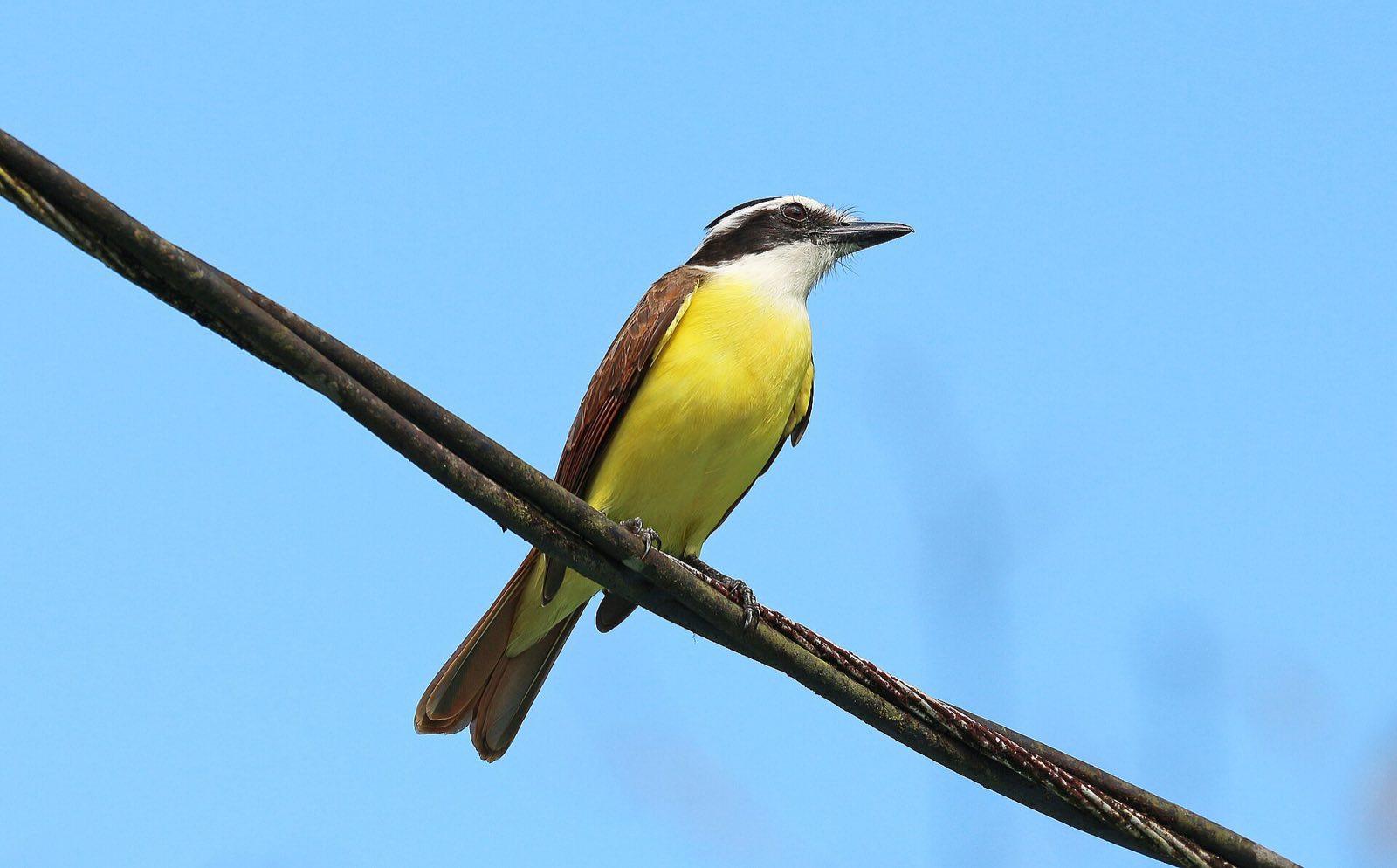
Great kiskadee in Puerto Viejo de Sarapiquí Photo: Bernard Gagnon, CC0, via Wikimedia Commons (https://commons.wikimedia.org/wiki/File:Great_kiskadee_in_Costa_Rica_01.jpg) Day 4: West to Arenal and into the canopy
Sarapiquí to La Fortuna, then a hanging-bridges park
- Drive about 2.5 h
- Breakfast and lunch
- Stay in La Fortuna
Day 4 details
There is one more optional dawn walk on the lodge grounds before breakfast. We leave at about 8 am and drive west across the northern plains by Aguas Zarcas, past pineapple, cattle and sugar cane, about two hours to La Fortuna, our base for two nights. Lunch is included in town. In the early afternoon we drive about 20 minutes to a hanging-bridges park on the flank of Arenal Volcano: a loop of forest trail and suspension bridges at treetop height. From the bridges you see the canopy from the level where most of the birds and monkeys live, and the naturalist sets the scope on whatever appears, from tanagers to motmots, while the volcano fills the gaps between the trees when the clouds allow. The afternoon light is warm and low by the time we finish, good for photographs of the cone. The evening is free in La Fortuna.
Included
- Optional dawn walk on the lodge grounds
- Drive from Sarapiquí to La Fortuna
- Lunch in La Fortuna
- Hanging bridges on the flank of Arenal Volcano with the naturalist
Easier option: Walk only the first section of bridges and wait at the entrance café.
Free time: Evening free in La Fortuna
Activity: About 3 km of trail with suspension bridges; some steps and slopes. The bridges are stable but high.
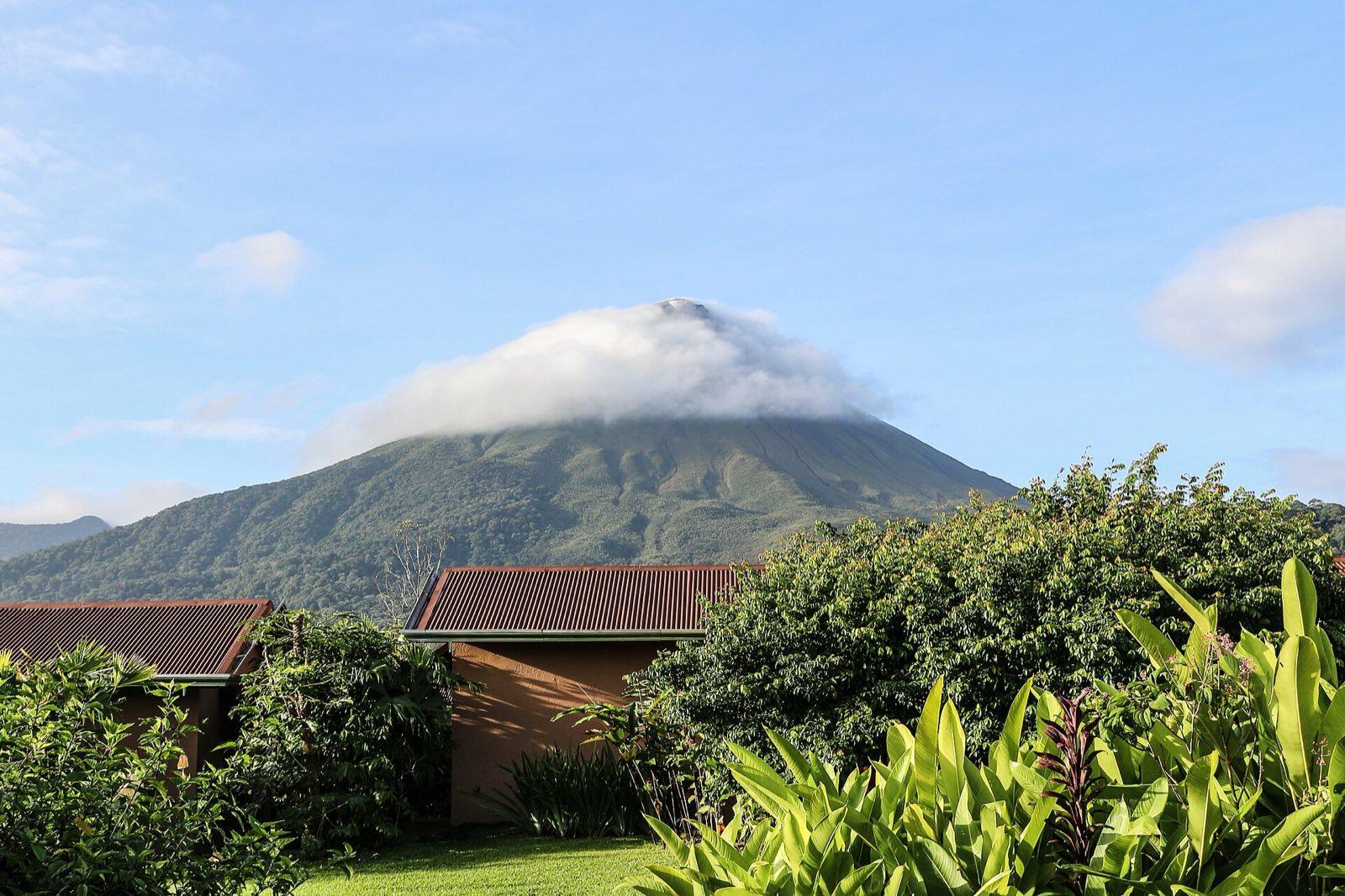
Arenal Volcano from a garden near La Fortuna Photo: Bernard Gagnon, CC0, via Wikimedia Commons (https://commons.wikimedia.org/wiki/File:Arenal_Volcano_01.jpg) Day 5: Arenal Volcano National Park at opening
La Fortuna to Arenal Volcano National Park and back
- Drive about 1 h
- Breakfast
- Stay in La Fortuna
Day 5 details
Arenal, about 1,630 m high, erupted without warning in 1968 and stayed active until 2010. Its summit is often in cloud by late morning, and the forest birds quieten as the day warms, so we are at the gate of Arenal Volcano National Park when it opens at about 8 am. The trails cross regrown forest and old lava flows, now covered in ferns and shrubs, to a viewpoint over the volcano and Lake Arenal. The naturalist works slowly, looking for crested guans, motmots, oropendolas and hummingbirds, with howler monkeys and coatis often close by; expect to walk about 3 km in three hours. We are back in town by noon. The afternoon is free: rest, edit photographs, or take an optional trip to the hot springs or La Fortuna Waterfall. For anyone who wants more birds, the naturalist offers a short late-afternoon walk near the hotel.
Included
- Arenal Volcano National Park entry from opening with the naturalist: forest trails, old lava flows and the volcano viewpoint
- Late-afternoon bird walk near the hotel with the naturalist
Optional experiences
- Hot springs near La Fortuna, La Fortuna Waterfall, ziplining or canyoning, booked at the operator's own price
Easier option: Walk only to the first viewpoint and wait in the van, or take the afternoon off entirely.
More active option: Add the late-afternoon bird walk, or the roughly 500 steps down to La Fortuna Waterfall (own entry).
Free time: Lunch, the afternoon and the evening free in La Fortuna
Activity: About 3 km on gentle park trails, loose rock on the lava flows; sun and heat in the open sections.
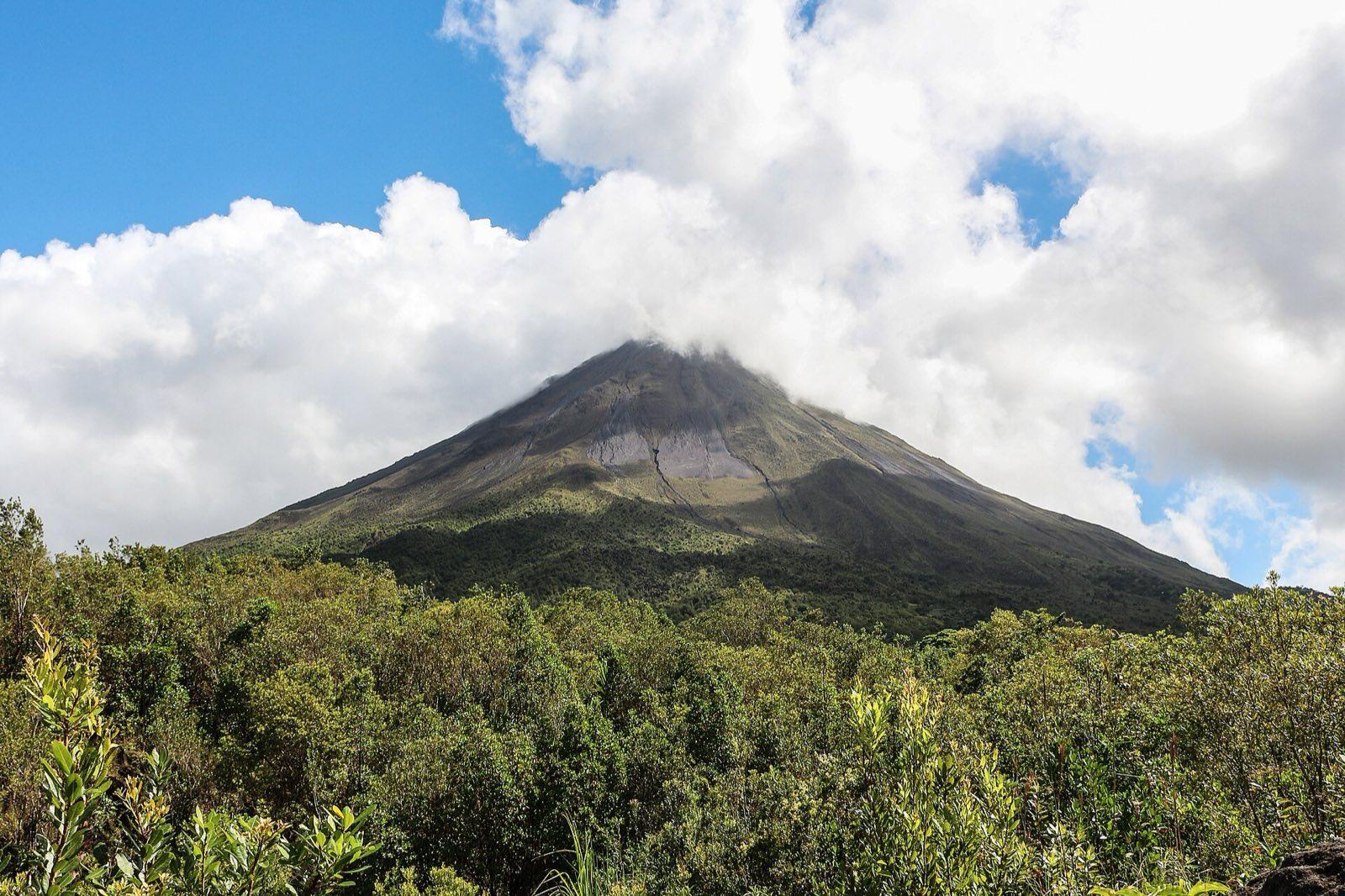
Arenal Volcano near La Fortuna Photo: Bernard Gagnon, CC0, via Wikimedia Commons (https://commons.wikimedia.org/wiki/File:Arenal_Volcano_02.jpg) Day 6: Across Lake Arenal to Monteverde
La Fortuna by road to Lake Arenal, by boat across the lake, then by road up to Monteverde
- Drive about 2 h
- Breakfast
- Stay in Monteverde
Day 6 details
There is no direct road from La Fortuna to Monteverde, and driving round Lake Arenal takes about four hours, so we cross the lake by boat. After breakfast and an 8 am departure, a short drive brings us to a dock near the Arenal dam, where a covered boat carries the group and our bags across the water, with the volcano behind us when the sky is clear; the naturalist watches the shore for herons, kingfishers and ospreys. On the far side our van meets us for the climb into the Tilarán hills, the last stretch winding and partly unpaved, to Santa Elena at about 1,400 m. We arrive around midday; lunch and the afternoon are yours, and the hummingbird feeders near the reserves are a good use of it. At dusk we go out with a local guide and our naturalist on a two-hour night walk in a private reserve: sleeping birds, tarantulas, tree frogs and, with luck, a sloth or a kinkajou.
Included
- Van and boat crossing of Lake Arenal, with road transfers either side
- Guided night walk in a private reserve near Santa Elena
Free time: Lunch and the afternoon free in Santa Elena
Activity: The night walk is about 2 hours on forest paths with a torch; Monteverde evenings are cool, so bring a warm layer.
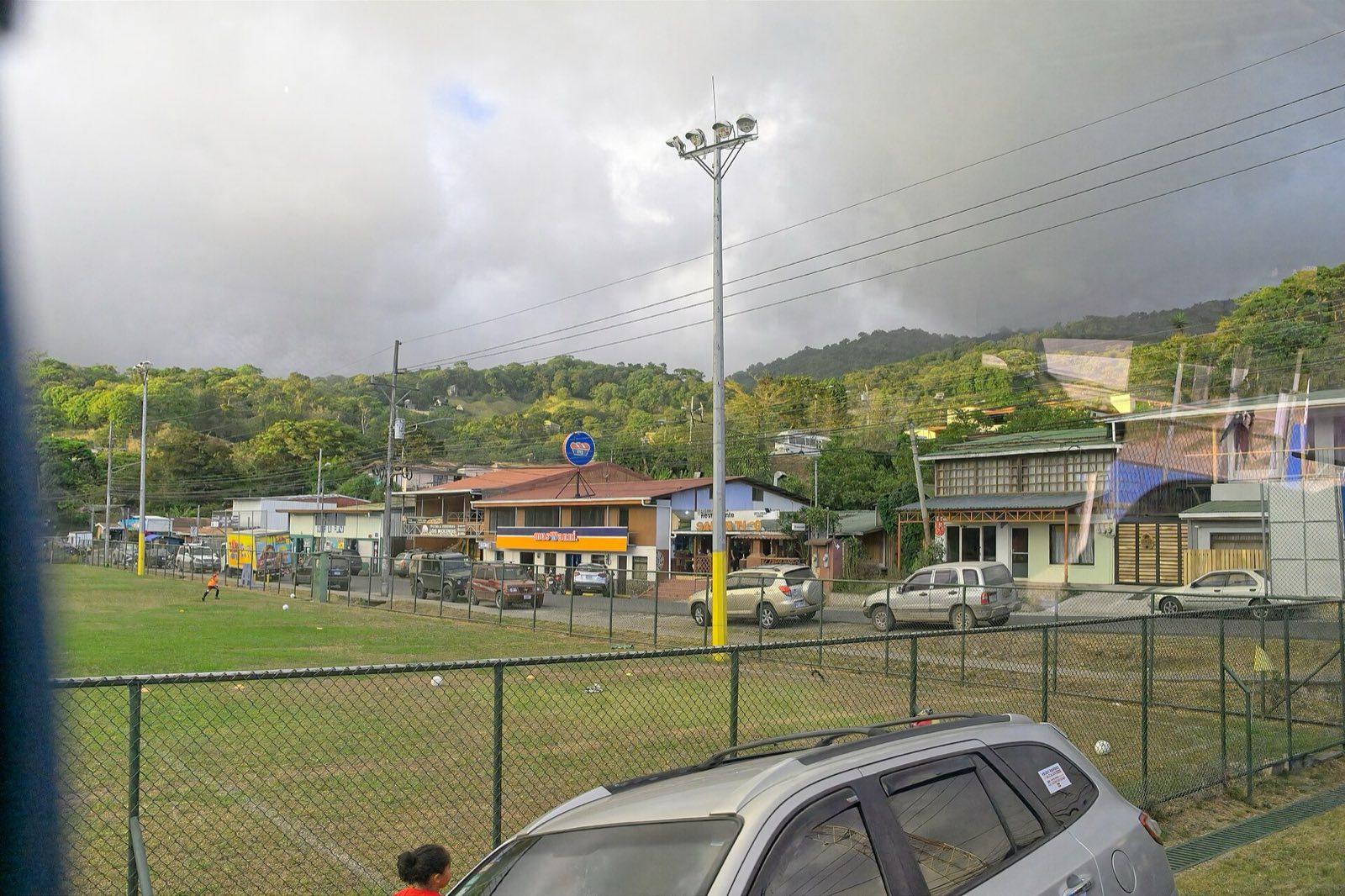
Santa Elena village, the gateway to the Monteverde cloud forest Photo: dave massie, CC BY 2.0, via Wikimedia Commons (https://commons.wikimedia.org/wiki/File:Monteverde,_Costa_Rica.jpg) Day 7: Looking for the quetzal in the cloud forest
Santa Elena to the Monteverde Cloud Forest Reserve and back
- Drive about 30 min
- Breakfast
- Stay in Monteverde
Day 7 details
This is the morning many birders come for. The Monteverde Cloud Forest Reserve opens at 7 am, the first hour is the quietest, and the resplendent quetzal feeds on wild avocado trees near the trails in the early morning, so we are at the gate when it opens. With a reserve guide alongside our naturalist we walk about 3 km under trees thick with mosses, bromeliads and orchids, listening for the metallic bonk of the three-wattled bellbird and watching for black guans, prong-billed barbets and the quetzal's green and crimson. Quetzals are seen most often from about February to May, when they nest; outside those months they are harder to find, and in any month never certain. The reserve was founded in 1972 on land from the Quaker families who settled here in the early 1950s. Lunch and the afternoon are free, and the evening too. If rain sets in, the naturalist moves the walk to the next clear spell.
Included
- Monteverde Cloud Forest Reserve entry from opening with a reserve guide and the naturalist
Optional experiences
- A coffee and chocolate farm tour, ziplining or a butterfly garden, booked at the operator's own price
Easier option: Walk the first loop only and return to the hummingbird feeders by the entrance.
More active option: Stay on in the reserve after the guided walk and walk out to the continental divide viewpoint; the van collects you in the early afternoon.
Free time: Lunch, the afternoon and the evening free
Activity: About 3 km on wet, root-crossed trails at about 1,500 m; cool and damp. Waterproof shoes and a warm layer.
Day 8: Down to the Pacific and the Tárcoles River
Monteverde to Tárcoles, then by boat into the river mouth
- Drive about 3 h
- Breakfast, lunch and dinner
- Stay in Tárcoles
Day 8 details
Anyone who wants one more look at the cloud forest can join the naturalist at the hotel garden at first light. We leave at about 8:30 am and wind down out of the hills to the Pan-American Highway, then south to the Pacific, about three hours with a stop and a sit-down lunch near the coast. In the afternoon, timed to the tide, we board a covered boat on the Tárcoles River for about two hours. Large American crocodiles lie on the mud banks, and the boat runs into the mangroves near the river mouth, where roseate spoonbills, boat-billed herons, wood storks, kingfishers and the mangrove birds of the Pacific coast feed. Scarlet macaws often fly over towards evening. Tonight we stay at a lodge near Carara National Park, where we have dinner together; we stop here, not at Manuel Antonio, because Carara is best at its opening tomorrow.
Included
- Optional dawn walk in Monteverde
- Drive from Monteverde to Tárcoles with a sit-down lunch
- Tárcoles River boat into the mangroves, about 2 hours
- Dinner at the lodge
Free time: Late afternoon free at the lodge after the boat
Activity: About 3 hours of driving, then 2 hours on a covered boat with steps on and off. Hat, sun cream and water.
Day 9: Carara at opening, then Manuel Antonio
Carara National Park, then the coast road to Manuel Antonio
- Drive about 2 h
- Breakfast, lunch and dinner
- Stay in Manuel Antonio
Day 9 details
Carara National Park lies where the dry forest of the north Pacific meets the wetter forest of the south, so birds from both meet here, and it is a stronghold of the scarlet macaw. We are at the gate at opening (7 am from December to April, 8 am from May to November) and spend about three hours on its flat trails, one of them paved and accessible. The naturalist looks for macaws, trogons, motmots, antbirds and manakins dancing at their display sites, with agoutis and white-faced capuchins on the ground and in the trees. We have a sit-down lunch nearby, then drive south past Jacó and through oil palm plantations to Manuel Antonio, about an hour and a half. The late afternoon is free for the pool, Playa Espadilla or the sunset over the Pacific. In the evening the group sits down together for a farewell dinner with the naturalist and your guide.
Included
- Carara National Park entry from opening with the naturalist
- Sit-down lunch near Carara
- Drive to Manuel Antonio
- Farewell dinner
Easier option: Stay on the paved, accessible trail near the entrance, with benches.
More active option: Walk the longer loop trail into the wetter forest for manakins and antbirds.
Free time: Late afternoon free in Manuel Antonio
Activity: About 2 to 3 km on flat trails; hot and humid by mid-morning.
Day 10: Manuel Antonio at 7 am, then fly home
Manuel Antonio National Park, then to Juan Santamaría International Airport
- Drive about 3.5 h
- Breakfast
Day 10 details
A last early morning. Manuel Antonio National Park is small and busy, with a daily cap on visitors, so we have tickets bought ahead and go in at 7 am, when the animals are most active and the paths are quiet. For about two hours the naturalist sets the scope on what the forest gives us: two- and three-toed sloths, white-faced capuchins, Central American squirrel monkeys, iguanas, toucans and fiery-billed aracaris, ending at the pale sand of Playa Manuel Antonio. We are back at the hotel by about 9:30 to change, and leave at about 10:30 for Juan Santamaría International Airport (SJO), about three hours and 170 km by Route 34 and Route 27, with a stop on the way for lunch (at your own cost), arriving at about 2 pm. Book a flight leaving after about 5 pm. The park closes on Tuesdays, so we set our dates so this morning is never a Tuesday.
Included
- Manuel Antonio National Park entry from opening with the naturalist
- Drop-off at Juan Santamaría International Airport (SJO)
Easier option: Skip the park and enjoy a slow breakfast and the hotel pool before the transfer.
Activity: Book international flights leaving after about 5 pm. Earlier flight, or want to stay on? Ask us for a separate transfer or extra nights.
Wildlife and weather: December to April is the drier season and the busiest; North American migrant birds such as warblers and tanagers are present from about October to April. Resplendent quetzals nest in the Monteverde area and are seen most often from about February to May. May to November is the green season, with fresh mornings, afternoon rain, fewer visitors and many resident birds breeding. Monteverde is cool and misty in any month and Arenal's summit is often in cloud, which is why we look early.
9 nights
Where you'll stay
Your hotels are named in your trip confirmation.
- San José1 night
- Sarapiquí2 nights
- La Fortuna2 nights
- Monteverde2 nights
- Tárcoles1 night
- Manuel Antonio1 night
One price
What's in the price
Included
Accommodation
- 9 nights: San José (1), a rainforest lodge in Sarapiquí (2), La Fortuna (2), Monteverde in walking distance of Santa Elena village (2), a lodge near Carara National Park (1) and Manuel Antonio near the park gate (1)
- Hotels and lodges of a 3-star-plus standard with private bathrooms and hot water, named when we confirm your dates
- Rooms shared, or your own for a supplement
Transport
- Pick-up at Juan Santamaría International Airport (SJO) on day 1, whatever your flight time, and drop-off on day 10
- An air-conditioned van with driver for the whole route
- Boat across Lake Arenal, with road transfers either side
- Tárcoles River boat
Your guide
- A See Sight Tours guide with the group for the whole trip
- A specialist birding naturalist with a spotting scope for the whole trip
- Local guides where sites require them: La Selva Biological Station, the Monteverde night walk and the Monteverde Cloud Forest Reserve
- Binoculars lent to every guest for the trip
Activities
- Feeder stop at Cinchona
- Dawn birding walks on the lodge grounds in Sarapiquí
- La Selva Biological Station guided morning walk
- Hanging bridges on the flank of Arenal Volcano
- Arenal Volcano National Park entry and guided walk
- Guided night walk in Monteverde
- Monteverde Cloud Forest Reserve entry and guided walk
- Tárcoles River boat into the mangroves
- Carara National Park entry and guided walk
- Manuel Antonio National Park entry and guided walk
Meals
- 9 breakfasts, 5 lunches and 5 dinners
- Lunches on days 2, 3, 4, 8 and 9
- Welcome dinner in San José, two dinners at the Sarapiquí lodge, dinner at the Carara lodge and a farewell dinner in Manuel Antonio
Not included
- International flights to and from San José
- Travel insurance
- Lunches on days 5, 6, 7 and 10 and dinners on days 4 to 7
- Drinks
- Tips for your guide, naturalist, driver and local guides
- Optional activities such as hot springs, La Fortuna Waterfall, ziplining, rafting, the Sarapiquí River boat and coffee farm tours
- Camera equipment and personal expenses
- Costa Rica's departure tax, if it is not already in your air ticket
Extras
- Room of your own
- CAD 505 (estimated price)

See Sight Tours has been providing travel services across North America since 2006. Operating in 20 cities across Canada and the USA, the company specializes in small group tours that offer personalized, high-quality experiences for travelers.


Book your Tour
Get in Touch
- Toll Free1-888-961-6584
- Local1-289-271-9767


© 2026 See Sight Tours. All rights reserved.