Printable itinerary
Bhutan: the Trans Bhutan Trail from Thimphu to Bumthang
11 days · Round trip from Paro · up to 12 guests
From CAD 6,640 per person, sharing a room (estimated price. Estimated price. The itinerary, hotels and availability are proposed and subject to confirmation. Your quote will set out the booking conditions; sending a request does not confirm a booking.)
Black Friday offer: 15% off the small-group price for requests received by Dec 1, 2026. From CAD 6,640 per person. Dec 2 to Dec 31: from CAD 7,185. From Jan 1, 2027: from CAD 7,810. The offer ends at 11:59 pm Toronto time and is for the small-group style only.
Day by day
Itinerary
The longest drive is 3 h, on day 4.
- Parostart
- Thimphu1 night
- Punakha2 nights
- Phobjikha1 night
- Trongsa2 nights
- Bumthang2 nights
- Paro2 nights
- Overnight stop
- Day trip
- By boat or train
Day 1: Arrive in Paro, on to Thimphu
Paro International Airport to Chuzom, then Thimphu, Buddha Dordenma and the National Memorial Chorten
- Drive about 1.5 h
- Lunch and welcome dinner
- Stay in Thimphu
Day 1 details
Land at Paro International Airport (PBH), where your guides meet you outside arrivals. Flights operate in daylight only and most land in the morning. Paro waits for the end of the trip, so today we drive about an hour and a half east along the Paro Chhu to Thimphu, the capital, at about 2,300 m, with a stop at Chuzom, where the Paro and Thimphu rivers meet below three chortens. After lunch in Thimphu and time to rest, we drive up to Buddha Dordenma, the giant seated Buddha on the ridge south of the city, for the view down the valley, then walk around the National Memorial Chorten, built in 1974, where older residents turn the prayer wheels in the late afternoon. Before the welcome dinner the group meets for a briefing on the trail: tomorrow's start time, what goes in the day pack and what rides in the vehicle. Your guide checks boots and layers.
Included
- Pick-up at Paro International Airport (PBH)
- Chuzom, the confluence of the Paro and Thimphu rivers
- Lunch in Thimphu
- Buddha Dordenma (Buddha Point)
- National Memorial Chorten
- Trail briefing and welcome dinner
Free time: Time to rest at the hotel after lunch
Activity: Plan to land by about midday to join lunch and the afternoon; later arrivals are met and join at dinner. Thimphu sits at about 2,300 m, so the first day is gentle.
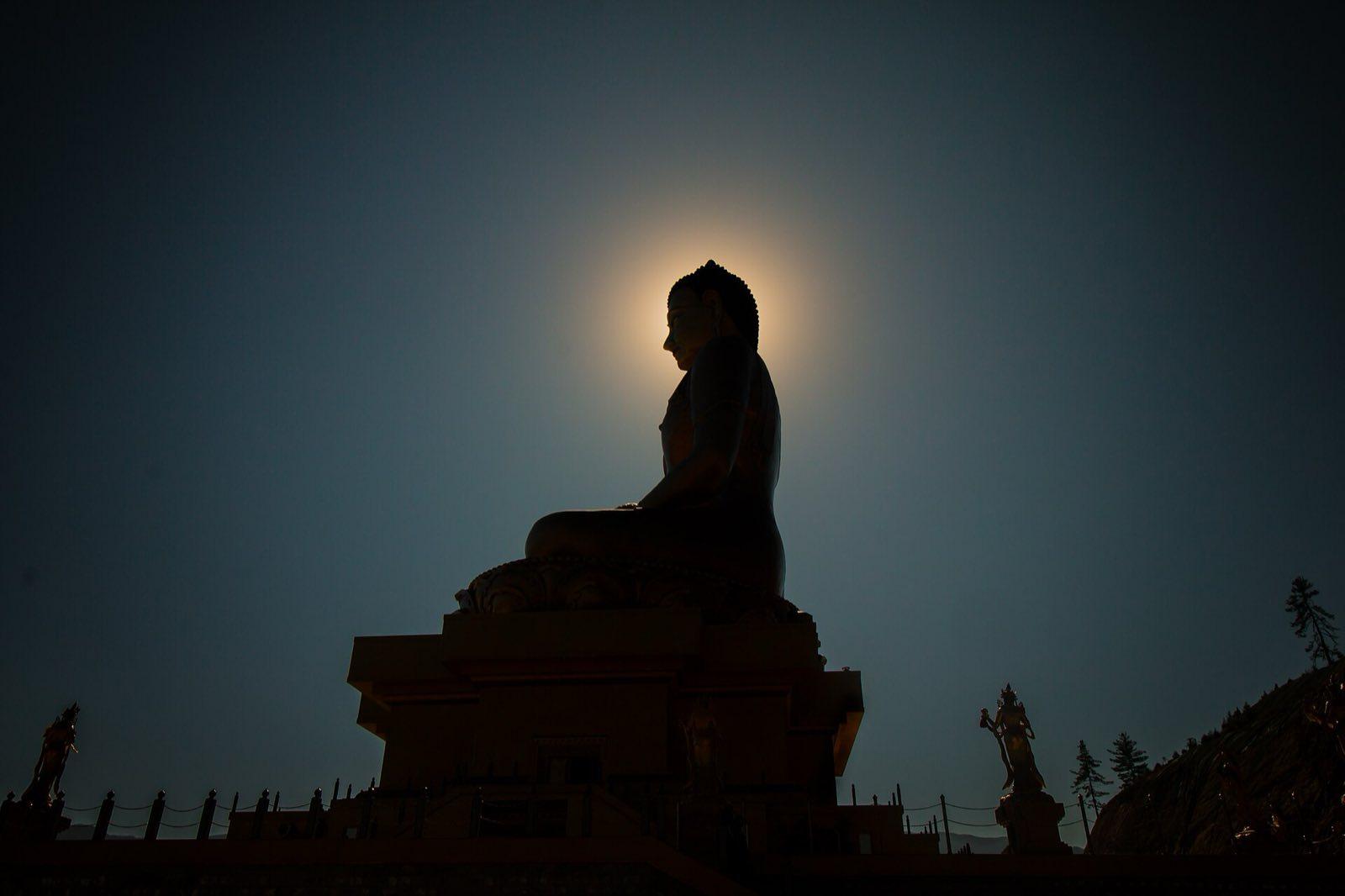
Buddha Dordenma above Thimphu, visited on day 1 Photo: RKTKN rktkn, CC0, via Wikimedia Commons (https://commons.wikimedia.org/wiki/File:Buddha_in_Bhutan_(Unsplash).jpg) Day 2: Walk up to Dochula, down to Punakha
Thimphu to Hongtsho, on foot to the Dochula Pass and down the Divine Madman Trail, then Punakha
- Drive about 1.5 h
- Breakfast, lunch and dinner
- Stay in Punakha
Day 2 details
The first stage of the Trans Bhutan Trail. We leave Thimphu at 8 am for the half-hour drive to Hongtsho and start walking on the old footpath that climbed to the pass before the road existed. It rises through blue pine, oak and rhododendron, past farmhouses and prayer flags, for about three hours and roughly 600 to 700 m to Dochula, at about 3,100 m, where the 108 Druk Wangyal chortens stand on the saddle. Our vehicle meets us there with a hot lunch at about 12:30, and on a clear day the high Himalaya lines the northern horizon. After lunch the trail drops down the far side on the Divine Madman Trail, named for the 15th-century teacher Drukpa Kunley, about 1.5 to 2 hours through forest towards Thinleygang, where the vehicle picks us up. From there it is about an hour's drive down into the warm Punakha valley, at about 1,200 m, arriving in the late afternoon with the evening to rest.
Included
- Trans Bhutan Trail walk from Hongtsho to the Dochula Pass
- The 108 Druk Wangyal chortens
- Hot lunch at Dochula
- Divine Madman Trail walk down towards Thinleygang
Easier option: Ride up to Dochula in the vehicle with one of the guides for the clearer morning view, meet the walkers for lunch and walk only the downhill afternoon section, or ride on to Punakha.
More active option: Walk the full stage: about 3 hours up from Hongtsho to Dochula and 1.5 to 2 hours down the Divine Madman Trail.
Free time: Evening free in Punakha
Activity: About 5 hours on foot for the full stage, with the biggest climb of the trip early on, at altitude. Take it slowly; the guides set the pace for the slowest walker.
Day 3: Punakha Dzong and the rice valley
Punakha Dzong, Chimi Lhakhang and Khamsum Yulley Namgyal Chorten
- Drive about 1 h
- Breakfast, lunch and dinner
- Stay in Punakha
Day 3 details
A shorter day on foot after yesterday's climb. The light on Punakha Dzong is best in the morning, so we cross the wooden cantilever bridge over the Mo Chhu soon after it opens to visitors. Built in 1637 to 1638 where the Pho Chhu and Mo Chhu rivers meet, it was the seat of government until the capital moved to Thimphu in the 1950s, and the central monk body still spends the winter here. We allow about two hours for its courtyards and the murals of the assembly hall. Then a short drive upriver and a walk of about 45 minutes up through rice fields to Khamsum Yulley Namgyal Chorten, for the view up the valley from its roof. Lunch is at a farm restaurant near Sopsokha, and from there we walk 20 to 30 minutes through the village and between paddies to Chimi Lhakhang, the temple built in 1499 for Drukpa Kunley, the Divine Madman. The afternoon is free.
Included
- Punakha Dzong with your guides
- Walk up to Khamsum Yulley Namgyal Chorten
- Lunch near Sopsokha
- Walk through the rice fields to Chimi Lhakhang
Easier option: Skip the chorten hike and drive up to the Sangchhen Dorji Lhuendrup Nunnery for the same valley view.
More active option: Climb to Khamsum Yulley Namgyal Chorten and walk back down through the fields to the river, about 1.5 hours.
Free time: Afternoon free
Activity: Punakha is the warmest stop on the route; bring sun protection. Shoes come off and photography stops inside temples.
Day 4: Phobjikha and a farmhouse night
Punakha to Wangdue and the Lawa La, then Phobjikha, Gangtey Goemba and the Gangtey Nature Trail
- Drive about 3 h
- Breakfast, lunch and dinner
- Stay in Phobjikha
Day 4 details
We drive about three hours south past Wangdue Phodrang and up through oak and rhododendron forest over the Lawa La, at about 3,300 m, into the Phobjikha valley, a wide glacial bowl of farmland, marsh and pine at about 2,900 m. Lunch is in the valley. In the afternoon we visit Gangtey Goemba, the 17th-century monastery on the knoll above the valley floor, then walk the Gangtey Nature Trail, 1.5 to 2 hours mostly downhill through pine and across the fields, late enough that, from about late October, the black-necked cranes are flying back to the marsh to roost. The Black-necked Crane Information Centre explains their story outside the season. Tonight we stay in a licensed farmhouse: rooms are simple and warm, with a wood stove, and the group may be split between neighbouring houses. The family heats river stones for a traditional hot stone bath, then serves dinner, often red rice, buckwheat and ema datshi, the chilli and cheese stew.
Included
- Lunch in Phobjikha
- Gangtey Goemba
- Gangtey Nature Trail walk
- Black-necked Crane Information Centre
- Hot stone bath and dinner with a farming family
Easier option: Walk only the first half of the nature trail, about 45 minutes, and ride to the crane centre with the driver.
More active option: Walk the full Gangtey Nature Trail, 1.5 to 2 hours, with the guide.
Free time: Early evening free before the hot stone bath
Activity: Phobjikha is the highest and coldest night on the route; bring warm layers. Bathrooms in the farmhouse may be shared. If you would rather not stay in a farmhouse, ask when you book and we will quote a lodge room in the valley.
Day 5: Pele La to Rukubji, on to Trongsa
Phobjikha to the Pele La, on foot down to Rukubji, then Chendebji Chorten and Trongsa
- Drive about 2.5 h
- Breakfast, lunch and dinner
- Stay in Trongsa
Day 5 details
After breakfast with the family we drive about an hour to the Pele La, at about 3,400 m, the pass that divides western from central Bhutan, and start walking by about 9 am. The Trans Bhutan Trail leaves the road here and drops through dwarf bamboo, fir and open yak pasture, where herders' summer camps stand empty in the shoulder seasons, down the valley to Rukubji, about 3.5 to 4 hours away. Rukubji is a village of terraced fields and a temple on its hill, with a language of its own; we eat a hot lunch there and meet the villagers over tea. Then the vehicle takes us about 30 minutes on to Chendebji Chorten, a large white chorten in the Nepali style beside the river, and about another hour and a quarter along the Mangde Chhu valley to Trongsa, where the dzong appears across the gorge in the late light. Trongsa gets two nights, so you unpack once.
Included
- Trans Bhutan Trail walk from the Pele La to Rukubji
- Hot lunch and tea in Rukubji
- Rukubji temple
- Chendebji Chorten
Easier option: Walk the first hour down from the Pele La through the pasture, then ride to Rukubji with one of the guides.
More active option: Walk the full stage from the pass to Rukubji, about 3.5 to 4 hours, mostly downhill.
Free time: Evening free in Trongsa
Activity: Mostly downhill, which is hard on knees; poles help. The pass can be cold and windy even in spring.
Day 6: The old road into Trongsa
Trongsa viewpoint, on foot down to the Mangde Chhu bridge and up to Trongsa Dzong, then the Tower of Trongsa
- Drive about 30 min
- Breakfast, lunch and dinner
- Stay in Trongsa
Day 6 details
Before the road, travellers from the west reached Trongsa on foot, dropping into the gorge of the Mangde Chhu and climbing to the dzong's western gate, and that is how we arrive today. From the viewpoint across the valley the trail descends steeply through forest to the river, crosses on a cantilever bridge rebuilt in the old style, and climbs back up the far side to the dzong, about 3 to 3.5 hours in all. Trongsa Dzong, founded in the 1640s on its spur, is one of the largest dzongs in Bhutan and the seat from which the Wangchuck family rose to become kings; by tradition the crown prince serves as Trongsa Penlop before taking the throne. After lunch in town your guides take you through its courtyards and temples, then up to the Ta Dzong watchtower above it, now the Tower of Trongsa museum on the royal family. The late afternoon is free in Trongsa's small main street.
Included
- Trans Bhutan Trail walk from the Trongsa viewpoint to the Mangde Chhu bridge and up to the dzong
- Lunch in Trongsa
- Trongsa Dzong with your guides
- Tower of Trongsa museum (Ta Dzong)
Easier option: Walk down to the bridge and back to the vehicle on the road side, about an hour, then drive round to the dzong for lunch.
More active option: Walk the full gorge crossing to the dzong's western gate, about 3 to 3.5 hours.
Free time: Late afternoon free
Activity: About 4 to 5 hours on your feet with the dzong visit. Trongsa Dzong's opening hours vary on festival and government days; ops confirms them for each departure.
Day 7: Over the Yotong La to Bumthang
Trongsa to the Yotong La, on foot down to Gyetsa in the Chumey valley, then Jakar
- Drive about 2 h
- Breakfast, lunch and dinner
- Stay in Bumthang
Day 7 details
We drive about an hour up from Trongsa to the Yotong La, at about 3,400 m, and set off on foot by about 9 am. This stage is the longest walk of the trip, about 4 to 5 hours, and mostly downhill: the trail leaves the pass through fir forest hung with lichen, crosses open meadows and, in spring, stands of flowering rhododendron, and comes down along a stream into the Chumey valley, the first of the four valleys of Bumthang. Our vehicle brings a hot lunch to a meeting point about halfway. At Gyetsa we finish at the village and visit a yathra workshop, where women weave the patterned woollen cloth the valley is known for. Then it is about 45 minutes over a low ridge into the Chamkhar valley and Jakar, the main town of Bumthang at about 2,600 m. Bumthang gets two nights; the evening is free in Jakar.
Included
- Trans Bhutan Trail walk from the Yotong La to Gyetsa
- Hot lunch on the trail
- Yathra weaving in Chumey
Easier option: Ride with one of the guides to the lunch point and walk the gentler second half down into the Chumey valley, about 2 hours.
More active option: Walk the full stage from the pass to Gyetsa, about 4 to 5 hours.
Free time: Evening free in Jakar
Activity: The longest walking day; start time is set so walkers finish before afternoon cloud on the pass.
Day 8: Ura village and Bumthang's temples
Jakar to the Shertang La, on foot down to Ura, then Kurjey and Jambay Lhakhang
- Drive about 3 h
- Breakfast, lunch and dinner
- Stay in Bumthang
Day 8 details
Ura is a village of stone farmhouses with shingle roofs, packed close around its temple in a high, open valley east of Jakar. We drive about an hour up to the Shertang La, at about 3,500 m, the highest point of the trip, and walk the old path down through pasture to the village, about 2 hours. Then we walk its lanes with our Bhutanese guide, visit Ura Lhakhang and have a home-cooked lunch at a farmhouse in the village. In the afternoon we drive back to the Chamkhar valley, about an hour and a half, and stop at Kurjey Lhakhang, where Guru Rinpoche is said to have left the imprint of his body in the rock of a meditation cave. If the group has energy left, Jambay Lhakhang, by tradition one of the temples built by the Tibetan king Songtsen Gampo in the 7th century, is a few minutes away. We are back in Jakar by late afternoon, with time to walk its main street or up to Jakar Dzong.
Included
- Walk from the Shertang La down to Ura
- Ura village and Ura Lhakhang
- Farmhouse lunch in Ura
- Kurjey Lhakhang
Optional experiences
- Jambay Lhakhang on the way back, if time and energy allow (entry included)
Easier option: Ride down to Ura with the driver and walk only in the village.
More active option: Walk up to Jakar Dzong from town in the late afternoon with your guide, about an hour return.
Free time: Late afternoon free in Jakar
Activity: The Shertang La is the highest point of the trip; go slowly on the walk down and drink plenty.
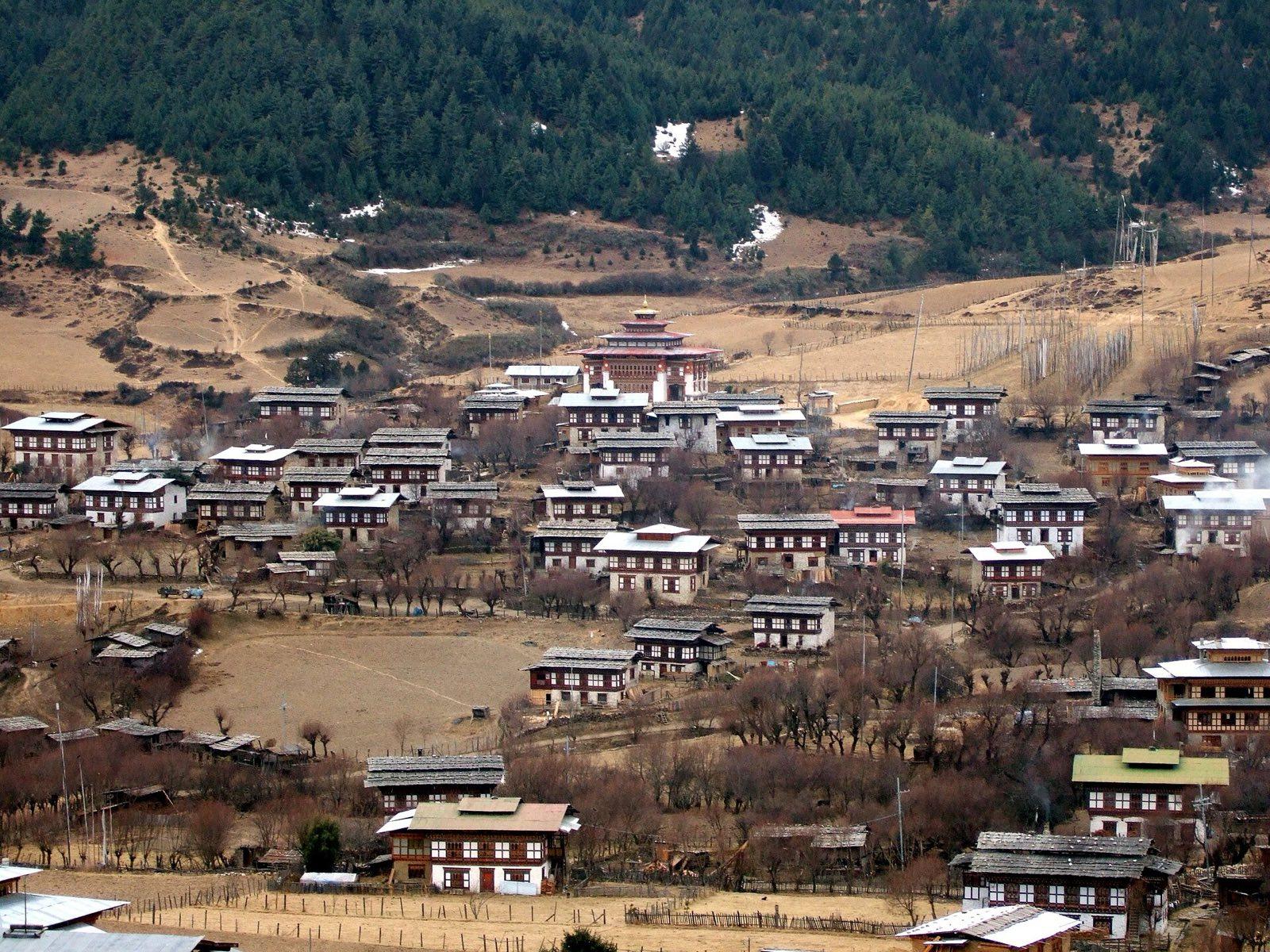
Ura village and its temple, reached on foot on day 8 Photo: Christopher J. Fynn, CC BY 3.0, via Wikimedia Commons (https://commons.wikimedia.org/wiki/File:Ura_Bumthang_Bhutan-2007-12-28.JPG) Day 9: Fly to Paro
Jakar to Bathpalathang airport, a domestic flight to Paro, then Rinpung Dzong and the National Museum
- Drive about 30 min
- Breakfast and lunch
- Stay in Paro
Day 9 details
Driving back west from Bumthang takes two long days, so we fly: a domestic flight of about half an hour from Bathpalathang airport, a few minutes from Jakar, over the passes we crossed on foot. The flight runs only on some days of the week, so departure dates are built around it, and its time sets the morning; if it leaves late, there is time for a last walk in Jakar. Domestic flights depend on the weather, and if the flight cannot operate, we drive back west in two days with a night in Punakha or Wangdue and give up the second Paro night. In Paro, at about 2,200 m, we have lunch in town, then walk down to the Paro Chhu and over the covered wooden bridge to Rinpung Dzong, completed in 1646, which still houses the district's monks and offices. Above it, the round Ta Dzong watchtower holds the National Museum. The evening and dinner are your own in Paro's painted main street.
Included
- Domestic flight from Bathpalathang (Bumthang) to Paro
- Lunch in Paro
- Rinpung Dzong and the covered bridge over the Paro Chhu
- Ta Dzong National Museum
Free time: Evening free; dinner on your own
Activity: Domestic flights are weather dependent and the schedule is confirmed close to departure. Baggage limits on the domestic flight can be lower than on international flights; we confirm them with your booking.
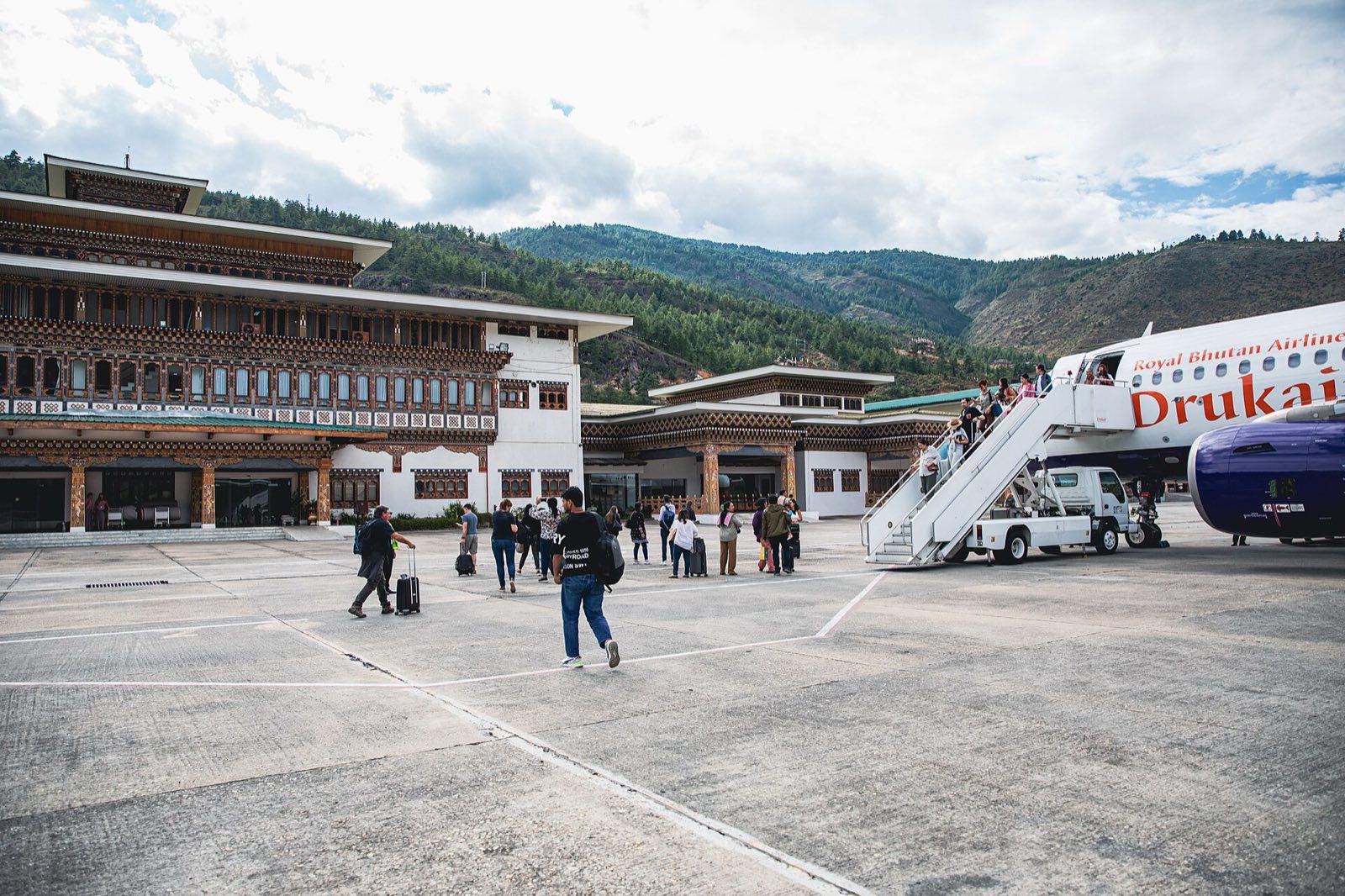
Paro International Airport, where the flight from Bumthang lands Photo: Mussi Katz, CC0, via Wikimedia Commons (https://commons.wikimedia.org/wiki/File:Druk_Air_plane_at_Paro_International_Airport.jpg) Day 10: The Tiger's Nest walk
Paro to the Taktsang trailhead, the cafeteria viewpoint and the monastery, then Kyichu Lhakhang
- Drive about 30 min
- Breakfast, lunch and dinner
- Stay in Paro
Day 10 details
The last full day is the most famous walk in Bhutan, and after a week on the trail at altitude it comes easier than it would at the start. We leave at about 7:30 am for the 20-minute drive to the trailhead at about 2,600 m, to be on the path before the main flow of walkers. Paro Taktsang, the Tiger's Nest, clings to a cliff about 900 m above the valley floor, around the cave where, by tradition, Guru Rinpoche meditated. The trail climbs through blue pine and oak hung with prayer flags to the cafeteria viewpoint, about an hour and a half up, facing the monastery across the gorge. Those who want to go on walk about another hour, down and up several hundred steps past a waterfall, to the monastery itself, where bags and cameras are left at the gate. We meet for lunch at the cafeteria, walk down together and stop at Kyichu Lhakhang, one of Bhutan's oldest temples. The farewell dinner is in Paro.
Included
- Guided walk to the Tiger's Nest (Paro Taktsang) cafeteria viewpoint, with the option to continue to the monastery
- Lunch at the Tiger's Nest cafeteria
- Kyichu Lhakhang
- Farewell dinner in Paro
Optional experiences
- A pony from the trailhead to the cafeteria (uphill only, paid locally)
Easier option: Stop at the cafeteria viewpoint for tea and the full view of the monastery across the gorge while the others go on, then lunch together.
More active option: Continue from the cafeteria to the monastery, about an hour each way on steps, and go inside the temples with our Bhutanese guide.
Free time: Late afternoon free before the farewell dinner
Activity: About 4 to 6 hours on the trail for the full walk, or about 3 hours to the cafeteria and back. The descent is steep and dusty; poles help.
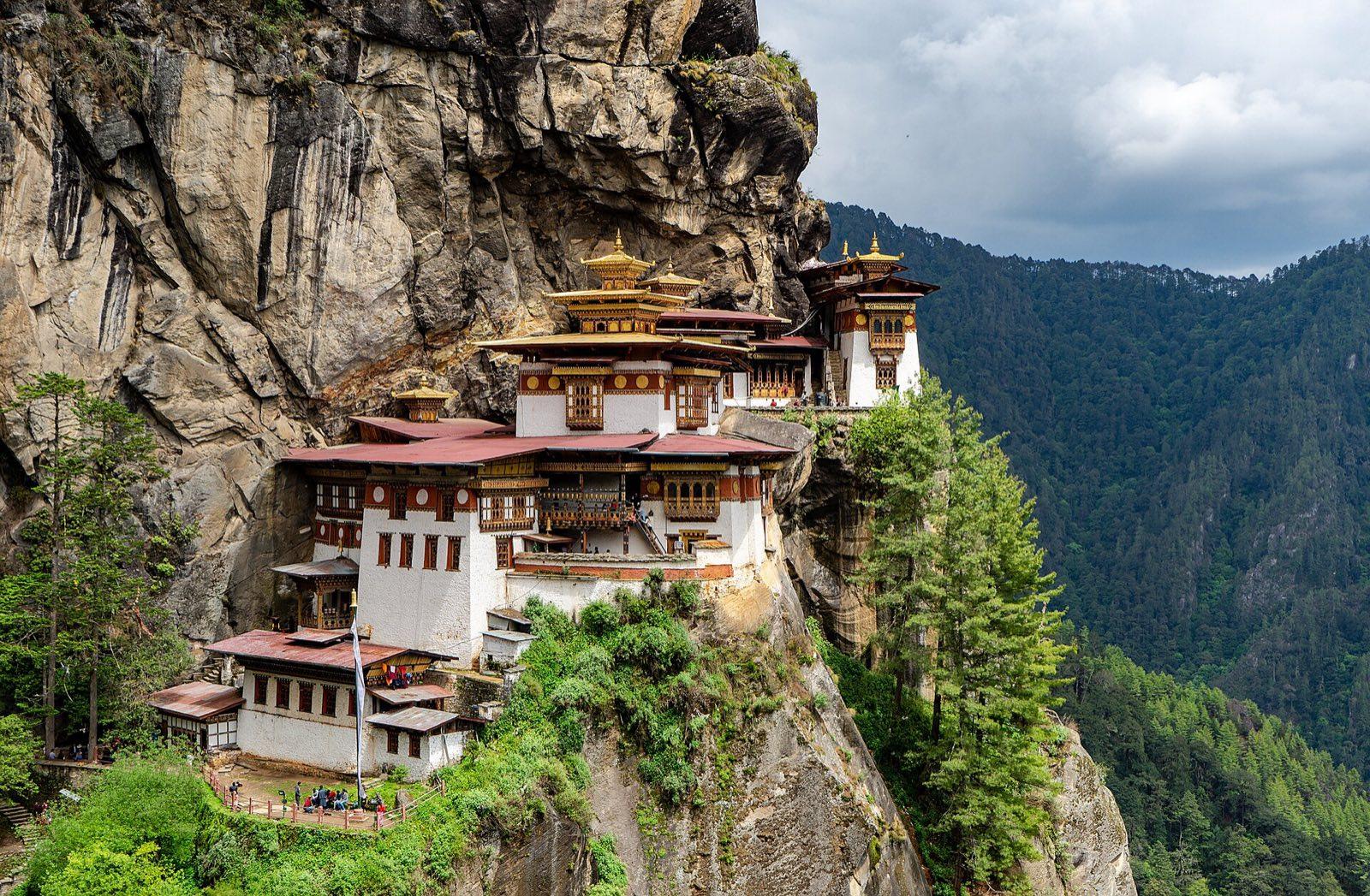
The Tiger's Nest, today's walk from the Paro valley Photo: Original: Nina R from Africa Derivative work: UnpetitproleX, CC BY 2.0, via Wikimedia Commons (https://commons.wikimedia.org/wiki/File:Paro_Taktsang,_Bhutan_(edited).jpg) Day 11: Leave from Paro
Your hotel in Paro to Paro International Airport
- Drive about 15 min
- Breakfast
Day 11 details
Breakfast at the hotel, then a transfer of about ten minutes to Paro International Airport. Flights out of Paro operate in daylight only and most leave in the morning, so plan to be at the airport about two hours before departure; your guides see you to the terminal and help with check-in before saying goodbye. If you fly to Kathmandu or Delhi, ask for a window seat: on a clear morning the high Himalaya can run along the horizon, though the view depends on the weather and the route flown. If your flight leaves later in the day, the morning is free in Paro, and your guide can suggest a short walk in the valley or a last visit to the shops on the main street, with a later transfer. If you would like to stay longer in Bhutan, ask us when you book and we can quote extra nights in Paro, though each extra night also carries the government's Sustainable Development Fee, which we would add to the quote.
Included
- Drop-off at Paro International Airport (PBH)
Free time: Morning free if your flight leaves later
Activity: Book any flight out of Paro; all departures are in daylight and the airport is about ten minutes from the hotel.
Wildlife and weather: October and November bring the clearest skies, dry trails and the best chance of a Himalayan view from Dochula, with cold nights in Phobjikha and Bumthang; the black-necked cranes arrive in Phobjikha from about late October. March to May is warmer, with rhododendrons in flower on the Pele La and Yotong La and more haze and afternoon showers. The June to August monsoon brings mud, leeches and landslides, and winter can close the high passes, so we run no departures then.
10 nights
Where you'll stay
Your hotels are named in your trip confirmation.
- Thimphu1 night
- Punakha2 nights
- Phobjikha1 night
- Trongsa2 nights
- Bumthang2 nights
- Paro2 nights
One price
What's in the price
Included
Accommodation
- 10 nights: 1 in Thimphu, 2 in Punakha, 1 in Phobjikha, 2 in Trongsa, 2 in Bumthang (Jakar) and 2 in Paro
- 9 nights in hotels of a 3-star-plus standard, central and walkable in Thimphu, Trongsa, Jakar and Paro, heated and certified for international visitors; we name each hotel when we confirm your dates
- 1 night in a licensed farmhouse in Phobjikha, with a heated private room; bathrooms may be shared and the group may be split between neighbouring houses
- Rooms shared, or your own for a supplement
Transport
- Pick-up and drop-off at Paro International Airport (PBH)
- Our own vehicle and driver for the group from day 1 to day 8 and in Paro, carrying your bags and meeting walkers at the end of each stage, with road days of about 3 hours or less
- The domestic flight from Bathpalathang (Bumthang) to Paro on day 9, in place of two long road days
Your guide
- A See Sight Tours guide with the group from day 1 to day 11
- A licensed Bhutanese guide throughout (Bhutan requires a licensed guide for most tours)
- On walking days one guide walks with the group and the other stays with anyone taking the easy option
Activities
- Trans Bhutan Trail walks: Hongtsho to the Dochula Pass, the Divine Madman Trail, the Pele La to Rukubji, the Trongsa gorge to Trongsa Dzong, and the Yotong La to Gyetsa
- Thimphu: Chuzom, Buddha Dordenma and the National Memorial Chorten
- The Dochula Pass and its 108 chortens
- Punakha: Punakha Dzong, Khamsum Yulley Namgyal Chorten and Chimi Lhakhang
- Phobjikha: Gangtey Goemba, the Gangtey Nature Trail, the Black-necked Crane Information Centre and a farmhouse hot stone bath
- Rukubji village and Chendebji Chorten
- Trongsa: Trongsa Dzong and the Tower of Trongsa museum
- Bumthang: yathra weaving in Chumey, the walk to Ura and Ura Lhakhang, Kurjey Lhakhang and Jambay Lhakhang
- Paro: Rinpung Dzong, the Ta Dzong National Museum, the Tiger's Nest walk (Paro Taktsang) and Kyichu Lhakhang
- All entrance fees for included sights
- Bhutan's Sustainable Development Fee for 10 nights
Meals
- 10 breakfasts
- 10 lunches, hot and sit-down on every walking day, including lunches at Dochula, Rukubji and a Ura farmhouse
- 9 dinners, including a welcome dinner, the Phobjikha farmhouse dinner and a farewell dinner
Not included
- International flights to and from Paro
- Bhutan visa fee (currently USD 40)
- Travel insurance, which must cover walking to about 3,500 m
- Dinner on day 9 in Paro
- Drinks
- Tips for guides, drivers and farmhouse hosts
- Optional activities, such as a pony to the Tiger's Nest cafeteria
- Walking boots, poles and other personal gear
- Personal expenses
Local fees
- None. Bhutan's Sustainable Development Fee, charged per person per night at a rate currently set by the government, is included in the price for all 10 nights; we confirm the current rate when you book.
Extras
- Room of your own
- CAD 1,330 (estimated price)

See Sight Tours has been providing travel services across North America since 2006. Operating in 20 cities across Canada and the USA, the company specializes in small group tours that offer personalized, high-quality experiences for travelers.


Book your Tour
Get in Touch
- Toll Free1-888-961-6584
- Local1-289-271-9767


© 2026 See Sight Tours. All rights reserved.